
205 | Food Fraud Testing in 2025 (and Beyond) |
Plus sugar weirdness and kitchen fails

Consumer data webinar this week
Food fraud testing in 2025 and beyond
Weird: the price of sugar
Kitchen fails (mostly fun)
Food fraud news, incidents and horizon scanning
Happy Monday!
Welcome to Issue 205 of The Rotten Apple. It’s great to have you here. And a big shoutout to 👏👏 Michelle 👏👏 for upgrading her subscription. Every subscription makes a difference, thank you!
In this week’s issue, I explore the current state of food fraud testing and discover that despite immense progress, there are still challenges, especially for small to medium businesses. And I learn a weird fact about sugar prices.
As always, there’s food fraud news at the end, for paying subscribers - lots of incidents in this week’s report.
Have a great week,
Karen
Cover image: DC Studio on Freepik
Webinar this week: How food brands are using consumer self-reporting for early warning
On Thursday (Friday for Australia), I’m webinar-ing with Patrick Quade, the founder of IWasPoisoned.com, who will share a system that can flag outbreaks earlier than traditional medical reporting networks, and show us how brands can use this knowledge to reduce the size of recalls and limit brand damage.
This webinar is for:
Food safety managers at quick service restaurant, manufacturers and retailers
Policy makers and enforcement agencies.
Click the preview box below for joining details.
And add it to your calendar - no reminders will be sent!
Webinar: Early Warnings With Consumer Data, 11 September 2025

Come and join our next live event and learn about a new way of discovering outbreaks using machine learning and consumer-derived data.
Food fraud testing in 2025 and beyond
Last week, I caught up with John Points of the Food Authenticity Network (FAN). John has a background in analytical testing and is the Technical Director of FAN, so he’s the perfect person to give us an up-to-the-minute perspective on testing for food fraud.
But first, for those of us who need a refresher…
What is food fraud testing (exactly)?
Food fraud testing, also referred to as authenticity testing, is the practice of verifying the claims of a food product in terms of its nature, origin and declared ingredients.
Testing comes in many forms, from targeted tests that look for known adulterants to broader, non-targeted approaches that examine a product’s overall chemical or biological ‘fingerprint’.
Today’s analytical tools include DNA-based species identification, chemical profiling by spectroscopy or isotope analysis, and physical examinations like microscopy. Together, they provide food businesses with evidence to detect and combat fraud, ensure compliance with regulations, and maintain consumer trust.
Targeted versus non-targeted testing
Targeted testing focuses on the detection of specific, known adulterants or markers. For example, a targeted test might look for the presence of melamine in milk or chicory in coffee powder. These methods are usually highly selective and rely on techniques tailored to a particular compound or group of compounds.
Targeted testing comes with one major drawback, however; it will not identify any unexpected compounds that are present in the food. That is, targeted tests are only useful for detecting known adulterants.
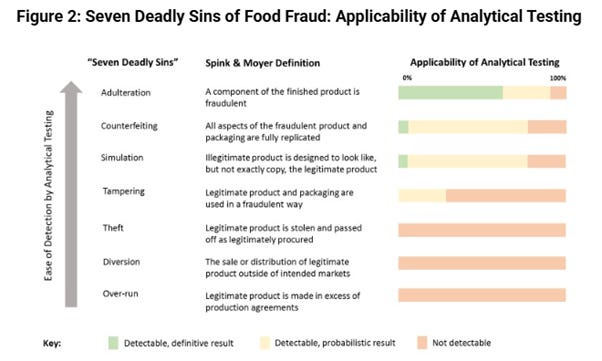
Non-targeted testing follows a different approach. It compares the test sample with a broad set of ‘typical’ authentic samples. If the test sample is similar to typical samples, it can be considered authentic. If the test sample is atypical, then it could be affected by food fraud.
With non-targeted testing, there is no need to anticipate what adulterants might be present before analysing the sample.
Non-targeted techniques involve the creation of a ‘fingerprint’ of a food, performed by collecting chemical, physical or genetic data from a large set of authentic samples and using statistical tools to generate a model.
Samples are then subjected to the same suite of analytical tests to generate a set of results. Advanced statistical tools, including machine-learning-assisted pattern recognition systems, are then used to spot differences between the sample and the authentic fingerprint.
This makes non-targeted tests helpful if new or unexpected adulterants are present. They are also used for authentication where there is no adulteration involved, such as to verify claims about geographical origin or growing techniques.
What’s changed in the last 10 years?
We’ve made great strides forward in terms of the options available for food companies and in the way we share analytical results and resources since 2015, but challenges remain, particularly for small and medium-sized food businesses.
In my conversation with John we discussed:
What are the options for authenticity testing for a medium-sized food business in 2025;
How to find methods, laboratories and resources, and
How testing fits into a best-practice food fraud mitigation plan.
Jump into the video to hear his thoughts. Or read the transcript here.
Sources:
IFST. (2024). Food authenticity testing part 1: The role of analysis. [online] Available at: https://www.ifst.org/resources/information-statements/food-authenticity-testing-part-1-role-analysis.
Amaral, J.S. (2021). Target and Non-Target Approaches for Food Authenticity and Traceability. Foods, 10(1), p.172. doi:https://doi.org/10.3390/foods10010172.
Bhat MA, Rather MY, Singh P, Hassan S & Hussain N (2024) Non-targeted screening for food chemical safety at Campden BRI. [online] Available at: https://www.campdenbri.co.uk/talking-heads/non-targeted-screening-methods.php
Further reading:
Fernando, I., Fei, J., Cahoon, S. and Close, D.C. (2024). A review of the emerging technologies and systems to mitigate food fraud in supply chains. Critical Reviews in Food Science and Nutrition, pp.1–28. doi:https://doi.org/10.1080/10408398.2024.2405840.
Weird: the price of sugar in the U.S. is double everywhere else
Last week, I learned that the United States operates a special sugar policy that makes the price of sugar twice as high there as in the rest of the world.
The U.S. sugar program is designed, says the USDA, to restrict the amount of sugar available to the U.S. market. The USDA does not explain why.
The program works through a series of complex mechanisms that limit the amount of cane sugar and beet sugar that can be produced in the U.S., provides guaranteed prices to processors, and strictly controls quantities of imports through quotas and tariffs.
The program began in 1981. That year also marked the beginning of a rapid increase in the use of high fructose corn syrup (HFCS) by food manufacturers in the U.S..
This unusual pricing policy and subsidy structure raises the wholesale sugar price in the U.S. by an estimated 20 cents per pound compared to where it would be without the program. The program also partially explains why the use of HFCS is so common in the United States compared to other countries.
I learned this from Aaron Smith of Ag Data News.
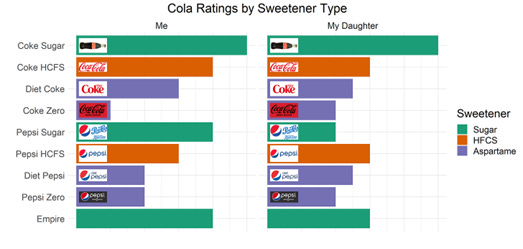
I also learned from him that Coca-Cola made with cane sugar is called ‘Mexican Coke’ in the U.S. and that people can taste the difference between Mexican Coke and ordinary American Coke made with HFCS.
Aaron says he prefers cola drinks made with cane sugar compared to those made with HFCS, and he conducted a blind taste test to confirm he could actually tell the difference. (Sensory scientists will not approve, but his method isn’t too terrible 😀).
President Trump believes that cane sugar is healthier than HFCS. He asked the Coca-Cola Company to switch from HFCS to “real cane sugar” in July 2025. A week later, the company announced they would launch a new cane-sugar version of Coke in the U.S. later this year.
Confusingly, this move comes even though the special sugar policy is expected to be expanded - rather than rolled back - in Trump’s One Big Beautiful Bill, a move that would raise the price of sugar even further.
It will be interesting to see how this plays out…. but the scenario is no doubt worrying for food manufacturers.
Read more about the sugar program and the MAHA push against HFCS here:
Is cane sugar healthier? Maybe a bit… Discover the modest differences between the health impacts of sugar and HFCS here:
Kitchen fails (mostly 😮 fun)
This “funniest of” video is sometimes very funny and sometimes not at all funny. The narration is ultra cringe.
But if you think you’re having a bad day, jump to 16:23 and thank your lucky stars you didn’t get your ponytail too close to your kitchen mixer (omg who even knew that was a thing?!). Or drop your phone while passing it across the table at a Korean hotpot restaurant.
Below for paying subscribers: Food fraud news, horizon scanning and incident reports
📌 Food Fraud News 📌
🔎 Are you working on food fraud detection or prevention?
The European Food Fraud Community of Practice (EFF-CoP) needs your help!
EFF_CoP is running a research study to collect insights on the systems and technologies used to fight food fraud worldwide. Your input will support a shared database for researchers, regulators, and industry professionals.
If you work in:
• Official control
• Food businesses
• Academia or research
• Certification bodies
• Laboratories
• Technology & innovation in food integrity,
the EFF-CoP would greatly value your contribution through a 15–25 minute pseudonymous survey.
📌 Start the survey here: https://lnkd.in/gMXGiyzv
In this week’s food fraud news:
📌 Food fraud analysis: 4,000+ incidents and 7,000+ adulterations
📌 Warnings for British hops, Italian tomatoes, Turkish apricots
📌 Legal proceedings for table grape counterfeiters
📌 Incidents with creatine, coffee, sugar, lamb, supplements, milk and more…