
208 | Highly pathogenic avian influenza in dairy foods - the story so far |
Also: a mystery mass poisoning in the UK and fashion fraud explored

This is The Rotten Apple, an inside view on food fraud and food safety for professionals, policy-makers and purveyors. Subscribe for insights, latest news and emerging trends straight to your inbox each Monday.
Highly pathogenic avian influenza in dairy foods: current status + new research
Mystery mass poisoning in the United Kingdom
Food safety news and resources
Fashion fraud (just for fun)
Food fraud news, incidents and horizon scanning
“We couldn’t taste anything and our tongues went bizarre.”
Welcome to Issue 208 of The Rotten Apple, where I share the story of diners who experienced immediate, intense pain and other worrying symptoms after eating at an Indian restaurant in the UK. One diner said it felt like they were chewing on broken glass and multiple ambulances attended the scene.
Also in this issue, new research about the potential for highly pathogenic avian influenza to infect human gastrointestinal tracts inspired me to revisit the bird-flu-in-milk issue with a complete overview of everything we know so far and a timeline of events.
Also this week, fashion fraud (off topic but fascinating), and food fraud news for paying subscribers.
Enjoy!
Karen
How to get your invoice for expensing this newsletter
Thank you to everyone who’s upgraded to a paid subscription in the past few weeks. Your support helps keep The Rotten Apple independent and ad-free.
Follow the instructions below to download an invoice/receipt for your subscription.
1. Access your account settings for Substack (the software I use to send emails) by opening this link in your usual browser: https://substack.com/settings
2. Scroll to ‘Subscriptions’ and click ‘The Rotten Apple’
3. In the payment information section, select ‘Billing history’ and ‘View’
4. On the ‘Payment history’ page, select ‘View invoice’ from the menu
5. Select ‘Download invoice’ and a pdf version will be downloaded to your device.
If you need to add billing details (company name, tax ID, etc.) for expensing purposes, do this by clicking ‘Edit’ next to ‘Payment Method’. Add the details, then re-download the invoice.
Having trouble? Write to me at therottenapple@substack.com or message me using the button below.
Highly pathogenic avian influenza in dairy foods
The story so far, plus new research
It was something of a surprise to some in the United States food system when a small number of dairy cows were diagnosed with highly pathogenic avian influenza (A(H5N1)) in March 2024. The virus was also discovered in their milk.
Since then, the infection has spread to many herds across the country, and viral material has been found in a significant number of samples of milk and other dairy foods in the United States.
As of September 2025, the virus has been confirmed in over 1,000 herds across 17 states, including California, Idaho, Colorado, and Texas. Testing of raw (unpasteurised) milk samples, collected from silos at dairy processing facilities, is performed by the USDA as part of its National Milk Testing Strategy
Milk containing infective viral particles could potentially transmit the disease to humans through both the respiratory route (by inhaling while eating/drinking) and the gastrointestinal tract.
Pasteurisation appears to inactivate the virus, rendering pasteurised dairy foods safe. Aged hard cheeses made from unpasteurised milk containing the virus may also be safe, with research ongoing.
In addition to posing risks through contaminated milk, the presence of A(H5N1) in mammals such as cows raises serious concerns. Although the virus is extremely harmful to birds, it causes relatively mild symptoms in mammals like cows and humans, and does not easily pass between mammals.
However, the longer this pathogen circulates in mammals, the more likely it will gain genes for virulence or transmission that render it more deadly to human populations.
Infected cows pose higher risks than other mammals infected with A(H5N1), because more of them are in closer proximity to more humans, compared to other mammalian populations that have been infected in the past, such as seals.
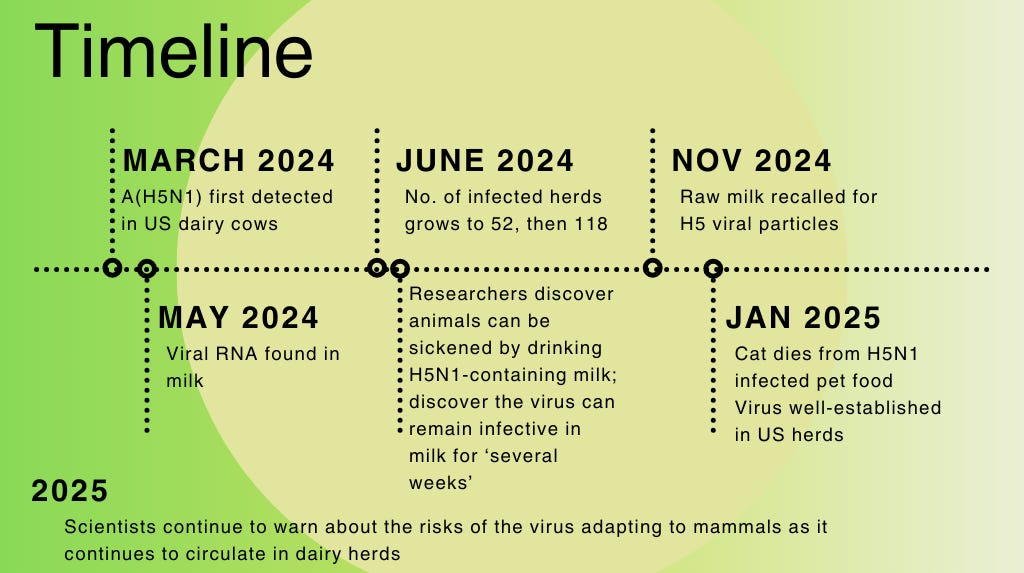
Timeline of A(H5N1) Events
March 2024:
Highly Pathogenic Avian Influenza (A(H5N1)) is first detected in US dairy cows.
May 2024:
Fragments of A(H5N1) viral RNA are found in milk, cottage cheese and sour cream (all pasteurized) at rates of 20-39% of samples, indicating the number of dairy herds infected with avian flu could be higher than previously suspected. Consumers are warned to avoid raw milk, undercooked beef and raw eggs.
June 2024:
The first case of a person being infected by dairy cattle is confirmed. A farmworker in Michigan, who had close contact with livestock, tests positive, experiences mild symptoms, and recovers.
The number of affected dairy herds is reported to be approximately 52 in 9 US states, with reports later in June estimating 118 herds are affected.
Research demonstrates that mice fed contaminated raw milk became ill, indicating the virus in milk can infect mammals through consumption. The same study finds H5N1 can remain infective in refrigerated raw milk for several weeks.
Traces of H5N1 are found in the meat of one culled dairy cow, though it did not enter the human food supply chain.
July 2024:
At the 2024 IAFP Annual Conference, experts revise their initial expectations, stating that resolving the situation will likely take “months, if not years,” not just the summer months as first thought.
Experts at the conference note that raw milk consumption in the US has “spiked” since the outbreak became public knowledge.
August 2024:
The H5N1 outbreak shows no signs of slowing, with the number of infected herds reaching almost 200 across 13 states. The virus begins to spread from dairy cattle to poultry farms.
The USDA announces it will increase its testing of beef, particularly from culled dairy cows which are often used for ground beef.
A survey of 167 retail dairy products finds H5N1 RNA in 17% of samples. No infective virus is found in any sample. The survey includes 23 samples of aged cheese made from unpasteurised milk, none of which contain the virus.
Nine poultry workers become infected during the culling of birds that were likely infected by nearby dairy cattle.
November 2024:
The CDC publishes research showing H5N1 remains infectious in unpasteurised milk for more than four days under refrigeration. The study also provides compelling evidence that high-temperature, short-time pasteurisation effectively inactivates the virus.
The USDA announces a monitoring programme to collect and test milk samples from bulk lots for H5N1.
A dairy in California recalls a lot of raw milk after a sample tests positive for an H5 virus, likely H5N1.
December 2024:
The USDA announces a National Milk Testing Strategy, requiring raw milk samples to be collected and shared for H5N1 surveillance.
2025
January 2025:
A pet cat dies after being infected with H5N1 that is a genetic match to the virus found in its contaminated raw turkey pet food, leading to a product recall.
New research shows that human influenza can remain infectious in refrigerated raw milk for up to five days.
February 2025:
The New England Journal of Medicine publishes an editorial warning that H5N1 could become significantly more dangerous to humans with just one genetic mutation. It highlights a lack of clear understanding of the virus’s transmission and evolution, which could hinder efforts to protect communities.
March 2025:
H5N1 is found in four black rats, which are considered a high transmission risk due to their proximity to people and farm animals.
Two domestic cats are infected with H5N1, suspected to be from contaminated raw pet food. This leads to a recall, and one cat is euthanised.
April 2025:
The FDA begins a testing programme on aged raw milk cheese to see if the ageing process eliminates H5N1. Initial results from 110 of 299 planned samples show 96 tested negative for the virus.
June 2025:
Scientists studying H5N1 in US cattle highlight failures in surveillance and the risks of the virus adapting to mammals as it continues to circulate.
September 2025:
New research is published about influenza A and the gastrointestinal tract.
New research: influenza and the human gastrointestinal tract
Influenza A is a respiratory illness, meaning it affects your lungs and airways. Or so scientists believed until recently. Now, new research has confirmed that influenza A can potentially also infect cells in the gastrointestinal tracts of mammals.
So… (this is going to sound weird), this discovery is not surprising to me: many members of my immediate family experience digestive symptoms when we are suffering from common respiratory viruses like cold and flu.
Science has now confirmed my suspicions, with a new report by the United States Centers for Disease Control and Prevention (CDC) summarising the potentially infectious behavior of influenza A on the gastrointestinal tract of mammals.
The work was done as part of the fact-finding needed to understand the risks of avian influenza H5N1 (bird flu) in dairy foods.
Reminder: Infective particles of the H5N1 virus were discovered in raw milk from infected cows in early 2024, with subsequent research showing that mice could contract the disease after consuming milk containing the virus. Pet cats have also died after consuming pet food that contained H5N1.
The latest research has shown that some strains of influenza A might be able to infect the human gastrointestinal tract, although there have been no confirmed human infections of A(H5N1) from consumption of cow milk or unpasteurised dairy products.
Such information changes the risk profile of A(H5N1) in dairy foods, since the presence of infective particles is now understood to potentially cause infection through the gastrointestinal tract as well as the respiratory tract (inhaling while eating/drinking).
The good news is that pasteurisation inactivates the virus in milk from infected cows, rendering it safe to consume and use in the production of other dairy products such as cheese.
Takeaways:
Don’t be surprised to experience gastrointestinal symptoms from ‘ordinary’ seasonal influenza.
And don’t (please don’t!) consume unpasteurised milk!
Source:
CDC (2025). Influenza A Viruses May Infect GI Tract and Cause Digestive Symptoms. [online] Avian Influenza (Bird Flu). Available at: https://www.cdc.gov/bird-flu/spotlights/influenza-gi-tract-09082025.html .
Read more:
🍏 H5N1 in Dairy Foods: a complete collection of The Rotten Apple’s articles about highly pathogenic avian influenza (A(H5N1)) in food, plus a comprehensive library of references and sources 🍏
☠ Mystery mass poisoning (UK)
Three weeks after eleven people were treated by ambulance crews in an Indian restaurant during lunchtime meal service in Manchester (UK), the cause is still unknown.
Two people were taken to hospital during the incident, with initial media reports describing a “mass allergic event” to the restaurant food.
A diner later shared his experience, telling the BBC he and ten other diners experienced severe pain and swelling after eating foods including curries, vegetables and sauces. He said he experienced symptoms after eating a dish containing yam, saying his mouth felt like he had been eating glass. He also described a feeling of needles penetrating his skin.
A second diner explained that members of her group experienced symptoms after receiving and consuming only one or two dishes, including Aviyal, a thick stew of vegetables containing yams.
She described a feeling of ‘being stung by bees’, and said, “We couldn’t taste anything and our tongues went bizarre. The sensation travelled to our gums, cheek and throats.”
Some yams contain natural toxins, which are eliminated with proper preparation and cooking techniques.
The restaurant reopened around two weeks later, with no comment about the incident nor any public apology. The local authority has not shared any information publicly and did not respond to requests from UK newspapers.

Sources:
Indian restaurant where 11 diners fell ill temporarily shuts
Manchester: ‘We went for curry and 11 of us needed paramedics’
Food Safety News and Resources
Our food safety news and resources roundups are expertly curated with no ads, fluff or filler, just information that I believe will be genuinely useful to you.
This week’s roundup includes an update on the Australian berry scandal from Issue 206. Plus (I can’t believe this!), the manufacturer behind the deadly Listeria outbreak and recall for pasta ready meals has got another recall underway. For… (you guessed it) Listeria 😯.
Click the preview box below to access it.

Fashion fraud + counterfeit dresses (just for fun)
I often write about counterfeiting of food and beverages like Dubai chocolate and soft drinks, but other products are counterfeited as well….
… including dresses.
Last week I discovered it’s not just food supply chains that have questionable suppliers and dodgy retailers in the online, direct-to-consumer space.
It’s a little off topic, but I really enjoyed this investigation into fashion fraud - copies, counterfeits and outright scams.
Below for paying subscribers: Food fraud news, horizon scanning and incident reports
📌 Food Fraud News 📌
In this week’s food fraud news:
📌 New food fraud dashboard from the European Commission
📌 Saffron fraud in 2025
📌 More meat warnings
📌 Vegetable cartel in court.