
209 | It's Fake! |
Counterfeit soft drinks, horizon scanning explained and a shop full of fake food

This is The Rotten Apple, an inside view on food fraud and food safety for professionals, policy-makers and purveyors. Subscribe for insights, latest news and emerging trends straight to your inbox each Monday.
Counterfeit Diet Coke in London?
Horizon scanning explainer
Food safety news and resources roundup
Fake food (for real)
Food fraud news, horizon scanning and recent incidents
Hello,
Welcome to another issue of The Rotten Apple. An extra special huge welcome to 👏👏Stephanie from the meat market, Quality from the banana bread crew, Terris from the candy company, Sonia from the U.S. and Daniel from Malta 👏👏 for upgrading your subscriptions. Thank you.
Also, thank you to Hernan from Argentina for providing an update on avian influenza in his country (find that in this week’s Food Safety News Roundup).
For those of you who work in U.S. agencies affected by the government shutdown, commiserations. I can’t imagine how disconcerting it must be to not know when you will next receive a paycheck. Hope things are resolved soon.
This week’s issue is all about faking it, from soft drinks to scones. Enjoy.
Karen
P.S. Got news to share? Reply to this email, or write to me at therottenapple@substack.com. I love to hear from you.
Counterfeit Diet Coke in London?
Counterfeiting is the imitation of a food or beverage, including its brand, packaging, or labeling, with the intent to deceive customers and consumers into thinking they are getting the authentic product.
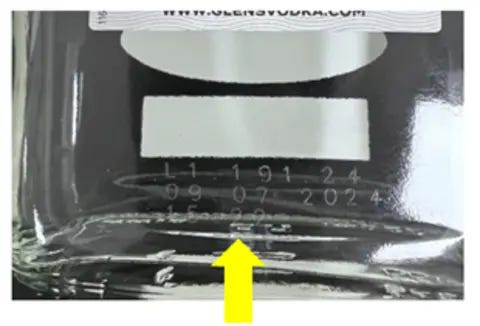
In a food fraud context, alcoholic beverages such as vodkas and whiskies are often affected by counterfeiting. For example, in July, Glen’s Vodka, the leading vodka brand in Scotland and the second best-selling spirit in the UK was affected by a counterfeiting scandal, after authorities detected fake versions of the product in the market.
The fake Glen’s vodka contained the harmful chemical isopropyl alcohol, and consumers were warned to seek urgent medical care by Food Standards Scotland in the wake of the discovery.
But it’s not only alcoholic drinks that are targeted by counterfeiters.
Non-alcoholic drinks, including copies of premium brands of carbonated beverages (soft drinks) are also made by counterfeiters. Reports about the counterfeiting of soft drinks surface quite frequently in my food fraud searches, most often in Pakistan.
Here’s an incident report I published in June, for example:
Authorities confiscated bottles of counterfeit soft drinks (3,900 bottles), artificial sweeteners (250 kg), empty bottles (4,000), fake bottle caps (60 kg), counterfeit labels (200 kg), filling machines, chemicals, gas cylinders and storage drums – Pakistan | Source: Issue 193
Last week, while researching counterfeit soft drinks, I stumbled upon a consumer’s musings about possibly fake Diet Coke, which piqued my interest.
While we know that counterfeit soft drinks are discovered every year by authorities in Pakistan, it’s rare to hear a consumer perspective. This is likely because consumers will be either unaware they have purchased a ‘fake’ and so don’t think to complain about it, or they complain to the legitimate brand owner, who does not publicise the information.
So to find a first-person account from a consumer of ‘fake’ soft drink was intriguing to me.
What made it more intriguing was that the consumer was in London, England.
It’s easy to imagine that counterfeit versions of low-cost products only occur in the developing world. However, soft drink fraud does happen in wealthy countries.
In fact, just last week, a man in the United States was sentenced for his role in a massive multi-year counterfeiting operation affecting 5-hour Energy drinks. At the height of the operation in 2015, it was shipping 75,000 bottles per day from an illicit manufacturing facility in California.
Could this also be happening in London with Diet Coke?
Here’s what the consumer, One_Inflation_9475 said on Reddit/r/london last month:
“I suspect that some of the soda sold in cheap kebab shops are counterfeit. The taste always put me off. So today, I compared it. I bought a Diet Coke bottle from a kebab shop. It was a bit harsh and seemed acidic. Then, I bought same thing from Tesco and its taste was soft and felt good to my taste buds.
“Price of the meal deal is also a suspect: £5 for a burger, handful of fries and a bottle of soda. What do you guys think?”
“I suspect that some of the soda sold in cheap kebab shops are counterfeit”
What do I think? I think s/he could be right in thinking the bottle of Diet Coke they got in a very low-cost meal deal from a takeaway shop is counterfeit.
There are, of course, other reasons the product could have tasted ‘harsh’ and ‘acidic’ compared to Diet Coke from Tesco. Notably, artificially sweetened beverages lose flavour over time as the sweeteners degrade.
Another reason, proposed by responders to the consumer’s post, is that soft drinks “taste different in different countries.” However, I’m not buying it.
The consumer would almost certainly have noticed the name of an offshore bottler or the presence of a foreign language on the label after they became suspicious of the product. And if they had discovered it was from overseas, I believe they would have attributed the taste difference to that, rather than claiming the product was counterfeit.
Anyway, how exactly would a takeaway shop owner obtain offshore versions of a product belonging to a company that is famous for tightly controlling its sales channels?
Perhaps the store owner (illegally) received soft drinks imported from another country? Perhaps from a place like Pakistan? Perhaps the imports were fakes.
We cannot know for sure. But it’s worth remembering that counterfeit drinks are manufactured by criminals who cut corners, ignore safety protocols, use dirty water and non-food-grade chemicals, and generally endanger the lives of consumers.
My advice to any consumer or business who suspects they have been given a counterfeit product is to keep the package and tell the brand owner. Provide photos of the labels, the batch code and the best before date so the company can hunt down the counterfeiters who are trashing their brand and selling potentially dangerous products.
The owner of 5-hour Energy realised their product was being counterfeited after a salesperson purchased a box of product from a distributor that had stopped ordering from them and discovered it had a different taste, color and smell to authentic 5-hour Energy. Investigators acting on their behalf seized more than 2.6 million counterfeit bottles during subsequent investigations.
Could counterfeit Diet Coke be available in London, England? Perhaps. I hope not, but stranger things have happened.
In short: A consumer in London, England, suspects the Diet Coke sold by a kebab shop (multiple purchases) is counterfeit 🍏 Soft drinks are affected by counterfeiting 🍏 Pakistan authorities frequently report the seizure of counterfeit copies of famous brands of soft drink 🍏 Large volumes of a popular energy drink were counterfeited in the United States in the 2010s 🍏 Consumers or businesses supplied with ‘wrong’ tasting foods should report their concerns to the brand owner who can investigate suspected counterfeits🍏
Main sources (minor sources are hyperlinked in the text):
Schnapp, D. and Frankfurter, B. (2016) ‘Counterfeiting in our own backyard’, New York State Bar Association Journal, 34(2), pp. 21–23. Available online: https://foxrothschild.gjassets.com/content/uploads/2016/10/SchnappFrankfurterArticle-InsideCorpCounselFall16.pdf
Reddit.com. (2025). I suspect that some of the soda sold in cheap kebab shops are counterfeit. r/london. [online] Available at: https://www.reddit.com/r/london/comments/1n8gt70/i_suspect_that_some_of_the_soda_sold_in_cheap/
Horizon Scanning for Food Fraud
Explainer and video
If you’re a food fraud nerd (like me!), you’ll know what I mean when I use the term ‘horizon scanning’. But if you are new to The Rotten Apple or new to food fraud, here’s a brief explanation.
Horizon scanning is the act of trying to anticipate threats that might develop in the medium- to long-term. It’s used in all sorts of fields and industries.
For example, in health care, horizon scanning is used to anticipate the next pandemic. In cybersecurity, experts might perform horizon scanning to understand the state of quantum computing and its potential impact on encryption systems.
In food fraud, and food supply chains in general, horizon scanning is the act of trying to anticipate or predict how future situations might cause problems in supply chains or affect the likelihood of food fraud occurring.
Food fraud horizon scanning is a big part of my work. I publish horizon scanning information in this newsletter almost every week, sharing information about expected situations that may increase the likelihood of food fraud occurring for various commodities.
For example, if there is pressure on egg supplies in a certain region due to an outbreak of avian influenza, that could increase the likelihood of fraud in eggs, and I will include that in the horizon scanning section of the weekly food fraud news.
Occasionally, I also share information about situations that could decrease the likelihood of food fraud, or signal an easing of a critical situation, as for cocoa beans this month (see today’s food fraud news for details).
We also collect every horizon scanning note from every issue and file it in the food fraud section of our index of articles, for easy searching.
This week’s horizon scanning news can be found in the food fraud news at the end of this email.
In short: 🍏 Horizon scanning is the act of trying to anticipate threats that might develop in future 🍏 Food fraud horizon scanning is the act of trying to anticipate or predict how future situations might affect food fraud vulnerabilities 🍏
Did you know…
Last week, my global news scans found a media report of suspected ongoing large-scale theft from a government food program, with millions of bags of wheat unaccounted for. It is likely that the missing wheat is being diverted to grey market distribution channels and may be smuggled out of the country.
This week’s food fraud incidents report includes news of tens of thousands of bags of wheat being discovered during an attempt to smuggle them across a border in the same country. Coincidence or not?
Roundup: Food Safety News
Our food safety news and resources roundups are expertly curated (by me 😎), to include only the most interesting and valuable news, guidance and webinars from around the world: no fluff, no filler, no junk, only information I believe will be genuinely useful.

Fake food for real
Most people who make ‘fake’ food are criminals seeking to make a profit by mimicking authentic versions of the foods they sell.
Not Kerry Samantha Boyes, who makes fake food that’s proudly fake and perfectly inedible at her workshop and store in Scotland. The replica food is used by filmmakers, historic houses and museums as a stand-in for real food that won’t stand up to the rigours of hours of filming or stay fresh for months on end.
With a background in stonemasonry and taxidermy, Ms Boyes has a talent for mimicry and uses many different materials, including resin, to make her realistic-looking creations.
My favourite? The classic British scones.
Ms Boyes’ store is Fake Food Workshop, and her beautiful replica foods can be purchased online and in person in Kirkcudbright, Scotland.


Centre: Kerry Samantha Boyes at her replica food store (Image: Colin Hattersley via the BBC) with replica scones and mini pork pies (Fake Food Workshop.)
Below for paying subscribers: Food fraud news, horizon scanning and incident reports
📌 Food Fraud News 📌
In this week’s food fraud news:
📌 Warnings for stolen frozen prawns and wheat
📌 Cinnamon fraud discovered in Europe
📌 Methods for wild versus farmed carp and dye in paprika
📌 Adulteration and misrepresentation in wine, coffee and olive oil