
229 | Hell in a hand basket |
How the new Middle East conflict will impact your supply chains

This is The Rotten Apple, an inside view on food fraud and food safety for professionals, policy-makers and purveyors. Subscribe for insights, latest news and emerging trends straight to your inbox each Monday.
The Middle East conflict, a 10,000 feet view for food professionals
What to watch out for in the coming months
Food Safety News and Resources
Making honey cough drops
Food fraud news, emerging issues and recent incidents
Happy Monday,
If the world feels like it’s going to hell in a handbasket, spare a thought for our colleagues in the Middle East whose food supply chains just got dismembered by Iran’s closure of the Strait of Hormuz, an internationally important shipping route.
In this week’s issue, I give you a 10,000 feet view of how the new conflict in the Middle East is impacting global food supply chains now and what to look out for in the coming months.
This week’s food safety news roundup has two unusual recalls; the food fraud news contains surprising price news for a vulnerable commodity and I’ve shared a beautifully hypnotic video of honey cough drops being made.
Thank you to 👏👏 Andrew from New Zealand, Claire from the UK and ‘QA’ from Australia 👏👏 for becoming paid subscribers last week, and to everyone who renewed their paid subscriptions in the past week, your continued support means the world to me.
Cheers!
Karen
The Middle East conflict, a 10,000 feet view
It sucks that geopolitics has so much influence over our food supply - this is, I guess, the price we pay for a globally-interconnected economy and year-round food availability for all but the poorest countries.
In this article, I’m going to do my best to explain how the new situation with Iran, Israel and the United States could impact our global food supply chains. Without getting bogged down in the politics.
First up, the situation is new. We don’t even have a consistent name for it yet. (Encyclopedia) Britannica has named it the 2026 Iran Conflict, Al Jazeera is calling it the Iran War, and others are calling it not war but “coordinated military operations”.
It began on February 28, 2026, nine days ago, when the United States and Israel launched joint strikes on Iran that killed many of the country’s political leaders, including its supreme leader.
Iran responded with retaliatory attacks against targets in Israel and nearby countries, including countries usually considered stable and safe, such as the United Arab Emirates, Saudi Arabia, Qatar, Kuwait, Bahrain and Jordan.
There are four main ways this situation is affecting food supply chains globally: impacts on the fossil fuel trade, increased voyage time and prices for international shipping, risk pricing strategies and purchasing diversification strategies.
1) Oil, petroleum and natural gas impacts
Iran owns all the land on one side of the Persian Gulf. And the Persian Gulf region produces a large chunk of the world’s fossil fuels: oil, petroleum liquids and natural gas. Ordinarily, much of what is produced is exported on ships that travel out of the Persian Gulf through the Strait of Hormuz, a narrow shipping lane between Iran on one side and the wealthy oil countries of Oman and the United Arab Emirates on the other.
Ships are not currently passing through that Strait. Some reports say the Strait has been ‘closed’ by Iran, others that Iran has said the straight it ‘open’ but that it will attack US and Israeli vessels. Either way, no shipping company is willing to risk the trip, with major shipping lines ordering their vessels to “seek safe shelter”.
With no shipping, no fuel is moving from the region.
Additionally, oil production has been cut in three major producing countries: Iraq, the United Arab Emirates and Kuwait, because of the backlog of oil that is accumulating due to the lack of shipping. There are also reports that energy production facilities in the region have been attacked.
Unsurprisingly, oil, fuel and gas prices have skyrocketed around the world since the war began.
But fossil fuels are not just important to food supply chains because they fuel the vehicles that move food around and allow farmers to grow food. They also provide the building blocks for major inputs, notably nitrogen-based fertilisers which are produced using natural gas. Roughly a third of globally traded urea fertiliser normally moves through the Strait of Hormuz.
Less fertiliser and more expensive fertilisers will impact food production volumes and costs. Farmers in countries as far away as Australia are already worrying about shortages and price rises for nitrogen fertilisers.
No one in the mainstream media seems to be talking about the possible impacts on feedstock for plastics, which are also made from fossil fuels. At least not yet. But it seems reasonable to also assume that virgin plastics will become more expensive in the coming months if the oil price remains high.
2) International shipping woes
It’s not just oil ships that are feeling the crunch. Although the Strait of Hormuz is crucial to oil shipping, it’s not the only shipping lane that is being impacted by the current conflict.
Carriers have also suspended routes through the Red Sea in response to the Iran conflict.
Reminder: The Red Sea is to the west (the ‘left’) of the Persian Gulf and the Strait of Hormuz. It’s the one with the Suez Canal, which connects the Red Sea to the Mediterranean and provides the shortest sea route from Europe to the Indian Ocean, Asia and beyond.
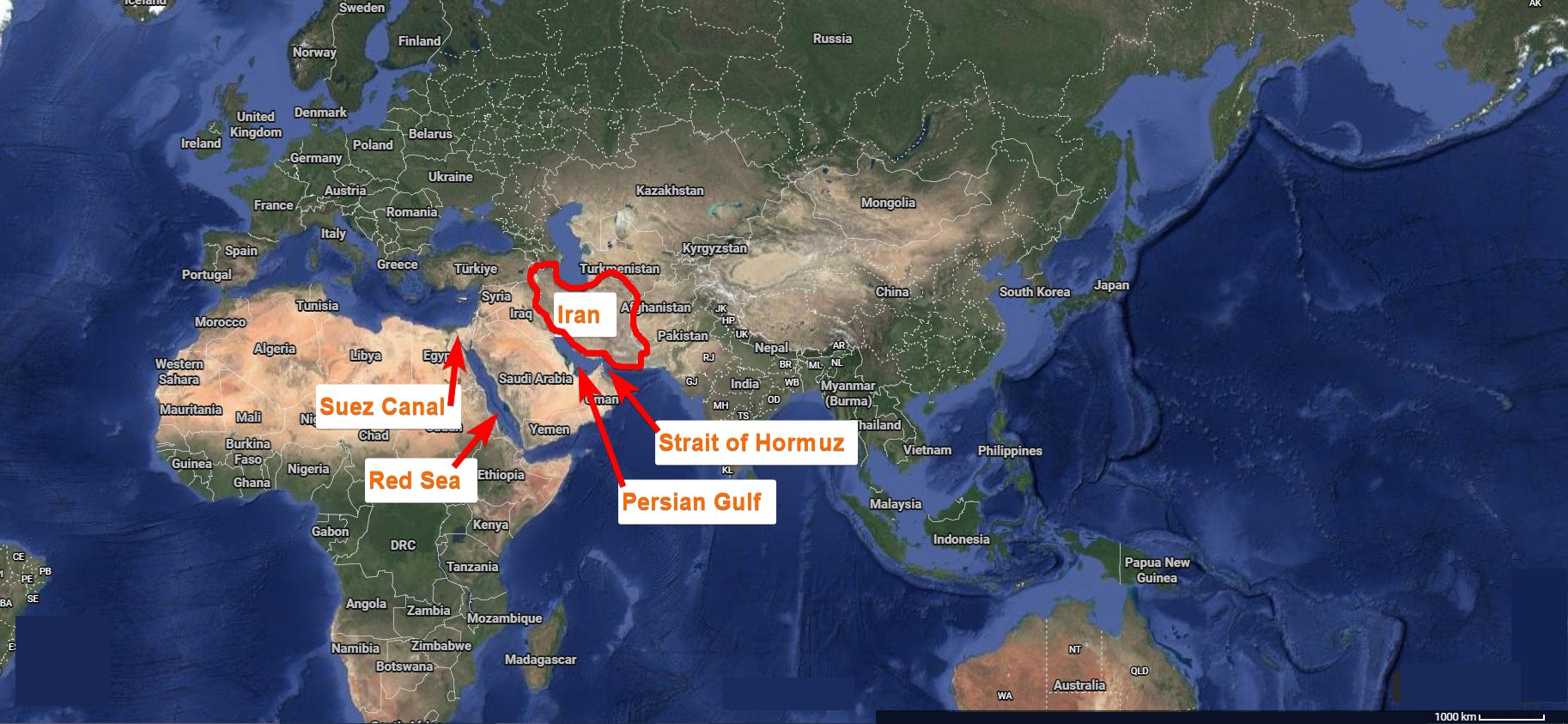
The Red Sea had its own problems, with Houthi rebels attacking boats in the narrow strait at the ‘bottom’ of the sea, near Yemen (Bab al-Mandab Strait) from 2023 until relatively recently. Some shipping had cautiously resumed with naval escorts in the past few months, but the new conflict has prompted major shipping lines to suspend all Suez transits until further notice.
When international shipping is disrupted, there are two big impacts: transport prices and travel time. Ships are now having to go around the Cape of Good Hope (the ‘bottom’ of Africa) to get from Asia and Australasia to Europe. That’s more expensive because it requires more fuel and because it ties up each ship for much longer.
Higher shipping prices impact food, ingredient and commodity prices directly. Longer transport times and transport delays pose risks to perishable cargoes.
Aside: I remember hearing of an Australian providore’s heartbreak during the COVID pandemic as she watched the unloading of a consignment of expensive European delicacies such as cheeses, hams and chocolate that she had been waiting on for months. The shipment from Europe had been delayed by the pandemic. All the beautiful food had expired in transit, and the whole lot had to go straight to the dump.
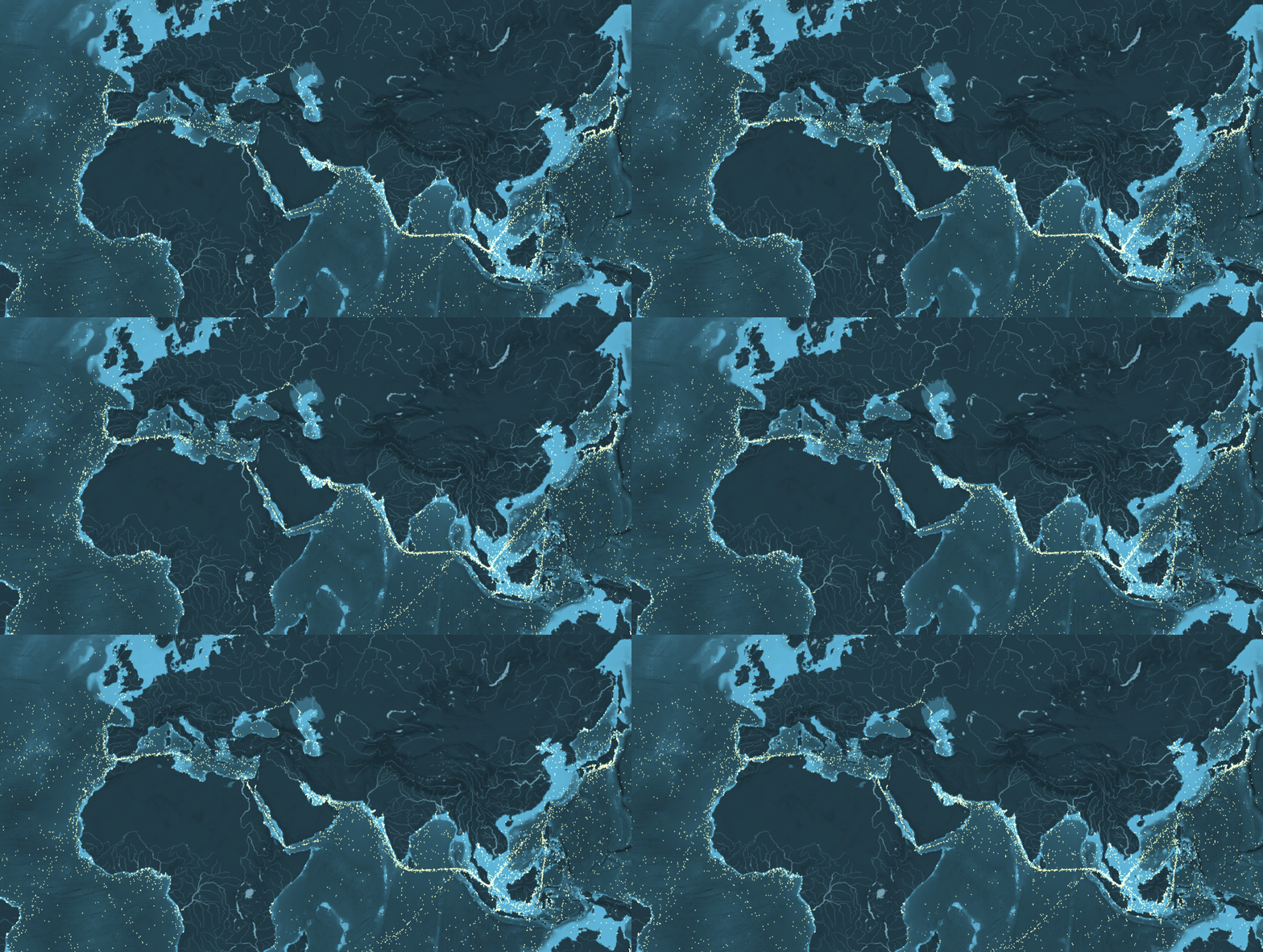
Global shipping movements in 2012
3) Pricing in uncertainty and risk
Higher insurance premiums for shipping and higher food production costs from fuel and fertiliser shortages are not the only things that can drive food prices up. Traders will also add extra margins to cover market uncertainties and compensate for riskier trading conditions.
For example, shipping companies that usually move refrigerated meat, dairy, fruit and veg into or out of the Upper Gulf / Red Sea region are adding war‑risk and emergency conflict surcharges of roughly USD 2,000–4,000 per container on top of base freight, explicitly to price in the Iran conflict risk, even before freight bookings reopen.
4) Purchasing diversification strategies
No one wants to be left without a crucial ingredient or product for their manufacturing operations or customers. Right now, big food companies are checking that they have reliable alternative sources for all major inputs.
According to FoodNavigator, confectionery manufacturers are already diversifying suppliers for sugar, cocoa, glucose syrups, speciality fats and packaging, and relocating production to reduce exposure to disrupted Hormuz and Red Sea routes.
Diversification of purchasing can mitigate risk for the purchaser. However, it also creates opportunities for food fraud, and headaches for quality and safety personnel who need to ensure that new suppliers can provide materials that are safe, authentic and consistently within specifications.
Food in the firing line
What to watch out for as the Iran war escalates
I’ve already demonstrated how the new conflict inthe Middle East can impact food supply chains at a general level. Now let’s get into some specific details for various regions and commodities.
Warning: I’m by no means an expert on any of these commodity-region combinations, so while I have researched this article very carefully, the information I share here is bound to be incomplete. It’s also likely to change rapidly as the situation develops and could be out of date by the time you read it.
If your business has purchasing experts or trusted supply chain partners, talk to them about your unique situation - they will be able to tell you more than I ever could.
The Middle East
It goes without saying that food companies in the Middle East are in for a very tough time.
For Gulf Cooperation Council countries (Bahrain, Kuwait, Oman, Qatar, Saudi Arabia, and the United Arab Emirates), roughly 35% of wheat and coarse grain imports and about 81% of rice imports transit either Hormuz or the Red Sea route; a large share of rice specifically comes via Hormuz.
Food exports as well as imports will be severely affected.
Biggest challenges: All foods and commodities. Rice, which mainly comes from Asia via the Strait of Hormuz, is a standout.
The United Kingdom
The United Kingdom is a notoriously food-insecure country, relying heavily on imports from Europe and further afield. While shipping routes between Europe and the United Kingdom are physically unaffected, the disruption to shipping movements caused by the conflicts related to longer transits, backlogs and chokepoints will have an effect and likely lead to price increases for imported foods.
Home-grown foods will be affected by higher input costs for fuel and fertiliser.
Biggest challenges: UK media and analysts expect the Iran war to push up the cost of staples like bread, flour and soft drinks mainly through higher fuel, packaging and processing costs.
Watch out for: Grey market and counterfeit foods such as soft drinks, alcoholic drinks, confectionery and illegally imported packaged foods, which are more appealing to consumers when legitimate prices are high.
The United States of America
Oil prices and fertiliser price shocks are the top concerns, with consumers expected to pay more for all foods as a result.
Biggest challenges: Price rises for inputs for domestic food production and transport.
Africa
In Africa, as with other areas, higher freight, energy and fertiliser prices will hurt local food production and increase prices for imported foods. Exports will be affected by shipping price rises and delays.
Many countries in North Africa, such as Ethiopia and Egypt, are dependent on imports of wheat and maize, and both prices and supplies of grain are likely to be affected due to shipping disruptions. Egypt is the world’s largest importer of wheat.
Watch out for: Heightened fraud risk in imported grains due to disrupted trade routes, increased mycotoxin risks (North Africa). Counterfeit fertilisers (East Africa).
Australasia and Oceania
Australian farmers are heavily reliant on imported fertiliser for both domestic food production and for export crops. Fertiliser price rises and/or shortages are leading to concerns.
The Middle East is a major export market for Australian and New Zealand meat, grain, fresh produce, and dairy. These exports have now been severely disrupted.
Australian beef and sheepmeat shipments to the Middle East are being halted or rerouted, with containers stuck at sea and exporters cancelling bookings as emergency surcharges, insurance withdrawals and port closures disrupt supply chains.
High-value, highly perishable exports, including dairy foods and seafood, which are usually exported by air have been disrupted due to flight cancellations.
Exporters are reportedly channelling product back into the domestic market at lower prices to avoid waste.
Watch out for: Surplus stocks of perishable foods that could not be exported, potentially with a short shelf life or falsified expiry dates.
South Asia and Southeast Asia
The largest impacts in South Asia and Southeast Asia are likely to be around fertiliser supply and price, combined with disruption to exports.
India imports over 40% of its urea and phosphatic fertilisers from the Middle East, and has already had to cut urea production at three plants because supplies of liquid natural gas from Qatar were disrupted. China and Indonesia are also heavily reliant on Middle Eastern sulphur for phosphate fertilisers.
On the export side, India’s basmati rice exports are imperilled: Iran is one of India’s largest basmati customers, accounting for about 25% of exports, with Iraq taking a further 20%, with exports halted since the conflict began and basmati prices falling.
Vietnamese seafood exporters say the Iran conflict has become “a major test”, with higher insurance, rerouting and cold‑chain risk for shipments that would normally move via the Red Sea–Suez to Europe.
Industry analyses note that chilled and fresh seafood exported from Asia to Europe is exposed because longer routes (around the Cape of Good Hope) and port congestion eat into shelf life and make reefer space and insurance more expensive.
Biggest challenges: local food price increases due to high fuel and fertiliser prices, disrupted exports of rice and seafood.
East Asia
Fertiliser supplies are at risk, as in other regions. China was already restricting fertiliser exports to protect its domestic market and is now expected to tighten controls further, worsening availability for its neighbours.
Central and South America
Fertiliser and export market disruptions are key concerns for major food exporters in South America, with Brazil particularly affected.
Brazil imports almost all of its urea fertiliser, and around 40% of those urea imports pass through the Strait of Hormuz, with Iran a significant underlying source via direct and indirect routes.
The Middle East remains a key market for Latin American exports. Iran purchased approximately 20 percent of Brazil’s corn exports in 2025.
Four days ago, Brazilian media reported that 10 vessels carrying more than 600,000 tons of soybeans and soymeal were scheduled to depart Brazil for Iran. If the conflict continues, those cargoes could be redirected to other markets.
Caribbean countries are heavily reliant on food imports, so any increase in fuel and shipping costs quickly affects food prices for consumers.
Europe
As with the United Kingdom and the United States, increased energy, freight and fertiliser costs will increase food prices in Europe.
European consumers will likely experience higher prices on imported items that typically move via Hormuz and the Suez, including Asian shrimp, rice, dried fruit, nuts, and Middle Eastern speciality products.
At the same time, analysts point out that if some imported meat, such as Brazilian beef and poultry, is diverted away from disrupted Middle Eastern markets into Europe, that could temporarily lower prices for those foods in Europe, even as other categories get more expensive.
Watch out for: Shortened shelf life of foods imported from Asia, shortages and unusual trading patterns in foods usually sourced from the Middle East; an unusual influx of meat and poultry from South America, perhaps mislabelled with respect to its origin or expiry date; supply disruptions for pistachios, dates, figs, aubergines, raisins and saffron which were major export crops for Iran, with Iranian exports now halted.
Final thoughts
Food supply chains have already been disrupted in multiple ways by the new Iran conflict. The disruptions will be amplified if the war escalates, spreads to more countries or becomes protracted.
Price rises are expected globally due to higher energy prices, fuel prices and international shipping costs. Price rises increase the likelihood of food fraud at both the consumer (retail) level and further up the supply chain.
Shortages and changes to trading patterns also increase the likelihood of food fraud as suppliers seek to retain important customers by fulfilling orders in the face of shortages, obfuscating the origins of materials that were originally destined for other markets, and misrepresenting the age of foods that have been affected by shipping delays.
Food safety challenges are amplified when export markets cannot receive shipments and they are diverted to other markets where they may not be compliant - for example, with respect to pesticide residues - and when commodities like grains or nuts are delayed during shipping, exposing them to mycotoxin contamination.
The highest risk foods are foods that usually travel between Asia and Europe via Middle East shipping routes such as rice; high value foods that are transported by air; foods that are produced in Iran and the Middle East, such as pistachios and saffron; and bulk consignments of grains and foods that were destined for the Middle East, but cannot be received there, such as soybeans from Brazil and meat from Latin America and Australasia.
Food Safety News and Resources
This week I share news of an unusual recall after hepatitis A was found in a food, despite no illnesses having been confirmed. It is rare for foods to be tested for the presence of foodborne viruses because it is difficult to confirm the presence of infective viral particles, even when they are thought to be present following epidemiological investigations.
Click the preview box below to read about that recall, and an enormous one for broken glass, in this week’s food safety roundup.
Food Safety News and Resources | March

9 March | Food Safety News and Free Resources |
⚠ Unusual recall: Frozen grated coconut recalled for Hepatitis A (Australia)
⚠ Enormous recall for broken glass (USA)
🧪 New reference dose for gluten risk assessment (Global)
🛍 PFAS exposure
🏢 Major staff losses at agencies (USA)
Making honey cough drops
This beautifully hypnotic video was just what I needed after hours (days!) of researching the impacts of the Middle East conflict.
It shows the production process for honey lozenges, with a simple musical accompaniment (watch it straight in your browser; you don’t need a TikTok account).

 Tiktok failed to load.
Enable 3rd party cookies or use another browser
Below for paying subscribers: Food fraud news, horizon scanning and incident reports
📌 Food Fraud News 📌
In this week’s food fraud news:
📌 Methods for sparkling wine and Scotch whisky
📌 Major fraud alleged in fruit juices
📌 Warnings for meat and dairy in the US and South Africa
📌 Incidents with probiotics, fertiliser, coconut water and more