

This is The Rotten Apple, an inside view on food fraud and food safety for professionals, policy-makers and purveyors. Subscribe for insights, latest news and emerging trends straight to your inbox each Monday.
Hidden traps in food testing: lessons from a protein bar lawsuit
18 Food defence blind spots + a self-assessment checklist
TraceMap, a new tool for fraud detection and traceability
Turning styrofoam into cinnamon candy (just for fun)
Glycerol in chardonnay (and more) in this week’s food fraud news
Happy Monday!
Food fraud’s a tricky thing. Every now and then, I make a call on food fraud that turns out to be way off the mark. As a reminder, I call something food fraud if it involves deception, economic gain and (of course!) food. I’m also willing to share allegations that haven’t been tested in a court of law because I want you to be able to see where vulnerabilities lie, so you can protect your own supply chains from similar scenarios (that is also why I almost never name brands in my food fraud reports).
Last year, I shared the news that a US consumer group had tested protein bars from various brands and found some of the brands appeared to be significantly under-declaring the fat and calorie content of their products.
When companies mislead consumers about the calorie content of a ‘healthy’ food, that counts as food fraud in my book, since there is an economic gain to be made from the deception. However, new information from one of those brands has recently been revealed. And that changes everything.
In this week's issue, I use the grey areas highlighted by that consumer group’s analyses and, one brand’s response to explore the hidden traps in food testing.
Also this week, discover 18 blind spots in your food defence plan (and get a downloadable checklist to use on your site walk-through). Plus, a Canadian chemist makes cinnamon candy out of polystyrene.
Enjoy,
Karen
P.S. Big shoutout to 👏👏 Chloe and Mads from the UK 👏👏 for upgrading to paid subscriptions and to 👏👏 the marvellous Dorey 👏👏 for becoming a ‘Good Apple’. Dorey’s subscription pays for 5 scholarships (free access) for students and academics. If you’d like one, reply to this email and let me know.
Hidden traps in food testing: lessons from a protein bar lawsuit
Last week I heard of an unusual situation that demonstrates just how difficult it can be to ‘prove’ allegations of food fraud using analytical testing alone.
It reminded me of the Subway tuna scandal.
In 2021, the sandwich chain Subway was accused of food fraud by plaintiffs who sued the company for supplying tuna sandwiches in which the tuna component was alleged to be “not tuna and not fish” after performing DNA-based tests on the sandwich fillings.
Lawyers for the plaintiffs said their claims were based on lab tests of “multiple samples” which found the ‘tuna’ was “a mixture of various concoctions that do not constitute tuna, yet have been blended together by defendants to imitate the appearance of tuna.”
The lawsuit was dismissed in 2023 after more tests, performed by a different laboratory, found the sandwich filling was ‘real tuna’. Experts questioned the test methods used by the original laboratory and explained the canning process for tuna can degrade DNA, confounding tests.
The current situation follows a similar pattern: fraud is alleged, a lawsuit follows, the plaintiffs base their case on a specific test, and the brand owner cries foul.
Misleading claims about fat and calories in protein bars
In Issue 214’s Food Fraud News, I shared allegations about mislabelling of protein, energy and nut bars in the United States. A consumer group tested a range of bars from different brands and found some contained significantly more fat, carbohydrates and/or sugar alcohols than was declared on the label, implying that those brands were deliberately misleading consumers about the healthfulness of the bars.
Last week, news broke about a lawsuit brought by three individuals against one of those brands, David. The plaintiffs claim David has been misleading consumers because its protein bars contain “way more” calories and fat than declared on the label.
So far, so normal… these sorts of lawsuits occur relatively often in the United States.
Except there’s a catch here. It’s related to the test methods used by the plaintiffs.
CBS News reports that the plaintiff’s case is based on independent testing that used a method known as the Atwater factors to determine the number of calories in the bars, with that method revealing the calories are much higher than claimed by David. They also report that testing revealed the fat content was 400% higher than declared on the label.
But something’s amiss, says sharp-eyed food scientist, Dr Abigail Thiel. The plaintiffs used the official AOAC method for fat determination in baked foods, AOAC 945.44, which does NOT measure metabolisable, edible fat, but simply measures the mass of material that is ether-extractable from a food, with that mass interpreted as “crude fat”.
The plaintiffs’ testing allegedly found that the David protein bars contain 11-13.5 grams of fat per bar, far higher than the 2 grams of fat per serving claimed on the packs.
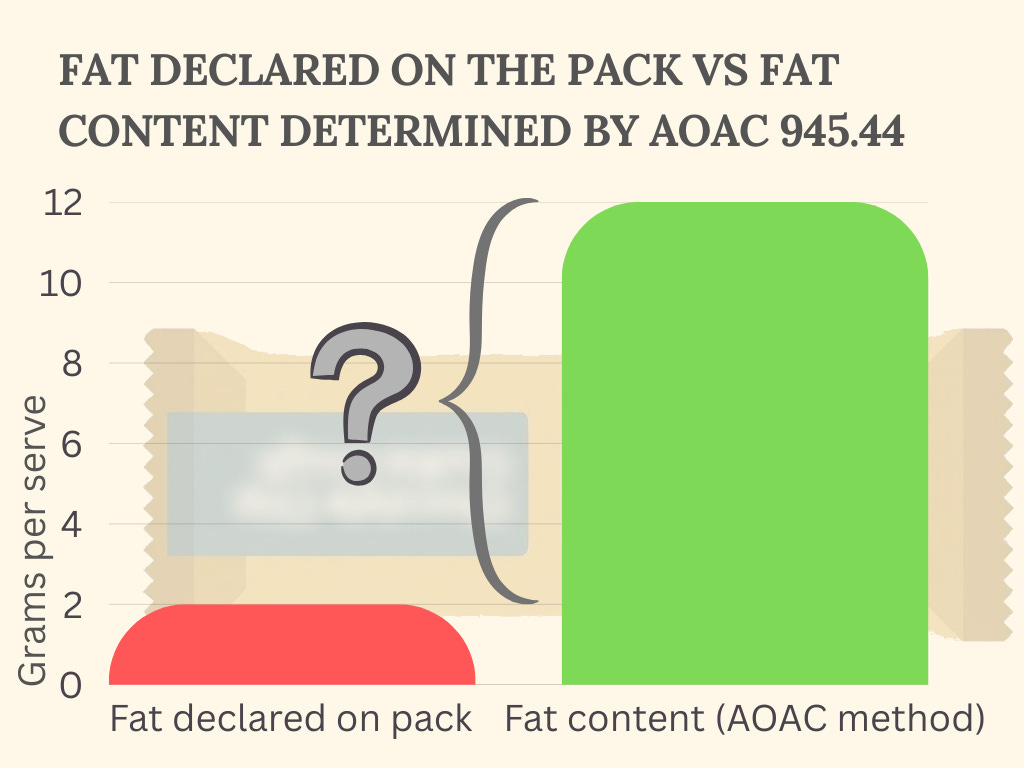
But there could be a problem with using AOAC 945.44, one of the methods accepted by the FDA for regulatory fat analysis in baked products, for David protein bars. And that is because the bars contain a fat substitute that has almost no calories but that is likely still ether-soluble.
In effect, it seems the fat substitute in the protein bars, esterified propoxylated glycerol, or EPG, shows up in the crude fat analysis performed using the approved AOAC method, but it does not contribute to nutritive calories when consumed.
The plaintiff’s complaint regarding calorie declarations was based on calorie calculations using Atwater factors, which are one of six methods permitted for calorie content declarations by the FDA. The Atwater factors are used to convert the grams of fat, protein, available carbohydrate, and alcohol, if present, into the calories in a serve of food.
If the fat content of a food has been overestimated by the AOAC method, then the calorie content calculated with the Atwater method will also be overestimated.
The magic ingredient
The protein bar manufacturer, David, says it has not been deceptive about its nutrition information, explaining that the fat and calorie mismatch is due to the presence of EPG in the bars.
The ingredient is usually listed on the label as ‘modified plant‑based oil (EPG)’ or ‘modified vegetable oil (EPG)’. It was recognised as GRAS (Generally Recognized As Safe) by the FDA in 2015. The manufacturer says it “passes through the digestive system, as an inert material”
The scientific literature cites a caloric content for EPG of 0.7 kcal/g.
So, just mistaken identity then?
On the face of it, this seems like a simple case of the plaintiffs using the wrong tests to check on-pack claims about fat content and calorie content.
But on closer inspection, the legal situation is not quite so clear-cut.
Declarations of calorie content in foods can be made using a number of methods, and relying on the scientifically published value of 0.7 kcal/g for EPG appears an acceptable way to declare the energy content of the David protein bars.
That is, David’s on-pack calorie values seem legally defensible.
The fat declarations, on the other hand, are another matter.
The FDA’s rules on nutrition labelling define total fat as “total lipid fatty acids and expressed as triglycerides where fatty acids are aliphatic carboxylic acids consisting of a chain of alkyl groups and characterized by a terminal carboxyl group.”
EPG has the chemical structure of a triglyceride with ‘normal’ fatty acids, albeit with extra propylene glycol units within the molecule to block digestive enzymes. That is, it seems to fit the FDA definition of components that must be declared at “Total fat” in a nutrition information panel. Even though it contributes almost no calories.
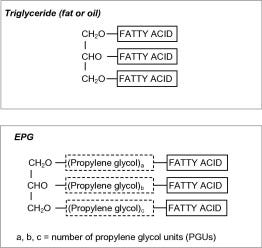
Notably, a different non-nutritive fat-like substance, Olestra, gained an exemption from the FDA so that it does not have to be considered a source of fat or calories in nutrition declarations. EPG has no such exemption.
Legal boffins will no doubt spend a lot of time arguing about the technical regulatory interpretations of the definitions and chemical structure of EPG during this lawsuit. I’ll leave them to it.
For me, the more interesting question is whether consumers were misled by the low figures for fat and calories on David packs, as the plaintiffs claim. I think that’s unlikely. Consumers generally imagine “fat” to contribute calories, and so I don’t consider a declared fat content that disregards non-nutritive fat to be misleading.
I wonder what the courts will say?
David says it has done nothing wrong. The company’s spokesperson says it “stands behind” its label claims and that it will “defend this claim vigorously”.
Grab the popcorn, this could get messy!
In short: Plaintiffs in a lawsuit against a protein bar company claim the company misled consumers by claiming their bars contain significantly lower fat and calories than was found in independent laboratory tests 🍏 The company says they have been truthful and have not misled consumers 🍏 The difference in fat and calorie values asserted by the plaintiff and the company seem likely due to the test methods used, with the plaintiff’s test methods accounting for non-nutritive fat not accounted for by the company 🍏 Food testing is not simple (grab the popcorn) 🍏
Main sources (others are linked inline):
Bechtel, D.H. (2014). Article series: Safety of esterified propoxylated glycerol (EPG), a nonabsorbable fat replacer. Regulatory Toxicology and Pharmacology, 70, pp.S91–S94. doi:https://doi.org/10.1016/j.yrtph.2014.11.010.
Classaction.org. (2026). David Protein Bars Contain More Calories and Fat Than Advertised, Class Action Alleges. ClassAction.org. Available at: https://www.classaction.org/news/david-protein-bars-contain-more-calories-and-fat-than-advertised-class-action-alleges.
Cunningham, M. (2026). Lawsuit alleges David Protein understates calories and fat content of its bars. [online] Cbsnews.com. Available at: https://www.cbsnews.com/news/david-protein-bars-lawsuit-calories-fat-labeling.
🍏 More like this: Limitations of DNA testing for food fraud | Issue 108 🍏
18 Food defence blind spots (are you guilty?)
Many food companies believe their food defence (food defense) program is strong… until an auditor or customer probes deeper.
That’s when hidden gaps can appear:
threat assessments not reviewed and updated
blurred responsibilities for the program - QA? Production? Site security?
mitigation measures not matched to identified vulnerabilities
missing monitoring records.
Here are my top food defence blind spots, clustered into three key areas of weakness: people/culture, physical access and ‘paper only’ plans. Are you guilty?
Reminder: Food defence is the protection of food against intentional adulteration designed to cause harm. Learn more: Everything You Need to Know About Food Defence
People and culture
Too much focus on malicious outsiders, with insufficient focus on disgruntled insiders, contractors, labour hire staff and cleaners who have routine access to product and systems.
Weak pre‑employment checks for agency staff, labour hire workers and contractors, plus no ongoing screening after incidents or grievances.
One‑off training with no refreshers, no behaviour-based drills, and no expectation that operators challenge suspicious behaviour such as tailgating or unaccompanied visitors.
Food defence siloed with QA: security, human resources, maintenance and procurement departments are not fully in the loop, or are running separate programs that are not integrated.
Physical access and process steps
Loading bays, waste collection points, tank farms and external silos treated as low risk, despite being easy points to gain access or introduce material.
Poor control of keys, access cards and passcodes, especially for CIP (clean-in-place) rooms, chemical stores, utilities/plant rooms and IT-server rooms.
Access exceptions made for maintenance, building and pest contractors during special projects.
Staging for WIP (work in progress), rework and other hold areas not locked or segregated, allowing unauthorised staff access to open or semi‑finished product.
Ancillary spaces such as engineering workshops, plant rooms, and welfare areas that open onto production corridors not included in the food defence threat assessment.

Surveillance, monitoring and records
Cameras installed at gates and main production lines, with no coverage of ingredient intake, blending tanks, rework, or off‑shift operations.
CCTV footage not actively reviewed, or not retained for long enough to support incident investigations.
Weak or missing records of food-defence monitoring, corrective actions and verification, so the procedures look good on paper but are not accompanied by evidence for an audit or incident investigation.
Vulnerability assessment and mitigation design
Treating the vulnerability assessment like HACCP and flagging every step in the process flow chart as medium or high risk, instead of asking “which 2–5 steps are genuinely attractive and feasible for an attacker?”
Ignoring ‘off-shift’ activities such as nights, weekends or public holidays when there is no production but people are still on site for regular sanitation, periodic deep cleans, pest control, maintenance or engineers doing trials.
Pre‑start and post‑shutdown periods when only a few operators, loaders, warehouse staff or cleaners are around.
Mitigation strategies that are purely procedural, such as policies, SOPs and signage, without physical barriers that reduce the ability of an attacker to reach ingredients or products.
No formal re‑assessment after process changes, equipment updates or layout changes.
Limited consideration of cyber risks - for example, physical access and remote access to computers that control chemical dosing systems, recipe management and production control systems.
These blind spots are areas where it’s easier for a determined bad actor to access your site and processes, or for auditors and customers to find holes in your systems. Food defence only really improves when managers are willing to ask, “Where would I attack this plant?” and take action to close those gaps.
Your mission: keep walking the site, asking awkward questions, and tightening controls every time you find a vulnerability.
Find your site’s blind spots with my printable Food Defence Walk-Through Self Assessment - 20 questions + 2 debrief prompts - and a great addition to your continuous improvement program. Available to paying subscribers at the bottom of this email.
Quick Bite: Trace Map
News from the European Commission: “The European Commission has unveiled a new artificial intelligence (AI) platform, TraceMap, to accelerate the detection of food fraud, contaminated food and foodborne disease outbreaks across the EU.”
Before you get excited about another AI-powered food fraud detection system, TraceMap is not for private businesses. It was developed for national authorities in EU Member States.
The aim is to help member states (countries) with the targeting of their enforcement activities and to help them undertake “more thorough investigations, without requiring additional resources”, by using the data in existing EU systems to track trade patterns and “production flows”.
A pilot version of TraceMap was used in conjunction with the recent recalls of the cereulide-contaminated infant milk formula.
Learn more: Press corner | European Commission
Styrene ➡ cinnamon (just for fun)
Is it possible to turn polystyrene into cinnamon candy?
Or (for the food science nerds), can you convert the styrene monomers in polystyrene packaging into cinnamaldehyde?
In this 52-minute video, a Canadian chemist finds out.
Below for paying subscribers:
👉👉 Food Defence Walk‑Through Self‑Assessment Checklist
and
📌 Food Fraud News 📌
In this week’s food fraud news:
📌 Warnings for cold water prawns, Spanish garlic and organic oregano
📌 Shocking stats for UK imports
📌 Atlantic salmon seized
📌 Adulterated wine, fake cream and more…