

This is The Rotten Apple, an inside view on food fraud and food safety for professionals, policy-makers and purveyors. Subscribe for insights, latest news and emerging trends straight to your inbox each Monday.
New horizon scan archive
Packaging corner: recycled PP containers
What’s in a (food) name?
Fred designs a potato chip (just for fun)
Food fraud news, emerging issues and recent incidents
Last week I had the pleasure of meeting my newest Good Apple-tier subscriber on Zoom. Like so many of you, she is juggling a daunting workload, managing hundreds of suppliers, dozens of co-manufacturers and thousands of ingredients, each with a differing food fraud risk.
Our conversation inspired me to think long and hard about how to control food fraud risks in co-manufacturing scenarios (stay tuned for an article about that in a future issue) and prompted me to create the easy-to-find archive of horizon scan reports unveiled in this issue.
Also in this week’s issue: new research into reusable food packaging, new rules for food names in Australia and lots of food fraud news, including another win for the UK’s National Food Crime Unit.
Enjoy!
Karen
P.S. This week, I’m delighted to welcome new paying subscribers from food companies in Tennessee and New Zealand and a government body in Scotland. Welcome 👋 Genie, Katie, Abigail and Pamela 👋 and thank you to Andrew and Ross for purchasing gift subscriptions for your colleagues and supporting my work.
Horizon Scanning for Food Fraud
Each week, I scour the interwebs for news of events that could impact the likelihood of food fraud. This process is called ‘Horizon Scanning’
Horizon scanning is the act of trying to anticipate threats that might develop in future. It’s used in all sorts of fields and industries. For example, in health care, you might do horizon scanning to anticipate the next pandemic. In cybersecurity, you might be keeping an eye on the impact that quantum computing will have on encryption systems when it becomes more widely available.
In food fraud and food supply chains in general, horizon scanning is the act of trying to anticipate or predict how future situations might cause problems in supply chains or affect the likelihood of food fraud occurring.
Horizon scanning is a vital element of all food fraud prevention programs, as it allows food businesses to proactively mitigate against upcoming threats, rather than waiting for a food fraud event to occur before taking action.
Horizon scanning in The Rotten Apple
I include horizon scanning information in The Rotten Apple’s food fraud news most weeks. I include actual events and predicted events, such as crop volume forecasts, that might indicate an increase in the likelihood of food fraud occurring for specific commodities. For example, if there is pressure on egg supplies in a certain region due to bird flu, I’ll include that in the horizon scanning news.
Limitations and caveats
However, it’s important to note that my system is fallible, with a bias towards news sources that are easily found by search engines and AI-powered search tools and English-language news.
And although I do publish industry insider tips from time to time, my reports rely almost exclusively on publicly available information, which means some emerging risks will be missed.
I also don’t repeat warnings consistently. For example, I flagged threats posed by citrus greening disease in 2023. Those threats have not vanished, but I don’t re-share them month after month.
And finally, I limit my horizon scanning reports to commodity-region combinations that are most likely to be relevant to my readers. So if there is a problem with the domestic wild boar meat trade in Paraguay - a market with limited geographical reach and/or small monetary value - you won’t hear about it here.
Alternatives
There are many food fraud and food safety alert services that provide more comprehensive coverage than mine. You can set them up to get alerts for every ingredient in your portfolio, and some services also track suppliers and food safety incidents as well.
If you are responsible for managing food fraud vulnerabilities for a large set of ingredients or products, I recommend using one of those automated services so you don’t miss anything.
You can find a list of food fraud databases and horizon scanning services at FoodFraudAdvisors.com.
Benefits
As for The Rotten Apple’s horizon scans, the reports I do for you, my dear readers, are carefully curated so as not to overwhelm. I aim to give you a broad sense of what’s going on in the world, rather than a fire-hose of notifications.
Each news item is carefully selected so that only high-impact and broad-impact news is included. In other words, I won’t clog up your inbox with news about wild boars in Paraguay.
As with my food fraud incident reports, my horizon scan reports aim to demonstrate the various types of pressures on supply chains and the types of vulnerabilities they can create.
I also take the time to tell you when threat levels seem to be easing, which is not something you get from other services.
However, if you’re looking for 100% coverage of every single commodity in every region, you need to sign up for 24-7 alerts from one of the big automated horizon scanning services.
Horizon scan archive
Until today, past horizon scan reports from The Rotten Apple lived on the Food Fraud Archive page among dozens of other sub-topics. Safe to say they were not easy to find! Today, I created a new stand-alone page containing all our past horizon scan reports, for you to search at your leisure. Check it out by clicking the preview box below.
Food Fraud Horizon Scan Archive

The archive contains a list of links to every horizon scan report published by The Rotten Apple from 2022 to today, in reverse chronological order.
This week’s horizon scanning news can be found at the end of this email.
In short: 🍏 Horizon scanning is the act of trying to anticipate threats that might develop in future 🍏 Food fraud horizon scanning is the act of trying to anticipate or predict how future situations might increase food fraud vulnerabilities 🍏 The Rotten Apple’s food fraud horizon scan reporting is hand-curated and designed to be representative and educational instead of overwhelming 🍏 Other services provide more comprehensive alerts 🍏 Paying subscribers can access The Rotten Apple’s horizon scanning reports in regular weekly issues and on a searchable archive page 🍏
Packaging Corner
Making reusable food containers from recycled materials
Researchers have explored the feasibility of making reusable food containers from post-industrial recycled polypropylene (PP), with a focus on functionality, material properties, and microbial safety.
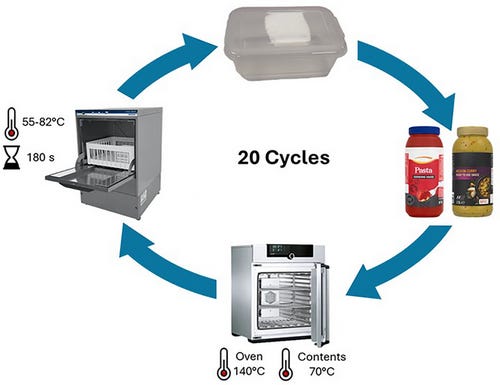
The scientists compared containers made from virgin PP homopolymer, virgin PP copolymer and post-industrial recycled PP during repeated test cycles that simulated oven heating and dishwasher washing.
The containers were filled with tomato sauce and curry sauce for the heating tests. They were then assessed for thermochemical properties, colour changes, and for their ability to be sanitised by washing, with the researchers finding no performance differences between the three materials.
The researchers conclude that containers made from post-industrial recycled PP are comparable in performance to containers made from virgin PP and are suitable for use as reusable food packaging.
Source:
Jameson, C., Farrell, R., McKenna, S., Pezzoli, R., Chyzna, V., Fitzpatrick, D.P., Hopkins, M. and Cortese, Y.J. (2026). Feasibility of Recycled Polypropylene for Reusable Food Packaging: Effects of Reuse Conditions on Packaging Performance, Material Properties, and Microbial Safety. Food Frontiers, 7(2). doi:https://doi.org/10.1002/fft2.70250.
What’s in a name?
Food and beverage names are being recalibrated in Australia
Australia has signed a trade agreement with the European Union that will affect how certain Australian-made foods are allowed to be named. Negotiations for the agreement commenced in 2018 (!). The negotiations stalled in 2023 due, in part, to an inability to reach agreement over naming rights for foods and beverages.
Australian producers make cheeses, wines and other products that they market with names the European Union considers protected.
Feta cheese, parmesan cheese and prosecco sparkling wine are names that were previously permitted for use on Australian-made foods in Australia, with ‘prosecco’ allowed for Australian wine made with prosecco varietal grapes, under an AU-EU wine treaty agreed in 2008.
Under the terms of the new agreement, parmesan has been allowed to continue as a common name in Australia, while other cheese names, including feta and gruyere, will be phased out under a ‘grandfather’ policy that allows prior users of the name to continue using it.
The name prosecco will not be allowed on wine exported from Australia, after a 10-year phase-out period, though domestic use of the name will continue to be allowed.
A full list of affected foods can be found here: Overview of EU geographical indications (GIs) protected with treatments | Australian Government Department of Foreign Affairs and Trade
Relevant to food fraud?
Protected geographical indications (PGIs), are legally codified names for specific foods and drinks such as Champagne and Parma Ham.
PGI status can increase the economic value and market visibility of a product, which creates incentives for food fraud perpetrators to profit by selling inauthentic copies. However, European PGI rules are not enforced uniformly around the globe, meaning consumers in different countries have different ideas about what makes a genuine or ‘fake’ protected food like Prosecco or feta cheese.
When a non‑EU product carries a protected EU name, or packaging implies a false EU origin, that can be a form of mislabelling, or outright fraud, depending on the area of jurisdiction.
For example, a Greek newspaper alleged fraud in a 2024 report about Australian-made feta-style cheese titled “A shocking truth: most Australians are unknowingly consuming fake feta”, although feta was legally considered a common name, not a PGI, in Australia at the time.
However, under the terms of the new trade agreement, Australians will have to recalibrate their expectations for certain foods, or risk being accused of fraud for real.
Source:
Australian Government Department of Foreign Affairs and Trade. (2026). Australia-European Union Free Trade Agreement. [online] Available at: https://www.dfat.gov.au/trade/agreements/not-yet-in-force/aeufta.
We need a new potato chip. Should we ask Fred?
“We need a new potato chip. Should we ask Fred?”
“Fred? Don’t you think he’s been a bit full-on lately?”
“He’s good though….”
Fredric “Fred” Baur was a Procter & Gamble R&D scientist who developed both the parabolic chip concept and the famous Pringles can.
He helped design the uniquely shaped chip so it could stack neatly and be protected in the can, rather than being sold loose in a bag.
Baur was so proud of this invention that he asked for his remains to be placed in a Pringles can. In 2008, when he died at 89, his family honoured this wish by placing part of his ashes in an Original Flavor Pringles can for burial.
Fredric Baur also worked on freeze‑dried ice cream for Procter & Gamble. The product was never a commercial success; his son described it as a powder you added milk to and froze at home.
Baur, who graduated from the University of Toledo in 1939, the year World War II began, also served in the U.S. Navy as an aviation physiologist.
Aussie comic Chris Kohler imagines the invention of Pringles in this short clip…
Below for paying subscribers: Food fraud news and incident reports
📌 Food Fraud News 📌
In this week’s food fraud news:
📌 Wins for the UK food crime unit
📌 High fraud rates in shark trunks and fins
📌 Warnings for strawberries, sugar beets, clams and mangoes
📌 Astonishingly bad results for St. John’s wort supplements
Wins against food crime
The United Kingdom’s National Food Crime Unit (NFCU) had a win last week, with a key figure in the illegal