
235 | Maple Syrup Fraud in Canada | Space Food in 2026 |
Artemis II: a crumb-free zone

This is The Rotten Apple, an inside view on food fraud and food safety for professionals, policy-makers and purveyors. Subscribe for insights, latest news and emerging trends straight to your inbox each Monday.
Maple syrup fraud in Canada (gulp!)
What is immature honey?
Food on Artemis II
US honey results: good (or are they?)
Food fraud news (sexual chocolate?!), emerging issues and recent incidents
Welcome to Issue 235 of the world’s least boring food safety newsletter, where I dive into the uniquely regulated world of Canadian maple syrup, which has been rocked by an adulteration scandal this month. Thanks to reader Brian for keeping me up to date with the latest developments.
Also this week: I take you on a tour of the menu aboard Artemis II to discover what space food looks like in 2026, and explain why ‘immature honey’ is on the radar of honey fraud specialists.
As always, there’s food fraud news for paying subscribers, with sexual chocolate in the spotlight (sounds like something invented by Chef from South Park!) and a deep dive into why the US FDA’s honey testing results might not be quite as good as they first appear.
Have a great week,
Karen
P.S. Big shoutout to all the wonderful readers who renewed their paid subscriptions in the past month, and to 👏👏 Simione, Melissa from Australia, Sonia the dessert queen from Texas, and Sule from South Africa 👏👏 who joined their ranks. Thank you, I couldn’t do this without you.

Maple Syrup Fraud in Canada (gulp!)
In last week’s food fraud news, I shared shocking allegations of fraud affecting a maple syrup company in Quebec, Canada.
Food fraud is everywhere, so why is this scenario so particularly shocking? Because the citizens of Quebec take their maple syrup very (VERY) seriously!
Canada is the world’s largest producer of maple syrup, and the province of Quebec accounts for 90% of Canada’s production.
Quebec maple syrup is tightly regulated for quality, authenticity and volume, with strict industry controls that have been compared to a state‑sanctioned cartel.
Authenticity and quality rules
Under Canadian law, maple syrup must contain only the concentrated sap of maple trees, with no added sugar, flavourings, or other sweeteners. Producers must meet standards codified in the federal Maple Products Regulations, which are enforced by the Canadian Food Inspection Agency (CFIA) and Quebec’s Food Regulations.
These standards specify composition, safety, and labelling rules. Both federal and Quebec systems classify syrup into four colour/grade classes based on density, clarity, and characteristic maple flavour.
In Canada, maple product means a food that is obtained exclusively by the concentration of sap from trees of the genus Acer or the concentration of maple syrup. (produit de l’érable). (Safe Food for Canadians Regulations (SOR/2018-108)
Institutions and enforcement
The Quebec Federation of Maple Syrup Producers (Producteurs et productrices acéricoles du Québec (PPAQ)) is a powerful marketing board that enforces quality standards, administers quotas and acts as the mandatory sales agent for almost all bulk syrup in Quebec.
The agriculture department of Quebec, the Ministère de l’Agriculture, des Pêcheries et de l’Alimentation du Québec (MAPAQ) and the CFIA oversee food safety and labelling, while the producers’ organisation (the PPAQ) can impose its own penalties, fees, and marketing rules on producers who want to access the regulated bulk market.
Quotas, reserve, and market control
In Quebec, maple syrup producers receive individual quotas that cap how much saleable syrup they can produce each year. Syrup sold in bulk, which represents the majority of production, must be traded through the PPAQ’s sales agency, which sets bulk prices, manages a strategic ‘global reserve’ of maple syrup, and pays producers gradually as inventory is sold.
The reserve and quota system is intended to stabilise prices and supply from year to year, but critics argue it limits entrepreneurship, delays payments, and functions as a monopoly over the province’s signature product.
However, not everyone plays by the rules.
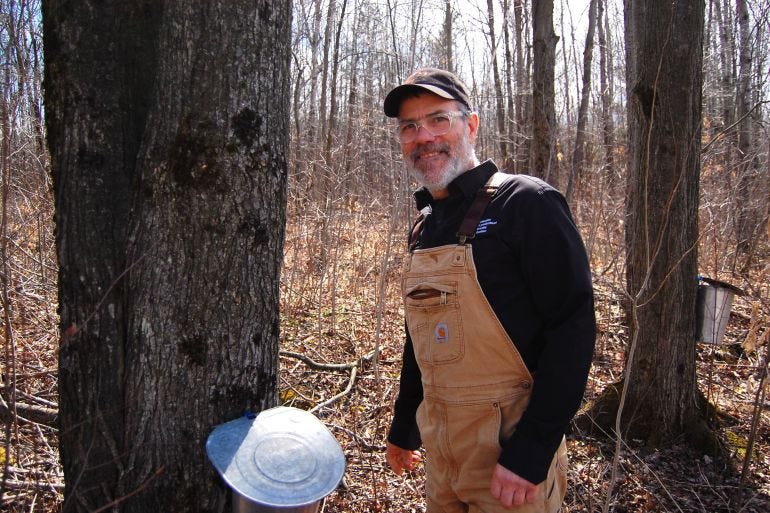
Rebel producers have sold bulk syrup directly to buyers in different Canadian provinces or to other intermediaries, bypassing the PPAQ system. The PPAQ has responded with investigations, seizure of syrup, private security guards at some farms, and very large civil claims or fines.
Shocking allegations
Against this backdrop of government purity rules and a tightly controlled market, it’s reasonable to assume that maple syrup from Quebec is pretty safe from fraudulent adulteration.
And this is supported by a long history of laboratory testing. Around 90 percent of bulk Quebec syrup is tested by the province’s laboratory, le centre ACER, which has never found any ‘falsified’ syrup. Until now.
"Since we've existed, we've never found any falsified syrup." G. Clermont, ACER’s head of testing (via CBC Canada)
So when a curious journalist at Radio Canada organised some analytical tests on a brand of maple syrup that didn’t taste quite right, no one imagined that a scandal would erupt.
Tests on multiple batches of the product purchased from different retail outlets indicated the syrup contained 50% cane sugar. Luc Lagacé, director of research at ACER, told Radio Canada, "This is the first time I've seen falsification of this kind. You can see that it's outright cane sugar that's been added to the cans."
Fifty percent! That’s a crazy-high level of adulteration. All against a background of close to zero public records of adulteration in Canadian maple syrup - I don’t have a single case of economically motivated adulteration for Canadian maple syrup in my food fraud database that stretches back to 2016.
With so much of Quebec’s maple syrup subject to testing, it seems improbable that anyone would try to get away with adulterating it with sugar.
However, the producer at the centre of these allegations was able to (legally) bypass testing by ACER because the testing organisation is not mandated to test products sold by a producer directly to a retailer, which is how this producer sells his wares.
A surprising admission
After Radio Canada received news of the shocking analytical results, they investigated further by reaching out to the producer of the suspicious products. Two people from the radio program Enquête posed as buyers for a retailer and met with the producer, filming their interactions using a hidden camera and taping telephone conversations to learn more about his syrup and sales practices.
He denied adding other sugar(s) to his syrups, telling the fake ‘buyers’ that such a practice is illegal.
But he admitted to the undercover journalists that his prices are unbeatable, saying “other [producers] can’t even come close” and explaining he “has the market” and that “it’s not entirely legal [but] I got away with it anyway”
When told about the test results, the producer first told Radio Canada it was “impossible” his products contained cane sugar, but later suggested that any adulterated syrup must have come from his suppliers in the other Canadian provinces of New Brunswick and Ontario. He told Radio Canada he was investigating the source of the falsified syrup.
Misrepresentation of origin
Earlier this month, CBC Canada reported that the producer had admitted to journalists that he sometimes purchased syrup from Ontario and sold it as “product of Quebec” during a phone conversation.
Misrepresentation of origin is illegal.
What to do with all that suspicious syrup?
When the story first came to light in early April 2026, grocery stores began removing the affected product from their shelves and offering refunds for unopened cans.
"As soon as we learned of the situation, we asked all stores concerned to pull this product from their shelves," said Metro grocery store spokesperson Geneviève Grégoire. "Clients who wish to be reimbursed are invited to return their unopened product to the store where they purchased it."
However, cans that appear to be from the same producer have since been found in stores labelled with a different brand name. CBC Canada reports that consumers have peeled labels from cans belonging to a new brand of syrup to reveal the establishment number of the accused producer underneath.
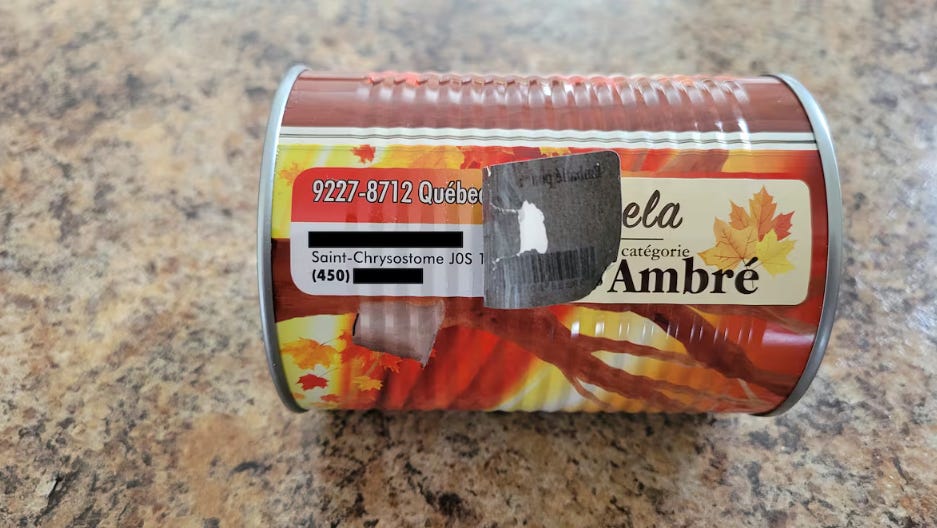
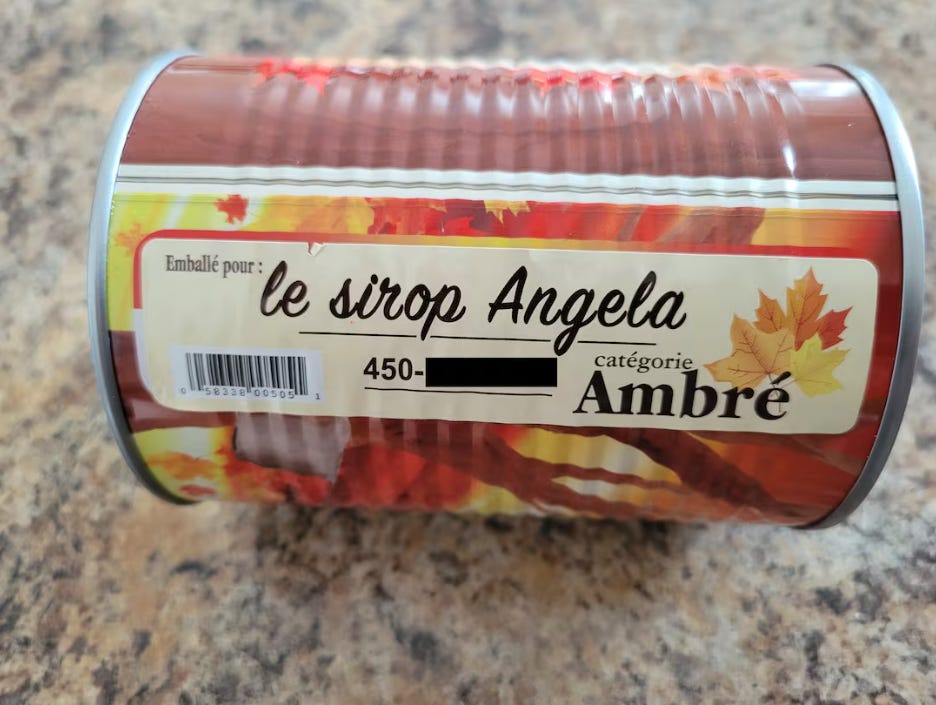
The producer has been aware of the investigation since February, which would have allowed him time to rebrand packages and avoid some of the fallout of the allegations. However, it is not known who overstickered the cans, or when such re-labelling might have occurred.
Final thoughts
Last year I warned about the risks US tariffs imposed on Canadian maple syrup, saying that Canadian producers were warning that maple syrup was at increased risk of fraud due to the tariffs, with syrups sold in the US and other export markets vulnerable to frauds such as dilution with water, and the undeclared addition of sugar syrups, other sweeteners and flavourings.
But the Canadian producers who made those warnings didn’t appear to imagine that such frauds might show up in their own country. And (frankly) neither did I.
If the allegations I’ve shared here prove accurate, this case includes incidents of adulteration, misrepresentation of origin and deceptive (though perhaps not illegal) re-labelling.
For me, the big takeaway is not that fraud can occur in even the most highly protected and regulated markets. It’s that detection doesn’t always have to rely on complicated analytical protocols. Sometimes an ordinary consumer who knows what an authentic product tastes like can blow a fraud wide open, simply by saying “This doesn’t taste right”.
Key takeaways:
Fraud can happen even in highly controlled products and markets.
Don’t overlook organoleptic (sensory) tests as a food fraud detection tool.
In short: Maple syrup is tightly regulated and controlled in Canada, with very strict systems and rigorous test requirements in Quebec 🍏 A media outlet discovered high levels of cane sugar adulteration in maple syrup labelled as a product of Quebec 🍏Quebec testing authorities say such falsification had never previously been detected 🍏 The syrup’s producer denies adding sugar to his products but allegedly admitted to undercover journalists that he sometimes misrepresented out-of-province syrup as being produced in Quebec and allegedly implied some of his practices were “not entirely legal” 🍏 Consumers later found cans of the allegedly suspect syrup over-stickered with new branding in stores 🍏 The adulteration was initially discovered because a consumer thought the syrup didn’t taste right 🍏 Sensory testing can be part of a food fraud mitigation plan 🍏
Main sources (others are hyperlinked inline):
Pouliot, G. (2026). Bogus maple syrup from Quebec producer found on grocery store shelves. [online] CBC. Available at: https://www.cbc.ca/news/canada/montreal/bogus-maple-syrup-quebec-9.7149822.
Pouliot, G. (2026). Fake maple syrup plot thickens: Cans found with label hiding name of implicated company. [online] CBC. Available at: https://www.cbc.ca/news/canada/montreal/fake-maple-syrup-stickers-cans-9.7157917.
Thank you to Brian from Canada for letting me know about the overstickering
What is immature honey?
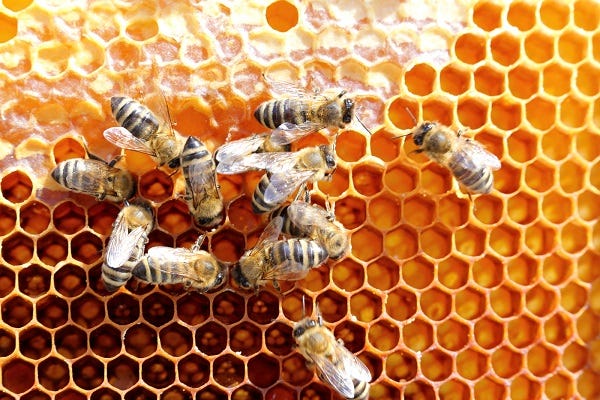
Immature honey (also called unripe honey) is nectar that bees have not fully processed into true honey, usually because it is harvested before the bees have reduced its moisture and completed enzymatic ripening.
Because immature honey has higher water content and different chemistry than mature honey, it is less stable, more prone to fermentation and spoilage in storage, and lower in nutrients and antimicrobial components.
Why it matters
If honey is harvested by the beekeeper while it is still unripe, the water content of the immature product must be reduced before packing to prevent the honey from fermenting during storage. This is frequently achieved by placing the liquid in vacuum dryers.
According to the definition of honey in the most widely accepted international honey standards (e.g. the CODEX Standard for Honey), the transformation of nectar into honey must be exclusively done by bees. Human intervention, such as through artificial drying, contravenes these standards.
International beekeeping bodies such as Apimondia argue that deliberately harvesting immature honey meets the definition of food fraud, since the product does not meet the technical and biological criteria for authentic honey even though it is often sold as such.
Honey from humid areas can be mistaken for immature honey
Immature honey is high in moisture. But naturally matured honey from humid regions can also be high in moisture, and this is considered by some to be a recurring issue in tropical climates rather than a deviation.
Detection
Lab tests alone struggle to spot immature honey once it has been dried and heavily filtered, but tools like traceability, auditing and economic-anomaly analysis - such as by price comparisons or export volume analyses - can be efficient complementary tools for its detection.
Main source: García, N (2025) ‘Apimondia Statement on Immature Honey Production’, Bee World, 102(2):56–60, https://doi.org/10.1080/0005772X.2025.2557068.
Space Food in 2026
What do you eat on the way to the Moon?
NASA’s Artemis II mission returned to Earth on 10 April 2026, having carried four astronauts around the Moon and brought them safely home. It was a landmark moment – the first crewed lunar mission since Apollo 17 in 1972. But while the world watched the astronauts float about their cramped workspace, I was thinking about their food.
Specifically: what do you eat when you’re four people crammed into a capsule with no fridge, no resupply, and nowhere to spill a crumb?
From squeeze tubes to shrimp and grits
Space food has come a long way. The early days were not glamorous. Astronauts on Mercury missions squeezed purées from toothpaste-style tubes and chewed chalky compressed cubes. Gemini introduced freeze-dried foods that could be rehydrated using the spacecraft’s water supply, and Apollo gave crews about 70 items to choose from, with hot water becoming available mid-program to make things marginally more civilised.
Skylab was a genuine leap forward, adding a freezer for the first time. Food developer Charles Bourland estimated about 15% of Skylab’s food supply was frozen while the rest was canned. Progress continued through the Shuttle era and onto the International Space Station, where crews enjoy a rotating ~200-item menu and the occasional fresh food delivery.
Then along came Artemis II, and it was back to basics in the best possible way.
189 Items, 19 kilograms, zero crumbs
The Artemis II menu comprised 189 items – roughly 19 kilograms (40 pounds) of food per person for the 10-day journey. With no refrigeration and no late-load capability aboard the Orion spacecraft, everything had to be shelf-stable, compact and microgravity-friendly. The crew sampled and rated options during preflight testing. Their preferences were then balanced against nutritional requirements and Orion’s strict mass and volume limits.
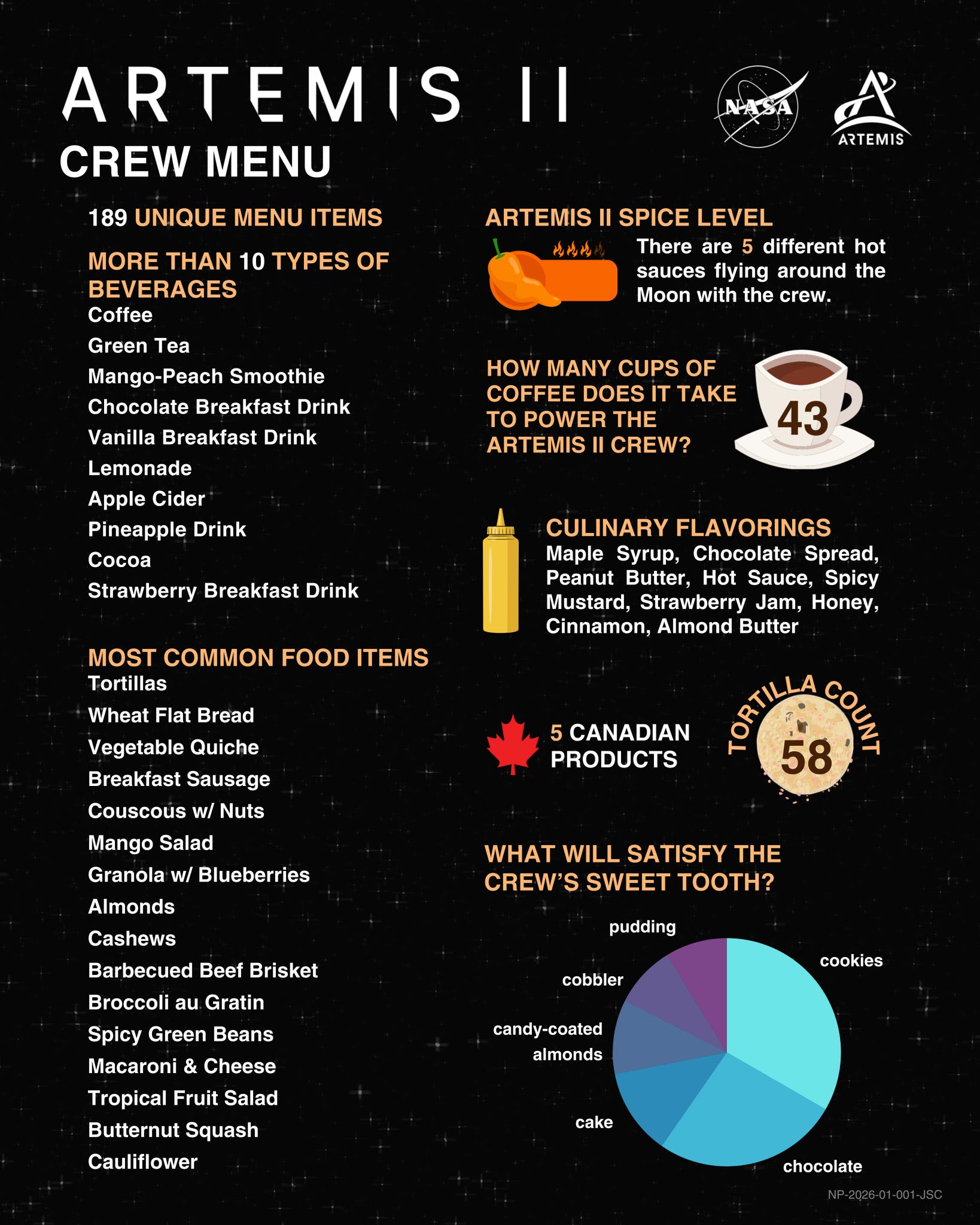
The result was a menu that’s more ‘elevated camping trip’ than ‘hospital dinner tray’: teriyaki beef, chicken fajitas, mac and cheese, shrimp and grits, jambalaya, and BBQ beef. Breakfasts featured oatmeal, granola bars and 43 packs of rehydratable coffee (clearly they had their priorities in order!). Dessert included cookies, peanut butter and cake.
And – a detail that I love – 58 tortillas. Because tortillas don’t produce crumbs. Bread, as the Gemini 3 crew discovered when a smuggled corned beef sandwich prompted an official political inquiry back on Earth, absolutely does.
Keeping it safe (as well as satisfying)
If food is weird in space, food safety is even weirder.
Floating particulates – crumbs, droplets, anything airborne – can damage avionics or end up being inhaled and damaging an astronaut’s lungs. Every design decision, from portion size to packaging geometry, needs to account for this.
And microgravity doesn’t just dictate the physics of food; it also influences how food is perceived, by changing the sense organs of astronauts. In microgravity, bodily fluids that normally pool in a person’s legs shift up into the head, leaving astronauts with stuffy sinuses and dulling their senses of taste and smell.
To account for this, space food is formulated to have bolder flavours than ‘earth food’.
And of course, the food must be microbiologically safe.
The preservation toolkit for Artemis II food included thermostabilisation (retort processing), irradiation, freeze-drying and foods with naturally low water activity. NASA holds special FDA dispensation to irradiate meat items to commercial sterility.
For non-commercially-sterile items, NASA’s microbial standards are strict: total aerobic counts must not exceed 2×10⁴ CFU/g, with tighter limits for yeasts and moulds (10³ CFU/g) and coliforms or coagulase-positive staphylococci (10² CFU/g), and zero tolerance for Salmonella.
The framework underpinning the flight food safety program is HACCP. The systematic, hazard-prevention thinking that NASA, the US Army Laboratory and the Pillsbury Company developed in the 1960s specifically to feed astronauts was the foundation for HACCP, which has itself become the foundation for all modern food safety systems on earth.
Space food didn’t just benefit from food safety science. It played a significant role in creating it.
Artemis II returned safely to Earth on 10 April 2026. No gastrointestinal incidents were reported.
Main sources below. Other sources are linked in the article.
Lee JA, Brecht JK, Castro-Wallace S, Donovan FM, Hogan, JA, Liu T, Massa GD, Parra MP, Sargent, SA, Settles AM, Singh NK & Justiniano YV (2021) ‘Microbial food safety in space production systems’, NASA White Paper.
Cooper M, Douglas G & Perchonok M (2011) ‘Developing the NASA Food System for Long-Duration Missions’, Journal of Food Science, 76: R40-R48.
Johnson Space Center Office of Communications (2026) ‘Artemis II: What’s on the Menu?’, NASA, 3 March.
Perchonok M, Douglas G & Cooper M (2012) ‘Evidence Report: Risk of Performance Decrement and Crew Illness Due to an Inadequate Food System’, NASA.
Uri J (2020) ‘Food on the International Space Station’, NASA, 14 August.
Below for paying subscribers: Food fraud news, research, emerging risks and incident reports
📌 Food Fraud News 📌
In this week’s food fraud news:
📌 Learn: analytical testing for non-analysts
📌 Good news for US honey (or is it?)
📌 Sexual chocolate
📌 Warnings for saffron, incidents with horsemeat, goosemeat, protein supplements and more
Food analysis for non-analysts (free on-demand webinar)
This webinar is certainly worth a watch. I shared a link to it in a food safety news roundup last year, but sharing again here in case you missed it.
Presented by the (UK) Institute of Food Science and Technology (IFST) and the Food Authenticity Network (FAN), the 80-minute webinar:
explains the basic principles behind common food analytical tests.
provides a practical guide for food workers who need to commission analytical work
features experts from leading laboratories discussing innovations in analysis and their practical applications.
Click below to watch: