

This is The Rotten Apple, an inside view on food fraud and food safety for professionals, policy-makers and purveyors. Subscribe for insights, latest news and emerging trends straight to your inbox each Monday.
Laboratory verification challenges
Foods of Iceland
Food Safety News and Resources
The child slave who changed vanilla cultivation forever
Food fraud news, emerging issues and recent incidents
Halló, Góðan dag,
This week I’m joining you from the marvellous shores of Northern Iceland, where the people are gracious and caring, every bend in the road reveals another epic vista, and every small settlement contains a fresh moment of delight.
We begin this week with a follow-up from last week’s special supplement, discussing the challenges of verifying laboratory reports, followed by a dip into Icelandic foods.
When collating the food safety roundup, I was surprised to see new notifications for cereulide toxin in infant formula, dated 1st of May and affecting products made in, and distributed to Poland, Ireland, Malta and Turkiye. Not sure if this is related to the original problems, which became public in December 2025, or not.
We finish up with a fascinating peek into vanilla production, courtesy of flavourist Michael of Nota Bene, followed by food fraud news, which this week contains a warning for whey protein.
Takk fyrir,
Karen
Lab verification challenges
In last week’s special supplement, where I shared my red flag review method (+ checklist), I suggested that certificates of analysis (CoA) and laboratory reports for high-fraud-risk foods and new suppliers should be verified by checking their contents with the issuing laboratory.
But what if the lab won’t cooperate?
During the week, I heard from Christine, a reader who works for a honey company in the United States. Christine told me that a laboratory she contacted for verification refused to assist. Specifically, laboratory staff would not tell Christine if the result sheet was genuine or not without getting permission from the original company first.
Is this a red flag in itself?
Maybe. Perhaps the lab suspects their customer is not being honest and doesn’t want to get them into trouble? More likely, the laboratory staff don’t want to waste time and effort checking reports over the phone.
What to do in this situation?
Unfortunately, for labs that don’t have a ‘do it yourself’ verification process, such as an online portal, we are forced to rely on their assistance.
Christine suggests that permission to check CoAs and other test results with the issuing laboratory should be written into supplier contracts, and that’s an excellent idea. Another option is to require suppliers to use laboratories with self-service verification checks such as QR codes or online portals.
Key takeaway
Consider updating supplier agreements to include permission to verify analytical test results with the issuing laboratory in order to avoid potential problems with laboratory confidentiality.
Foods of Iceland
Iceland’s food culture is built on fermentation, smoking, drying and salting — four of the oldest food preservation techniques known to humans. The food tells a story of a proudly unique nation shaped by isolation, a harsh climate and a strong connection to the natural environment.
Three of the best examples of Icelandic food are hákarl, the fermented shark that has become Iceland’s most notorious delicacy; Kjötsúpa, a comforting lamb stew; and skyr, a creamy yoghurt-like dairy product that has been a staple of Icelandic cuisine for centuries.
Together, they give a snapshot of Icelandic food culture: inventive, resilient and timeless.
Hákarl: Iceland’s best-known dish
Hákarl is made from the fermented meat of the Greenland shark. Shark meat is widely consumed around the world, so there’s nothing too surprising there.
What is interesting, however, is that fresh Greenland shark flesh is actually toxic to humans as it’s high in trimethylamine oxide and urea.
Early Icelandic settlers, confronting long winters and limited food sources, developed a fermentation technique that both neutralised the toxins and produced a protein source stable enough to store throughout the year.
The fermentation process involves beheading and gutting the shark, and removing all internal organs, before cutting it into large sections and burying it in gravelly sand for several weeks. During the burial, fluids containing the toxic chemicals drain away. The meat is then hung in open-air sheds for several months to dry.
While hákarl is considered to be one of Iceland’s national dishes, it’s not a daily staple and usually only eaten at the mid-winter festival of Þorrablót or when showing it to guests.
It’s served in tiny cubes and chased with a shot of Brennivín, Iceland’s signature caraway‑flavoured schnapps, sometimes nicknamed “Black Death.”
I have not yet had the honour of tasting hákarl. However, I’ve read the aroma is noxious and ammonia-ish, the texture is rubbery and the flavour is a gag-inducing mix of pungent cheese and strong fish.
Kjötsúpa and rugbraud: lamb soup and rye bread
Kjötsúpa is a traditional soup made from lamb simmered with hearty root vegetables like potatoes, carrots, and rutabaga (swede), often with cabbage and a handful of grains such as rice, oats, or barley. Unlike hákarl, which is eaten for special occasions, kjötsúpa is a household staple.
In Iceland, lamb is the primary terrestrial protein, and Icelanders are (rightly) proud of their delicious grass-fed lamb. As with soups and stews the world over, kjötsúpa is a way of transforming tougher cuts of meat into a hearty, warming meal.
Icelanders have a unique way of raising their sheep. The sheep are kept indoors during winter but allowed to roam freely across the countryside through summer, going wherever they please, and venturing far into the hilly countryside, which is largely unfenced.
At the end of summer, Icelanders meet for réttir, an annual round-up where people on foot, horseback, and all-terrain vehicles bring the flocks down and sort them by farm using ear markings.
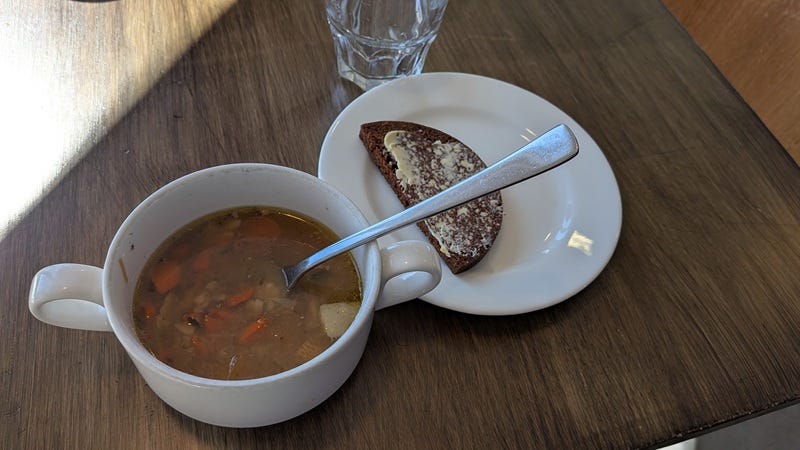
Kjötsúpa appears on the menus of casual lunch spots and traditional restaurants, and I enjoyed a bowlful yesterday, accompanied by the delicious Icelandic rye bread, rugbraud, which is very dark and has a distinctly sweet, malty flavour. Delicious!
Rugbraud is traditionally baked underground using geothermal energy. Dough is placed in a pot or an empty milk carton and buried directly into the hot ground near natural hot spots to bake slowly for 12 to 24 hours. The slow cook time means almost no crust develops, and it’s less chewy than rye breads from other countries.
Skyr: delicious dairy staple
Skyr is a cultured dairy product that has been a staple of Icelandic cuisine since the time the island was settled (874 AD to 930 AD), and is mentioned in the Icelandic sagas, the famous tales of Iceland’s early era. It is eaten much like yoghurt, but technically closer to a fresh cheese.
Skyr is made from skimmed cow’s milk that is cultured and then strained, giving it a very thick, creamy texture and a mildly sour flavour with a hint of sweetness.
Historically, skyr was made as a sour‑milk cheese: milk was acidified, rennet was added to form a curd, the curd was cut, and the whey was drained, then the curd was eaten soft.
Modern skyr production includes a yoghurt-type fermentation with thermophilic, Lactobacillus–Streptococcus cultures, but still includes a step where the whey is strained off. The straining concentrates the proteins and nutrients, and it takes several times more milk to make a cup of skyr than to make regular yoghurt.
Compared with Greek yoghurt, skyr is thicker and smoother, with a milder sour flavour. I’ve had it for breakfast with fruit, as a flavoured dairy drink and as a dessert. Delicious!
Other Icelandic foods I’m keen to try include plokkfiskur, a traditional fish stew made with haddock or cod and pylsur, the Icelandic hot dog, made with Icelandic lamb and often topped with both fried and crispy dried onion.
Food Safety News and Resources
In this week’s food safety news roundup: two unusual recalls, more cereulide in infant formula (?!), a scary emerging pathogen with two sets of toxin genes, plus more.
Click the preview below to read.
Food Safety News and Resources | May

17 May | Food Safety News and Free Resources |
An emerging pathogen, unusual recalls, follow-up of a food defence incident + more
The child slave who changed vanilla cultivation forever
Vanilla, the ‘Queen of Spices’, is a fascinating foodstuff extracted from the seed pods of rare climbing orchids.
You probably already knew that vanilla orchid flowers (Vanilla planifolia) have to be painstakingly pollinated by hand in order to produce vanilla beans.
But, like me, you may have struggled to understand why the orchid needed hand pollination and how we figured this out.
The story below explains all. Click the link to read.
Below for paying subscribers: Food fraud news, horizon scanning and incident reports
📌 Food Fraud News 📌
In this week’s food fraud news:
📌 Fishy questions in the UK
📌 Sexy honey (again!)
📌 Warnings for whey, palm oil, apples, stone fruits and more
📌 Method for fast origin authentication of green coffee beans
Fishy questions in the United Kingdom
British media outlets report that consumers and some fish and chip shop owners are furious about so-called fraud in “traditional fish and chips”. They say traditional versions of the battered, deep-fried fish in fish and chips should be made with haddock or cod, but some outlets are making the dish with “catfish” - pangasius, a farmed freshwater fish from Asia. It is unclear whether