
241 | Lab confidentiality and verification - a thorny issue |
Plus, the science of airline food, highlights from the food fraud conference and winners of the potato salad challenge

This is The Rotten Apple, an inside view on food fraud and food safety for professionals, policy-makers and purveyors. Subscribe for insights, latest news and emerging trends straight to your inbox each Monday.
Lab confidentiality - a thorny issue
Highlights from the food fraud conference
The science of airline food
Potato Salad Competition: answers and winners
Food fraud news, horizon scanning and incident reports
Hi lovely readers,
If you’re new here, thank you for joining me. A special thank you 👏👏 to David from the UK, Mere from Australia, Doris from Germany and Quality from Austria for becoming paid subscribers👏👏. Your financial support makes this publication possible.
The biggest shoutout goes to ✨🌟 John ✨🌟, who works with whistleblowers in New York and is our newest super-supporter (a Good Apple). John’s subscription pays for scholarships for students, academics and readers from developing countries. If you want one, get in touch by replying to this email.
Welcome to Issue 241 of The Rotten Apple, which goes out shortly before I begin my long journey home to Australia from Ireland, where I attended the inaugural Food Authenticity Conference.
What will I be eating during my 41-hour journey home? A lot of airline and airport food… Which inspired this week’s article about the science of airline food.
Also this week, I discuss the thorny issue of laboratory confidentiality, beginning with an apology about my comments in Issue 239.
Plus, the winners of last week’s potato salad safety competition and highlights from the conference.
Thanks for being here,
Karen
P.S. Love this newsletter? Please tell your friends and colleagues about it, and help grow our global community.
Lab confidentiality - a thorny issue
Food fraud prevention experts always tell food businesses to verify results in certificates of analysis and laboratory reports/certificates for materials vulnerable to food fraud.
How exactly do you do this? Experts (including me!) are vague about the exact method.
Earlier this month, I shared my 7-step ‘Red Flag Review’ process, which describes red flags for pre-screening new suppliers, commercial red flags, documentation red flags, site audit red flags and more, plus how to prioritise red flags, whether to action, escalate or disengage and trigger points for reassessment.
In response, a reader, Christine, from a US-based honey company, wrote to tell me about her experience with a lab that refused to confirm or deny the contents of a ‘results sheet’ when questioned.
Turns out the issue is quite contentious. After I published a note about Christine’s experience in Issue 239, I heard from another reader, who works at a large and well-known laboratory, who told me that my coverage was unfair on labs, explaining that “staff regularly go the extra mile to be helpful, even when the enquiry isn’t from someone likely to spend anything on testing” and reminding me that confidentiality agreements prevent lab workers from sharing results with third parties.
I am sorry. I absolutely didn’t intend to imply that laboratories are ‘covering up’ for deceptive customers or that their employees are unhelpful. I tread a very fine line with some of the things I publish and this time I landed on the wrong side of the line. Sorry.
Where to from here? I discussed this issue with a number of food fraud and analytical experts at the conference last week, hoping to discover better options regarding checks and balances for verifying lab reports.
The good news is that in some countries, including the United Kingdom, it is possible to have law enforcement agencies verify results with the lab. This is because IAF1-member accreditation bodies such as UKAS, ANSI and JASANZ require accredited labs to share data with enforcement agencies on request.
If your business is in the United Kingdom, you can contact the National Food Crime Unit and ask them to check on suspicious results for you.
Unfortunately, if a lighter verification approach is needed, we didn’t come up with any new answers at the conference, beyond what I suggested previously (update supplier agreements to include permission to verify analytical test results with the issuing laboratory to avoid confidentiality issues).
If anyone has any better suggestions, please let me know by replying to this (or any) email. And thank you for those of you who take the time to write in; it means so much when people reach out to me personally - even if it’s to tell me I’ve crossed the line.
Highlights from the Food Authenticity Conference
Last week I had the pleasure of attending the first ever EFF-CoP Food Authenticity conference. It was a fantastic event. EFF-CoP is the European Food Fraud Community of Practice, an EU-funded project within the Horizon Europe research and innovation program.
In future issues, I’ll share some of the insights I learned. For now, here are my top four highlights.
Meeting my readers. A number of The Rotten Apple readers sought me out to say “hi”, including Ben, Sophie, Hans, and Dauphine. Special mentions to my ‘Dirty Money’ game buddies Pauline and Corrine.
Meeting my heroes. Many of the biggest names in food fraud prevention and research were in attendance, and I feel priveleged to have met Prof. Chris Elliott (known for leading the UK horsemeat scandal review), Prof. Saskia van Ruth (Wageningen University & Research, a leading expert in food authenticity), Ghislain Maréchal (a key figure in the EU Food Fraud Network), Selvarani Elahi (of the Food Authenticity Network), Annemieke Pustjens (Wageningen Food Safety Research, specialising in food authenticity and analytical detection methods), Karen Gussow (food fraud investigator) and Quincy Lissaur (SSAFE).
‘Forced’ bonding events 😀. The conference included a range of active participation events, including a treasure hunt, an escape room, a specially devised ‘Dirty Money’ game and an astonishing percussion session where groups of participants stomped, clapped and slapped rhythms corresponding to spectographic peaks for cinnamon and paprika. Lots of fun.
Insights and stories, including a fascinating peek into why clenbuterol became a staple of unethical meat growers in the 80s and 90s, an exploration of “the cheating brain” by a neuroscientist and presentations from fraud experts from the financial and non-profit/charity sectors.


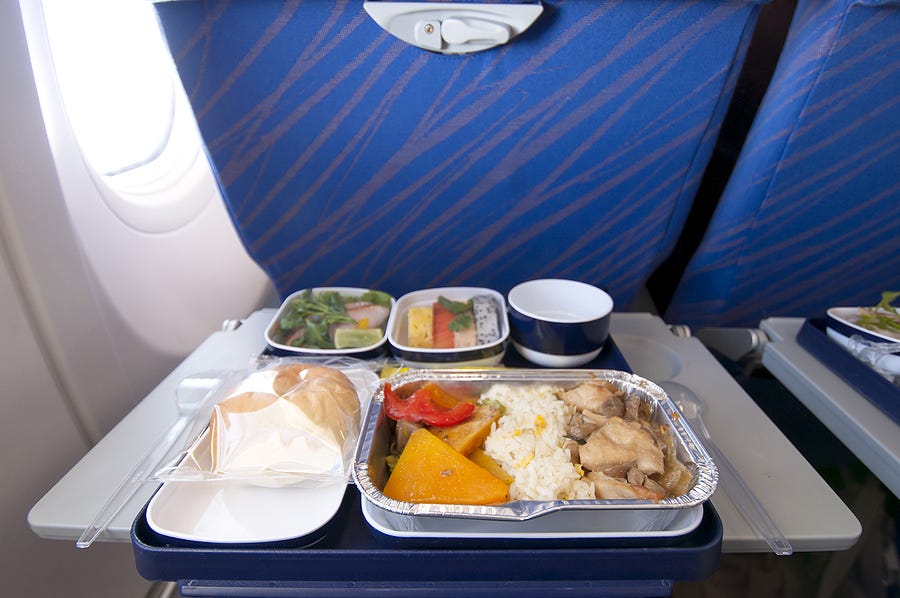
Eating in the sky – the science of airline food
I’m one of those weird people who likes aeroplane meals. I get a curious thrill when the food trolley approaches and trays are handed out - excited to find out what (exactly) is under the cover.
But I know I’m a rarity: for most people, eating at 35,000 feet is a joyless experience.
Low cabin pressure, exceedingly dry air and the engine noise in the cabin all combine to numb our taste buds and make everything seem a bit bleh.
Let’s unpack the science of why flying delivers such a dull dining experience.
Your senses under siege
When we are at cruising altitude, cabin pressure can be as low as 75 kPa, or just 74% of ordinary air pressure at sea level. That’s around the level we’d experience on a mountain at around 8,000 feet. Lower pressure means fewer air molecules in the cabin, and this inhibits the ability of odour molecules to leave the food and enter the air in our nasal cavity.
When fewer odour molecules connect with our olfactory system, that diminishes our perception of aromas and flavours.
Reminder: Around 80 per cent of flavour perception comes from retronasal olfaction – aromas travelling from the back of your mouth up to your nasal receptors as you chew.
Dry cabin air can also dehydrate our sensory organs. The low cabin humidity of around 10 to 15 per cent (significantly lower than the average humidity found in many arid regions) prevents the solubilisation of odour molecules onto the mucosal layer at the back of the throat. This further reduces our sensitivity to flavour.
A series of experiments undertaken by Lufthansa in 2010 found that at cruising altitudes, the perception of saltiness drops by 20 to 30 per cent, while the perception of sweetness falls by 15 to 20 per cent. This is why a dish that tastes perfectly seasoned on the ground feels under-salted once you are in the air.
Surprisingly, however, sour, bitter and spicy flavours remain largely unaffected.
The role of sound, space and psychology
Perhaps a less obvious contributor to the flavourless dining experience while aboard is aircraft noise. The hum of the engines, air conditioning system, passenger conversations, even the toilets flushing, all impact our overall experience.
While researchers aren’t clear on why background noise compromises our sense of taste and smell, one suggestion is that it’s related to our sensory processing or cross-modal perception.
Cross-modal perception is the brain’s integration of inputs from multiple senses – sight, sound, smell, touch – into a form that other parts of the brain can more easily understand. The senses of taste and sound are closely linked, such that louder noises tend to suppress most taste perceptions. Interestingly, however, the perception of umami, or savoury taste, is actually enhanced by noise.
Aside: Tomato juice and Bloody Mary cocktails (tomato juice plus vodka, lemon juice, pepper, worcestershire sauce and Tabasco sauce) have always been my go-to drinks when flying, despite never drinking them at any other time. Perhaps this is because umami and spicy tastes are better at altitude than other tastes.
The unfamiliar environment of the aircraft cabin also impacts people’s psychological perception. The cramped seating, artificial lighting, vibration, plastic cutlery and the likely mismatch between our body clock and the airline’s mealtime all contribute to a poor impression of the food, no matter how good it actually is.
Of course, expectations play a role here too – most of us board already primed to hate airline food, which amplifies every perceived ‘flaw’ through confirmation bias.
Making dishes flight-ready
Delivering a menu that’s pleasing to the airborne palate is not an easy job.
Airlines attempt to punch through passengers’ diminished senses by upping the salt and spices. Most in-flight meals are seasoned with around 20 per cent more salt and sugar than a similar restaurant dish on the ground. Get the balance wrong, however, and passengers can be left with dishes that are overly salty or taste artificially flavoured.
Because of this, many airlines prioritise ingredients that are naturally high in glutamates, such as parmesan, shellfish and spinach, which can provide a depth of flavour without relying on sodium.
While Lufthansa found that seasoning oils can improve the aroma of dishes and tomato essences can provide a more harmonious taste experience, they conceded that the results are very subjective. No two passengers experience airline food in the same way.
How to keep your taste buds zinging when you fly
Spicy and umami-rich flavours hold up well at altitude, so if you have a choice, choose Asian cuisine or dishes that lean into bold ingredients like mushrooms, tomatoes, soy sauce or parmesan.
When it comes to drinks, the reduced air pressure alters how we perceive acidity and tannins, so be prepared that your favourite red wine on the ground might not stack up well in flight. The exception is sparkling wine – its effervescence is magnified in the dry cabin environment.
For non-alcoholic beverages, experts say tomato juice, with its naturally high levels of glutamate, is the perfect choice.
Agreed!
Main source: Cosmos (2022) ‘The science behind inflight food’, Cosmos, 21 October 2022. Other sources are linked inline.
Potato Salad Competition | Answers and Winners
Thank you to everyone who entered the competition.
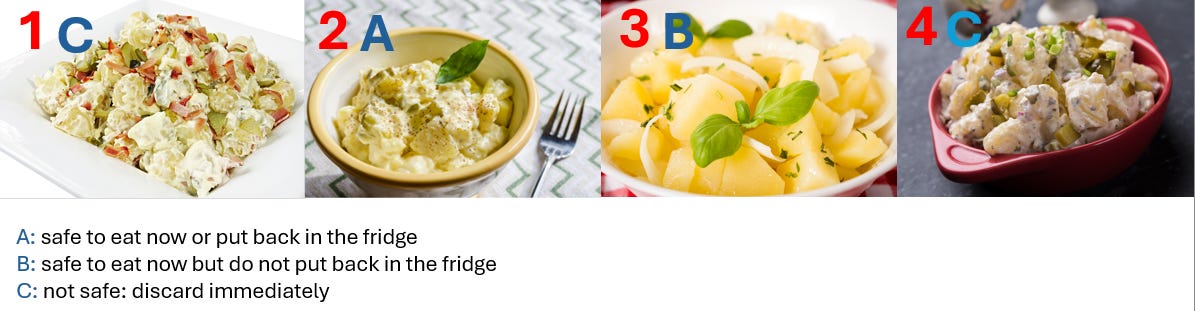
The answers are: Salad 1: C | Salad 2: A | Salad 3: B | Salad 4: C
The winners
Three winners have been randomly chosen from correct entries and will receive a food safety champion mug.

The winners are: Nery, Trevor and Anson. Congratulations! I’ll write to each of you individually about your prize.
Congratulations to everyone who entered; almost 70% of you submitted answers that agreed with mine, and based on the two-hour-four-hour rule (also acknowledging that there are no 100% black-and-white answers in microbial ecology).
Explanations
Find the questions and scenarios in Issue 240.
Salad 1 was prepared and handled correctly until it arrived at the consumer’s home. Once at the home, it was left on the table from 10:30 am until the decision time of 3:00 pm, a period of 4.5 hours. According to the two-hour-four-hour rule, the salad has been in the temperature danger zone for too long and must be discarded; it should not be placed back in the refrigerator, and it should not be eaten.
Salad 2 was prepared and handled correctly with prompt cooling and refrigerated storage between preparation and serving. It was placed on the table at 1:30 pm, 1.5 hours prior to the decision time of 3:00 pm. According to the two-hour-four-hour rule, the salad has been in the temperature danger zone for less than 2 hours, so it can be placed back in the refrigerator or eaten now.
Salad 3 was placed on the counter immediately after preparation at 11:30 am, 3.5 hours prior to the decision time of 3:00 pm. According to the two-hour-four-hour rule, the salad has been in the temperature danger zone for less than 4 hours, so it can safely be eaten now but must not be placed back in the refrigerator (or sold as a takaway/take-home dish), and it must be discarded after 4 hours have elapsed.
Salad 4 was not prepared safely, with slow cooling of the potatoes. In addition, it was left on the bench for 2 hours before being taken to the picnic, and was left on the picnic table for 3 hours before the decision time of 3:00 pm. According to the two-hour-four-hour rule, the salad has been in the temperature danger zone for more than 4 hours, so it must be discarded.
Thank you to everyone who entered
I got great feedback about this competition, and I am so glad you enjoyed it. I certainly had fun making it.
Below for paying subscribers: Food fraud news, horizon scanning and incident reports
📌 Food Fraud News 📌
In this week’s food fraud news:
📌 Research: drivers of lead adulteration in turmeric
📌 Warning for organic foods
📌 Whole fennel seeds adulterated
📌 Incidents with mangoes, beef, octopus and more