
243 | What is PAS 96 and why is everyone so excited about the latest version? |
Plus, massive seizures + massive settlement: counterfeiting case study

This is The Rotten Apple, an inside view on food fraud and food safety for professionals, policy-makers and purveyors. Subscribe for insights, latest news and emerging trends straight to your inbox each Monday.
Case study: high-energy diversions and millions of counterfeit products land criminals in jail
PAS 96:2026 unpacked for you
Food safety news
Illegal pineapples
Food fraud news, emerging issues and recent incidents
Hello, lovely readers,
Welcome to everyone who signed up recently. And a special shoutout to 👏👏Sundeep from the USA, Sam the chocolate expert from the UK, RA from Canada, Malika the seafood expert from Canada, Adam and DH 👏👏. Your subscriptions help keep this publication independent and ad-free. Thank you.
In this week’s issue: the most ‘official’, government-endorsed food defence guidance in the (non-US, English-speaking) world has just been updated. It’s PAS 96 and food safety thought leaders are frothing about it.
I explore what it is, why everyone’s so excited about the new version, and help you decide if the updates actually change anything for you.
Also this week: another fascinating story in our series of food fraud case studies, and pink pineapples plus food fraud news for paying subscribers.
Enjoy!
P.S. Subscription fees increase on 30 June. Current subscribers are unaffected and will retain access to the current price. Upgrade today to lock in the existing price forever!
Case study: The first U.S. criminal prosecution for counterfeit food
5-Hour Energy
It took more than four years, but the beverage brand 5-Hour Energy, victim of a massive, multi-year counterfeiting operation, finally got justice, winning $20 million in civil action against more than 70 defendants and seeing the counterfeiters convicted and given jail terms in a criminal case that was the first prosecution of its kind in the United States.
So what did the counterfeiting operation look like and how was it successfully prosecuted?
This case study examines a food fraud operation that snowballed into a complex counterfeiting operation crossing international borders.
Reminder: Counterfeiting occurs when unauthorised producers create and market copies of products without the knowledge or permission of the brand owner.
The frauds
The story begins in 2011, with 5-Hour Energy dominating the new category of ‘energy shots’ - beverages containing functional ingredients, sold in small packages and marketed as a fast, no‑sugar pick‑me‑up for office workers, drivers and older adults who wanted alertness without drinking a full energy drink.
At the time, U.S. energy‑shot sales were around $1 billion, with 5‑Hour Energy holding roughly 90% of market share, with its competitors scrambling to keep up.
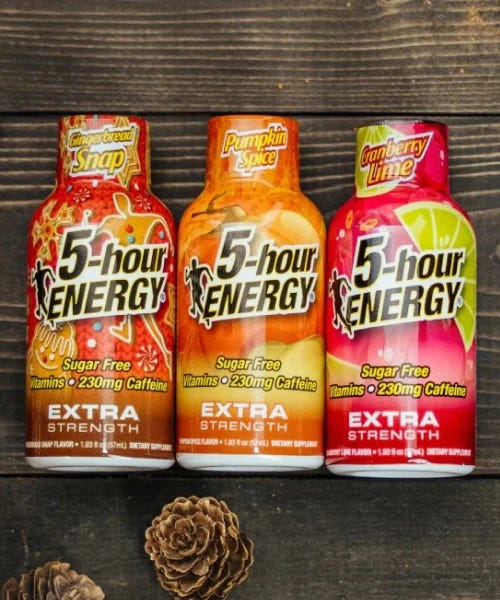
The makers of 5-Hour Energy, Living Essentials, manufactured the products in Wabash, Indiana and sold them directly to retail outlets and through independent brokers across the U.S.
For the Mexican market, Living Essentials had partnered with Baja Exporting LLC, selling Spanish-language labelled versions of 5-Hour Energy to Baja Exporting LLC at a significantly lower price than the one paid by distributors in the U.S.
In 2011, contrary to their agreement with Living Essentials, the owners of Baja Exporting began selling 5-Hour Energy intended for Mexico into markets in the United States.
They also began swapping the Spanish-language labels on the genuine Mexican product for unauthorised English-language labels, ultimately selling more than 350,000 bottles during this stage of their unlawful operation.
So to begin with, the product they were selling was genuine 5-Hour Energy, but the labels were unauthorised copies of genuine English-language labels. And the distribution area was not authorised by the brand owner.
The counterfeit activity did not stop there, however.
When their stocks of legitimate product ran out, the owners of Baja Exporting and their associates began producing completely fake versions of the product, sourcing counterfeit display boxes, bottles and caps and filling them with beverages that had been brewed, labelled and packaged in California at a rate of 75,000 bottles per day.
The counterfeiters even changed the lot codes and expiry dates on the counterfeit products to match codes found on authentic products.
Detection
In 2012, one of Living Essentials’ U.S. sales agents noticed that a retail outlet that had previously been a major purchaser of 5-Hour Energy was continuing to stock the product despite no longer ordering it from them.
An initial review by the company revealed the caps on this mystery stock did not have the distinctive raised ‘pimple’ found on authentic 5-Hour Energy caps. The logo on the caps was also slightly different.
Subsequent inspections by private investigators working for Living Essentials ultimately resulted in the seizing of more than 2.6 million bottles of 5-Hour Energy from the market.
Outcome
In 2012, Living Essentials initiated action against dozens of defendants that were allegedly selling counterfeit versions of their products.
After further investigations into the source of the counterfeits, they filed another action, which included the owners of Baja Exporting LLC and co-conspirators, including the man responsible for supplying the counterfeit packaging.
Meanwhile, the FBI and the FDA Office of Criminal Investigations were also pursuing the counterfeiters, with 11 defendants ultimately facing criminal charges that included conspiracy to traffic in counterfeit goods, conspiracy to commit criminal copyright infringement and conspiracy to introduce misbranded food into interstate commerce.
In 2016, Living Essentials won its civil action against the counterfeiters and their co-conspirators, with the court awarding more than $20 million in damages. The criminal cases ended with multiple convictions and significant prison sentences for key members of the counterfeiting network, with several co‑defendants pleading guilty to related charges.
5‑Hour Energy continues to thrive as a brand. Its packages are equipped with overt and covert anti‑counterfeit elements to assist in the prevention and detection of counterfeiting. Examples of anti-counterfeit features include microtext, invisible inks, unique codes, and subtle design elements that are hard to replicate accurately.
Insights for food professionals
Counterfeiting often affects category leaders, because strong brand recognition makes the counterfeits easier to sell. (Products in wealthy countries are not immune!)
Different types of fraud often coexist within one operation, such as in this case where diversion evolved to counterfeiting.
Trusted supply chain partners such as distributors, exporters and brokers can cause more damage than unconnected criminals because they understand your pricing, packaging, and channel structure well enough to exploit it.
Overt and covert security features on products make imitation more difficult and support authentication, investigations and enforcement.
Sales and traceability data such as lot sizes and shipment information can be used to flag anomalies that could signal diversion and counterfeiting. Red flags include impossible volumes in a region and product appearing in channels without authorised distributors.
Private investigations and civil litigation can effectively complement regulatory enforcement activities. Brand‑led investigations, coordinated with law enforcement, can accelerate seizures, inform indictments, and strengthen the position of civil actions against counterfeiters and unauthorised distributors.
Main Sources (others are hyperlinked inline):
Schnapp, DA & Frankfurther, BA (2016) ‘Counterfeiting in Our Own Backyard’, NYSBA, 34(2):21-23.
U.S. Attorney’s Office, Northern District of California (2017) ‘Counterfeiters Sentenced For Convictions In Nationwide Conspiracy To Distribute Fake 5-Hour Energy Drink’.
Food protection guidance
PAS 96:2026
The most ‘official’ food protection guidance in the non-US English-speaking world has just been updated. Here’s what you need to know.
What is PAS 96 and why is everyone so excited about the updates?
PAS 96 is a guidance document developed by the United Kingdom’s Department for Environment, Food & Rural Affairs (Defra) and Food Standards Agency (FSA) and published by the British Standards Institution (BSI), the UK’s national standards body and a member of the International Organization for Standardization (ISO).
Its stated aim is to “To provide guidance to food business operators to help them identify potential threats and associated vulnerabilities in their operations and supply networks.”
It was first published in 2008, and the previous version was published in 2017.
Is it a food fraud thing or a food defence thing?
It’s both. And more besides.
To quote: “The focus of this PAS is on food protection, encompassing food defence, cyber resilience of information technology (IT) and operational technology (OT) and food authenticity (mitigation of food fraud).”
Is it relevant beyond the United Kingdom?
Yes, the guidance in PAS 96 is applicable to food businesses everywhere.
What’s been updated?
The document has been thoroughly rewritten. It has been modernised to reflect new threats related to cybersecurity, global supply shocks, such as those caused by the COVID pandemic and the Ukraine war, climate change and increased focus on sustainability and ethical governance.
It contains real-life examples of different types of incidents, fictitious case studies demonstrating threat assessment protocols and more practical implementation guidance than previous versions
Is it useful to GFSI-certified businesses?
Yes. And no.
The document conflates food fraud risk assessments and food defence risk assessments, and this is unhelpful for businesses that operate to GFSI benchmarked standards, which require separate programs for food defence and food fraud.
However, the annexes contain comprehensive lists of questions, prompts and mitigation ideas that are well separated and which food businesses of all sizes and certifications will find useful.
How does it compare to other guidance?
PAS 96:2026 has a much broader scope than other guidance documents for food protection. For example, the United States FDA guidance on food defence (Intentional Adulteration Guidance) focuses on adulteration incidents intended to cause large-scale public health harm, while PAS 96 covers espionage, extortion, sabotage and other threats with smaller-scale impacts, as well as ideologically motivated attacks.
The cybercrime-related sections extend beyond impacts on food, food safety systems and food consumers, also addressing threats to business continuity, theft of intellectual property, impacts on financial records and the security of employee information.
It also seeks to encompass vulnerabilities related to:
Climate change-mediated supply disruptions,
Efforts to meet environmental, social governance (ESGs), and
The donation of surplus edible food.
It’s unusual in its approach to combining risk assessments and horizon scanning activities for food fraud and food defence.
Do you need it?
If you’re looking to learn more about food defence or threats from cybercrime or if you are ready to make improvements to your food defence or food fraud prevention programs, you’ll find useful lists of prompts for risk assessments, lists of mitigation measures and a list of intelligence sources in the document.
If you’re seeking to raise awareness about threats to food businesses, Annex B contains descriptions of real events pertaining to many different types of threats, including extortion, espionage, malicious contamination, ideologically motivated adulteration, cyber-enabled disruptions to business, cyber-enabled frauds and food fraud events.
If you want to learn more about cybercrime techniques in a food business context, Annex C contains short descriptions of cybercrime techniques, including DDoS attacks, ransomware attacks, and cyber-enabled fraud. Worth a look.
Where to get it
PAS 96:2026 Food defence – Protection and prevention from deliberate acts (Guide) can be downloaded for free from the BSI website (contact details must be provided first).
Food Safety News and Resources
My food safety news and resources posts have no fluff, no filler, no ads, no junk, just expertly hand-curated food safety news from around the globe.
Click the preview below to read.
Food Safety News and Resources | June

15 June | Food Safety News and Free Resources |
🍄🟫💀Deadly mushroom outbreak (USA)
❓⚠️Mystery withdrawal (United Kingdom)
⚠️Unusual recall: Cat food for low thiamine (USA)
📰 Newspaper wrapper warning (India)
🔎🔬Possible source for infant formula botulism - root cause investigations ongoing (USA)
Patented Pineapples: A “Beautiful Ride”
This video tells the story of how one company got “a beautiful ride” by finding a “once in a lifetime fruit” and explains why a pink pineapple sells for $400 - if you can get it at all.
Below for paying subscribers: Food fraud news and incident reports
In this week’s food fraud news:
📌 Rapid DNA method for seafood speciation
📌 Warning for fresh berries
📌 Two unusual frauds with seafood and veg
📌 Incidents with mangoes, carrots and milk