

This is The Rotten Apple, an inside view on food fraud and food safety for professionals, policy-makers and purveyors. Subscribe for insights, latest news and emerging trends straight to your inbox each Monday.
It was the iceberg lettuce. Oh wait…
Histamine in fish - a quick explainer
Cocoa and cocaine?
A pufferfish puffing
Food fraud news, horizon scanning and recent incidents
Hello, food champions of the world!
And a huge thank you to 👏👏Mel and Andrew👏👏for becoming paid subscribers. Paying subscribers keep the wheels turning for this publication; I couldn’t do it without you.
The big cyclosporiasis outbreak (outbreaks?) continues in the United States, and we finally have some answers. Or we thought we did. As I sat down to write this issue, the news broke that the FDA’s positive iceberg lettuce sample was a false positive. Where does that leave us? Good question…
Also this week, I went searching for answers about a curious food safety alert for cocoa powder and ended up down a drug smuggling rabbit hole. Plus, a quick guide to histamine in fish.
Enjoy,
Karen
Cover image: High-histamine fish, Hong Kong Centre for Food Safety
Cyclosporiasis update:
It was the iceberg. Oh wait…
Has the United States public health system got better at tracebacks?
By the end of last week, it certainly seemed so.
After months of fast-rising case numbers and increasing panic among American consumers, answers had begun to emerge.
On Thursday, the Food and Drug Administration (FDA) created an outbreak page which said there were strong epidemiological links between illnesses and iceberg lettuce served by Taco Bell in five states, and that the FDA’s traceback process had identified a single supplier of iceberg lettuce from Mexico.
That was good.
The first illnesses began on May 13, and by last Thursday, the outbreak was 9 weeks old, so the traceback wasn’t super-swift. However, the fact that traceback was even possible at all is a major improvement compared to U.S. outbreaks linked to fresh produce in past years.
On Friday, a large produce supplier, Taylor Farms, initiated a recall of iceberg lettuce from a supplier in Mexico.
On Saturday, major news outlets reported that the FDA had declared that a sample of shredded iceberg lettuce supplied by Taylor Farms had tested positive for “a parasitic illness that has sickened thousands of people in the U.S.” (USNews.com)
I was surprised by this, because it’s technically difficult, if not near impossible, to positively identify Cyclospora oocysts in food samples, as we learned in Issue 247.
Intriguingly, Taylor Farms said the sample that had tested positive was not from product included in its recall (via CBC Canada).
On Sunday, the FDA backtracked and declared the test result a false positive. Their earlier announcement about finding a Cyclospora-positive iceberg lettuce sample was removed from the official FDA outbreak page.
There are no confirmed positive sample results, the FDA told CBC Canada on Sunday.
Where are we now?
The FDA is still (July 19) talking about one product from Taylor Farms, using the phrase “product [singular] implicated in this outbreak” and says it is continuing to “collect and analyse product samples”.
The Centers for Disease Control and Prevention (CDC) continues to frame the lettuce-related outbreak as a small part of a larger group of illnesses - just one of many outbreaks.
The total case numbers are impossible to pin down because of overlapping jurisdictions (state and federal) and definitions (probable cases versus confirmed cases). The CDC’s official number of cases in the iceberg-linked outbreak is “more than 1,644” while the state of Michigan’s total number of confirmed cyclosporiasis illnesses (in Michigan) is nearly five times larger, at 5,002.
What consumers are being told
The CDC tells consumers to wash fresh produce “under running water before eating” in one paragraph on its outbreak webpage, followed by “washing alone cannot guarantee Cyclospora removal” in the next. Hmm.
What next?
It’s unlikely that a single field of lettuce, which has a very short shelf life, could be the only source of thousands of illnesses over 9+ weeks. But it’s hard to theorise about a root cause when we know so little about infective doses and oocyst survival in the environment.
A 2020 outbreak was tentatively linked to Cyclospora found in an irrigation canal, but a definitive root cause could not be established for that outbreak (read more about that here).
Remember, Cyclospora cayetanensis’ only known reservoir is humans, and immediate human-to-human transmission is unlikely because oocysts shed in faeces are not immediately infectious – the oocysts must sporulate in the environment first.
This means that human faeces, or water contaminated with faeces, had to come into contact with a lot of food over a period of many weeks to cause the thousands of illnesses that have already occurred.
Some of that contaminated food may still be out there, and illnesses may continue to appear.
What can we learn from this?
We don’t know what caused these outbreaks yet. But I really hope the authorities in the United States, and/or specialist microbiologists working for Taylor Farms, figure it out - and tell us what they find! Their investigations, if successful, can help us make sure this does not happen again.
When (if) an investigation report or root cause is published, I’ll be sure to share it with you.
Outbreak and recall information:
Investigation of 5-State Outbreak of Cyclospora Illnesses | FDA
Cyclospora Outbreak Linked to Iceberg Lettuce in 5 States | CDC
Histamine in fish - a quick explainer
What is histamine?
Histamine is an amine – a small nitrogen-containing organic molecule – produced from the amino acid histidine. It exists naturally in healthy organisms, where it functions as a signalling molecule in immune, gastric and neural processes.
Why is histamine a food safety hazard?
When histamine is present at elevated levels in food, it can cause an acute intoxication called scombroid poisoning, with symptoms similar to a severe allergic reaction with a rapid onset of flushing, hives, headache, heart palpitations, nausea, vomiting and diarrhoea, sometimes requiring life-saving interventions.
Histamine becomes elevated in fish products when microorganisms convert the amino acid histidine in the fish flesh into histamine. This can happen before any obvious spoilage occurs, because many histamine‑producing bacteria are part of the natural microflora on the skin, gills and gut of freshly caught fish.
Elevated histamine in fish is usually related to temperature abuse. When fish is stored for too long at warm temperatures, bacteria can convert histidine in the flesh into histamine.
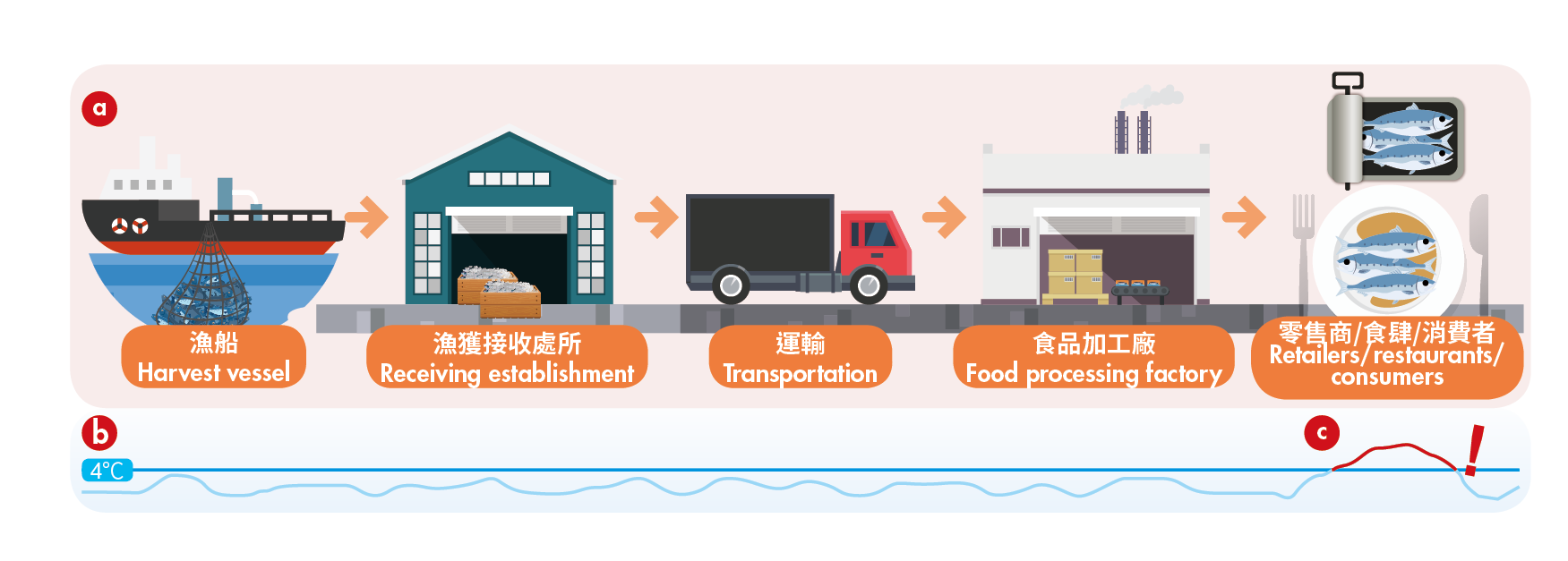
The histidine decarboxylase enzymes responsible for the conversion retain the potential for activity at refrigeration temperatures and can survive freezing, so histamine can accumulate during chilled storage if the cold chain is not properly maintained.
Once formed, histamine is heat‑stable and persists through cooking, canning or smoking.
The species most likely to be affected are those with high levels of naturally occurring histidine, including fish in the Scombridae family such as tuna, mackerel and bonito, as well as anchovies, herrings, sardines and mahi‑mahi (dolphinfish).
Is histamine in fish a microbiological toxin or a chemical hazard?
Histamine in fish is classified as a chemical hazard, even though it is microbiologically produced. In a HACCP plan, you’d list histamine (scombrotoxin) as a chemical hazard arising from improper temperature control.
Learn more:
FAO: Production of biogenic amines
Histamine in Fish and Fish Products | Hong Kong Centre for Food Safety
Cocoa and cocaine?
A suspicious food safety notification has got me curious…
Every week I trawl through dozens of sources, sites, reports and databases to find food safety and food fraud news for you, my dear readers.
And last week I found something a bit weird.
Authorities in Spain flagged the theft of a commercial shipment of cocoa powder in an official food safety alert system.
Stealing shipments of food and ingredients is not unusual. But the notification, which appeared in the European Commission’s Rapid Alert System for Food and Feed (RASFF) is unusual because alerts are usually reserved for events related to food safety hazards, and theft of food is not usually notified.
The RASFF notification is short on details, so I went looking for more information.
But then it got weird. When I searched for stolen cocoa powder (Spain), I found countless stories about the illicit cocaine trade.
And that made me wonder: is there a potential food safety problem with the stolen cocoa powder in the RASFF notification that is somehow related to cocaine?
Here are just a few of the cocoa-cocaine stories I found on page 1 of Google:
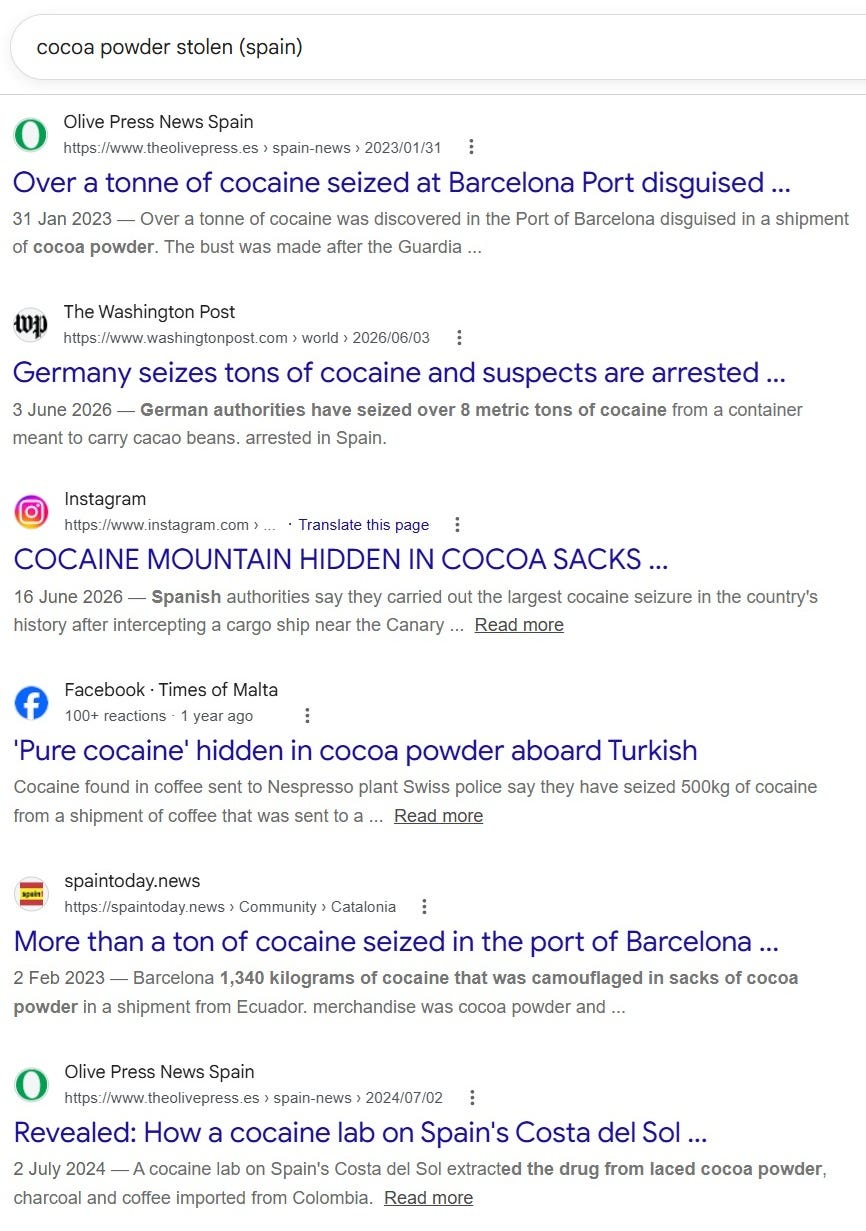
In 2023, more than 1 tonne of cocaine was discovered at a port in Spain in a shipment of cocoa powder from Ecuador (Spain Today).
In 2024, Spanish media reported that criminals were extracting cocaine from laced cocoa powder imported from Colombia (The Olive Press).
In 2025, Italian authorities found cocaine worth $560 million hidden in cocoa powder in a ship that had travelled from Ecuador via Panama, Colombia and (yes!) Spain (Times of Malta).
In June 2026, 8 metric tonnes of cocaine were seized in Germany from a container meant to carry cocoa beans that was destined for Spain, from West Africa, with two people arrested in Spain (Washington Post).
Does the recent RASFF notification have something to do with this cocoa-cocaine pattern? Perhaps. However, to be clear, I have seen no evidence that it is.
Then again… I often perform online searches for “[commodity name] ‘stolen’ [(country name)]”, and I have never before been served up a list of search results that were exclusively about cocaine smuggling.
Add to that the “whistleblower information” source for the RASFF notification, the timing of the notification, just a few weeks after the large cocaine raid and arrest of two suspects in Spain, and I can’t help but wonder… Perhaps this is somehow related?
It all seems a little suspicious to me…..
Main source:
RASFF Notification: Cocoa powder stolen during transport
Pufferfish puffing
Today’s ‘Just for Fun’ is a short video of a puffer fish, captured by a snorkeller who filmed it as it puffed up like a balloon. The video was published 7 years ago, before AI-generated video became common, so I believe it’s genuine, despite the bizarre-looking thumbnail.
Says the videographer: “It swam away safely right afterwards” 💖
For more on pufferfish, find out what it’s like to eat fugu in Issue 190.
Below for paying subscribers: Food fraud news, horizon scanning and incident reports
In this week’s food fraud news:
📌 Severe shock to food prices predicted
📌 Trends in production for six speciality crops may increase fraud risks
📌 Coffee adulteration detection method
📌 Incidents with chewing gum, fennel seeds, cats (yes, cats!), canned fish, milk and more.