

This is The Rotten Apple, an inside view on food fraud and food safety for professionals, policy-makers and purveyors. Subscribe for insights, latest news and emerging trends straight to your inbox each Monday.
Four Emerging Food Safety Risks
Foodborne virus self-assessment
Food Safety Resources - 2 free webinars
Science meets hotdog (just for fun)
Food fraud horizon scanning reports and recent incidents
Hello,
Welcome to another issue of The Rotten Apple. An extra special huge welcome to 👏👏Sakshi, Merete, ‘Contact’ and Joop👏👏 who upgraded their subscriptions. I’m thrilled to welcome you to our special community of supporters.
In this week’s issue I share the most recent batch of emerging food safety risks, as determined by the European Food Safety Authority, including two we’ve already explored here in this newsletter, and some we haven’t.
Also this week, a 12-question self assessment on foodborne viruses - use it to check your food safety plan is covering these often-overlooked pathogens. Plus: two free food safety webinars and nerds having fun with thermite and hotdogs.
As always, this week’s issue finishes with food fraud updates for paying subscribers. Sad to say it seems I was wrong about olive oil. Earlier this year it looked like olive oil fraud in Europe was decreasing after major enforcement operations across multiple countries and increased availability of olives. But a recent investigation in Italy uncovered “significant irregularities” at many sites, with approximately 16% of 108 operators found non-compliant, and hundreds of tonnes of oil affected by suspected fraud. Disappointing!
Karen
P.S. Got a burning food safety question you need answered? Or an interesting bit of news to share? Reply to this email, or write to me at therottenapple@substack.com and let me know. I love to hear from you.
Four emerging food safety risks
Every year the European Food Safety Authority (EFSA) publishes a report on emerging food safety risks. The report for 2025 is out now. I read it, so you don’t have to.
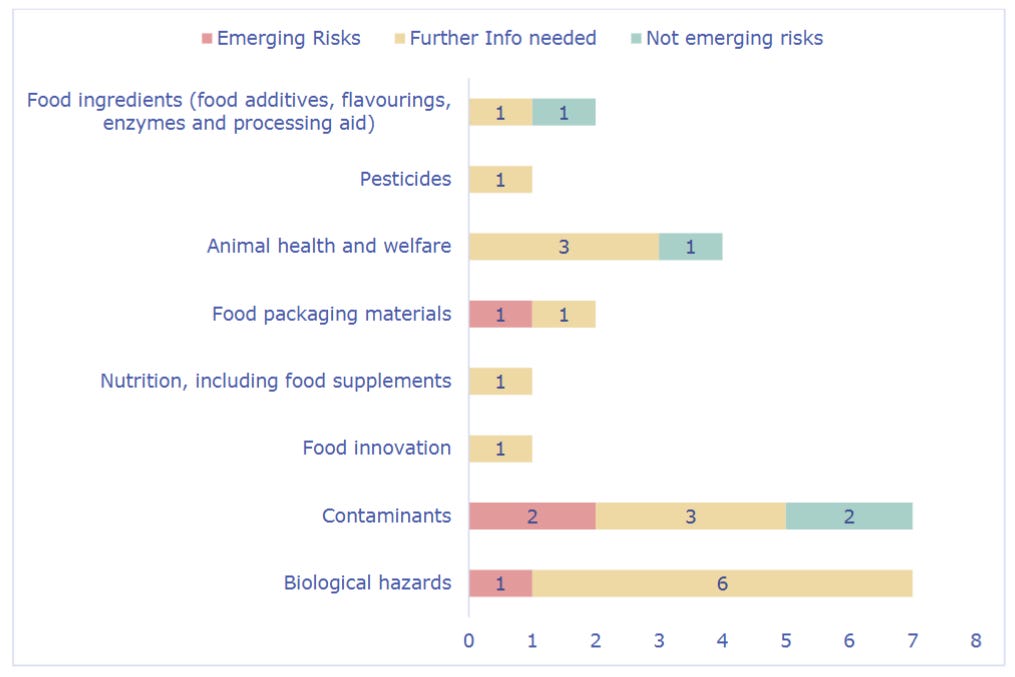
To determine which food safety issues are “emerging risks”, the EFSA considers a range of issues - this year it was 55 in total - and then decides whether they should be classified as emerging, not emerging, or not enough information.
For the 2025 year, the EFSA considered fifty-five issues and classified four as emerging risks. These are listed below. All four were assessed as already-known hazards, with unexpected or increased exposures.
In this article I’ll provide a brief overview of each.
Biological hazard: Antiparasitic drug resistance
Contaminants: Bongkrekic acid in fermented foods
Packaging: Increased use of bio-based and biodegradable materials to manufacture food contact materials
Contaminants: Illicit use of Cafodos as a fish preservative
Emerging risk 1: Antiparasitic drug resistance
This risk refers to the fact that certain parasitic worms which infect food-producing animals (soil-transmitted helminths) are developing multidrug resistance to veterinary antiparasitic medicines, which is causing economic losses in livestock-dependent low-income countries.
Takeaway for food safety professionals: This is an animal health and welfare risk, with no direct impact on food safety.
Emerging risk 2: Bongkrekic acid in fermented foods
This is not a new hazard, but has been flagged because of “warmer conditions” and diagnostic challenges in detecting contamination during home fermentation and in clinical settings.
🍏 Learn more about bongkrekic acid, and the bacterium that produces it in Issue 134 🍏
This risk was included in the EFSA list because there was a fatal case of bongkrekic acid poisoning in North America from homemade fermented corn. The EFSA’s recommendations are that there should be public awareness campaigns about in-home fermentations and clinician training.
Outbreaks caused by bongkrekic acid (a bacterial toxin) have mortality rates of about 50%. That is, half the people who have eaten contaminated foods have died.
Takeaway for food safety professionals: Bongkrekic acid is not a new food safety hazard, and should already be in your HACCP analyses if your foods are susceptible. Rather, this risk was designated “emerging” by the EFSA because of increased/unexpected exposure from in-home fermentations.
Emerging risk 3: Increased use of bio-based and biodegradable materials to manufacture food contact materials
This has been designated an emerging risk because of new and evolving composition formulations and uses for bio-based food contact materials, combined with gaps in systems to prevent exposure from contaminants in such materials.
The key concerns are that bio-based and biodegradable food contact materials could introduce chemical contaminants such as environmental chemicals, pesticide residues, “complex mixtures with uncertain characteristics”, and allergens into foods.
In Issue 216, I unpacked research that showed significant quantities of gluten could migrate from biodegradable servingware into gluten-free food, posing risks to coeliacs and gluten-allergic individuals.

Takeaway for food safety professionals: Bio-based and biodegradable servingware can contain chemical and allergen hazards which pose food safety risks. If these are purchased or used by your organisation, ensure risk assessments address these hazards.
🍏 Read more about this risk: Gluten contamination from wheat-based tableware | Issue 216 🍏
Emerging risk 4: Illicit use of Cafodos as a fish preservative
This risk is related to food fraud.
Cafodos is a trade name for a blend of sodium citrate and hydrogen peroxide that’s used to hide signs of spoilage in fish and cephalopods (squid, octopus). The risk was classified by the EFSA as “emerging” because of a foodborne illness outbreak from anchovies apparently treated with Cafodos.
The food safety risks associated with Cafodos have nothing to do with its chemical composition, which is generally considered harmless, but with its ability to conceal the presence of histamine in spoiled fish.
As we learned in Issue 248, histamine can cause an acute intoxication called scombroid poisoning, with symptoms similar to a severe allergic reaction, sometimes requiring life-saving interventions. Elevated histamine in fish is usually related to temperature abuse. When fish is stored for too long at warm temperatures, bacteria can convert histidine in the flesh into histamine.
The outbreak that inspired Cafodos to be classified as an emerging risk by the EFSA seems to be one that occurred in Italy in 2009 (per EFSA minutes). The EFSA said the outbreak, which was linked to adulterated anchovies, “highlighted detection challenges due to the rapid decomposition of the product [Cafodos]”.
The illicit additive Cafodos has become “famous”, said Italian researchers in 2023, because it is difficult to detect and because it improves the appearance of seafood, especially fish fillets, and increases its ability to retain water, making the seafood appear fresher.
Intriguingly, it seems that Cafodos may have been approved for use in cephalopod processing in Italy in about 2016 (per EU parliamentary questions), though possibly only as a processing aid for the removal of skin, rather than as an additive.
In 2024, I warned about adulteration scams designed to mask spoilage and histamine in tuna that included the use of colour additives such as beet juice concentrate and paprika oleoresin, to artificially enhance the appearance of low-quality tuna loins; ascorbic acid (the resulting product is colloquially known as ‘vitamin tuna’), and a mixture of citric acid, beet juice and carbon monoxide (see The Great Tuna Scam (and what was going on with my salad in New York | Issue 167 for sources). However, this is the first time I have heard of Cafodos through official channels.
To mitigate the risks posed by the use of Cafodos, the EFSA recommends enhanced histamine monitoring and targeted inspections of high-risk seafood supply chains to identify adulterated seafood.
Takeaway for food professionals: the use of Cafodos, or any other spoilage-masking agent in seafood, poses food safety risks because it can hide the warning signs of histamine, which can cause scombroid poisoning. If your company purchases seafood, be aware of this risk and consider histamine testing for at-risk materials.
In short: 🍏 In its 2025 report on emerging risks, the European Food Safety Authority (EFSA) identified four emerging risks from a list of fifty five issues 🍏 The risks are: Antiparasitic drug resistance in soil-transmitted helminths (worms); Bongkrekic acid in (homemade) fermented foods; Increased use of bio-based and biodegradable materials in food contact materials; Illicit use of Cafodos as a fish preservative 🍏 Food safety professionals that purchase or work with bio-based and biodegradable servingware and seafood products should review the chemical and allergen hazards in such products based on these emerging risks 🍏
Source:
Georgiev, M., Chobanov, G., Matas, R.G., Gkrintzali, G., Maggiore, A., das Neves, C.G., Tramontini, S., Verloo, D., Vlachou, A., Elsersawy, N. and Bottex, B. (2026). 2025 EFSA Annual Report Emerging Risks and Horizon Scanning Activities. EFSA Supporting Publications, 23(7). doi:10.2903/sp.efsa.2026.en-10262. Available at: https://efsa.onlinelibrary.wiley.com/doi/epdf/10.2903/sp.efsa.2026.EN-10262
The Foodborne Virus Risk Check: 12 Questions
By Dr. Martin D’Agostino, foodborne virus specialist
How clearly are foodborne viruses considered within your organisation’s food safety arrangements?
Most food businesses have well established controls for bacterial hazards. But viruses can fall somewhere between microbiology, hygiene, supplier assurance, laboratory testing and HACCP.
This Foodborne Virus Risk Check contains 12 questions to help you gauge how clearly your organisation considers foodborne viruses. It is intended to identify areas where foodborne viruses may not yet be receiving the same attention as other food safety hazards.
Proceed through the questions below and select the answer that best reflects your organisation, keeping notes of your scores:
YES, CLEARLY — 0 points
PARTLY — 1 point
NO OR UNSURE — 2 points
Q1. Are foodborne viruses explicitly considered within your food safety or HACCP system? Or are they assumed to be covered by the controls used for foodborne bacteria?
Q2. Do relevant staff understand how viruses differ from bacteria? Viruses cannot multiply in food, but they may remain infectious and can be transmitted in very small quantities.
Q3. Does supplier approval consider virus-associated foods and supply chains? Depending on your operation, these may include berries, fresh produce, shellfish, ready-to-eat foods and raw or undercooked pork products.
Q4. Are potential pre-harvest contamination routes considered? These can include contaminated irrigation water, sewage, flooding, heavy rainfall, harvesting practices and poor worker hygiene.
Q5. Are your sickness reporting and exclusion procedures clear enough? Would managers know what to do if a food handler reported vomiting or diarrhoea, including when it would be appropriate for them to return to work?
Q6. Does your organisation understand that virus shedding may occur without obvious symptoms? An infected person may shed virus before symptoms develop, after recovery or without becoming noticeably ill.
Q7. Have cleaning and disinfection procedures been considered specifically in relation to viruses? Controls effective against bacteria should not automatically be assumed to provide equivalent control of foodborne viruses.
Q8. Do relevant staff understand the limitations of washing and freezing? Washing may reduce contamination but may not eliminate it. Freezing can preserve viruses rather than reliably inactivate them.
Q9. Does your organisation understand the limitations of bacterial indicators? Acceptable results for bacterial indicators do not necessarily demonstrate the absence of viral contamination.
Q10. Does your sampling plan recognise that viral contamination can be unevenly distributed? A negative result from a small or unrepresentative sample may not reflect the wider batch.
Q11. Would your team know how to interpret a positive or negative viral RT-PCR result? Detection of viral RNA does not automatically prove infectivity. Equally, a negative result does not prove that the entire batch is virus-free.
Q12. Is there a response plan for a suspected foodborne virus incident? Would your organisation know who to contact, what information to retain, how to investigate traceability and when specialist laboratory advice may be required?
What your score means
0–5: Good foundations — Foodborne viruses appear to be recognised. Check that each ‘yes’ is supported by effective procedures.
6–12: Some important gaps — Several aspects of foodborne virus awareness may need greater attention.
13–24: A possible virus blind spot — Foodborne virus risks may not yet be fully integrated into your food safety arrangements.
How did your organisation score? Which of the questions made you stop and think?
Dr. D'Agostino is a co-author of the soon-to-be released book An Introduction to Food Virology, available for pre-order now.
Food Safety Resources - 2 free webinars
🎓Webinar - Crisis Management Communication, 28th August
Join IFSQN for a free webinar and learn how to communicate effectively during a crisis—covering key principles, how to align quality, marketing, and leadership teams, and real lessons from recent recalls on what to do (and avoid).
Register here: https://event.webinarjam.com/3qnw0/register/xnk8ls9v
🎓Webinar - Implementing an SQF Code Edition 10 compliant Food Safety Management System, 23rd September
Hosted by Food Safety Essentials, the webinar will provide guidance on SQF Code Edition 10 requirements and how to develop a Food Safety Management System compliant with SQF Code Edition 10.
Register here: https://event.webinarjam.com/3qnw0/register/o4n0zh89
Science meets hotdog (just for fun)
What happens when you bring together science nerds, the incendiary chemical thermite and hot dogs? Some loud bangs, unscheduled flames and a serious burn hazard.
The guys behind this youtube clip invented an instant hotdog machine that uses the exothermic chemical thermite to rapidly heat a frankfurter (hot dog) in a test tube of water.
Why?
“Remember”, the narrator says “We do these things not because they are easy, but because we think they’ll be easy.”
My favourite quote from the video: “Fire extinguisher. Fire extinguisher! Fire extinguisher!!”
Below for paying subscribers: Food fraud news and incident reports
📌 Food Fraud News 📌
In this week’s food fraud news:
📌 One quarter of salmon affected by species substitution
📌 Fresh veg supplies disrupted
📌 Unauthorised residues in farmed shrimp
📌 Methods for saffron and salmon, plus more…