

This is The Rotten Apple, an inside view on food fraud and food safety for professionals, policy-makers and purveyors. Subscribe for insights, latest news and emerging trends straight to your inbox each Monday.
“I told you so” - the wooden pallet problem
More new food safety hazards
Food Safety News and Resources
A bottomless pickle jar
Food fraud news: horizon-scanning and recent incidents
Hello,
Welcome to Issue 253 of The Rotten Apple. I’m Karen, and I spend my days scouring the global food industry for news and information that will help you level up your food supply chain knowledge, do better at your job and become a thought leader in your field (without wasting your time on fluff and filler).
This week, I share a scenario to use in your next food safety toolbox talk to demonstrate that wooden pallets really do create hazards in food that can hurt consumers and lead to expensive recalls. (Try to resist the urge to say “I told you so!”)
Plus, more possible new hazards from the European Food Safety Agency, the return of my monthly Food Safety News Roundup and the inspiring nerdism of a guy who builds a bottomless pickle jar.
Enjoy!
P.S. Huge shoutout to 👏👏J, Bilal, Grace and Technical 👏👏 who upgraded their subscriptions last week; I’m thrilled to have your support in our community of food safety champions.
Cover image: AI-generated representation of physical contaminant in bread
“I told you so” - the wooden pallet case study
Use this in your next food safety toolbox talk
If you’re a food safety manager, consultant or auditor, you’ve probably had many conversations about wooden pallets over the years.
The conversations go a bit like this….
Warehouse manager: “Wooden pallets are fine. We’ve always used them.”
Purchasing manager: “They’re cheaper and easier to source.”
Finance boss: “Why would we spend more on plastic pallets when wooden pallets do the job?”
Production leader: “Don’t worry, if one gets damaged we’ll pull it out of the area straight away.”
This is the familiar stand-off between cost, practicality and food safety. With pallets, the food safety aspects of the argument are a no-brainer.
Wooden pallets present both physical and microbial risks in food production areas: physical risks from splinters, staples and nails; microbial risks because their absorbent nature makes them a cosy harbourage for pathogens like Listeria monocytogenes.
Problem is, it can be hard to convince your colleagues (and clients) that wooden pallets are not just a theoretical hazard, but present real dangers to consumers.
And that’s why a foreign object recall caught my eye last week. It specifically named the contaminant as coming from a pallet.

This is helpful because you can use this recall as evidence that pieces of pallet can (and do!) end up in food ingredients and food equipment, despite the best efforts of operators to check for pallet damage and pallets that are broken or chipped.
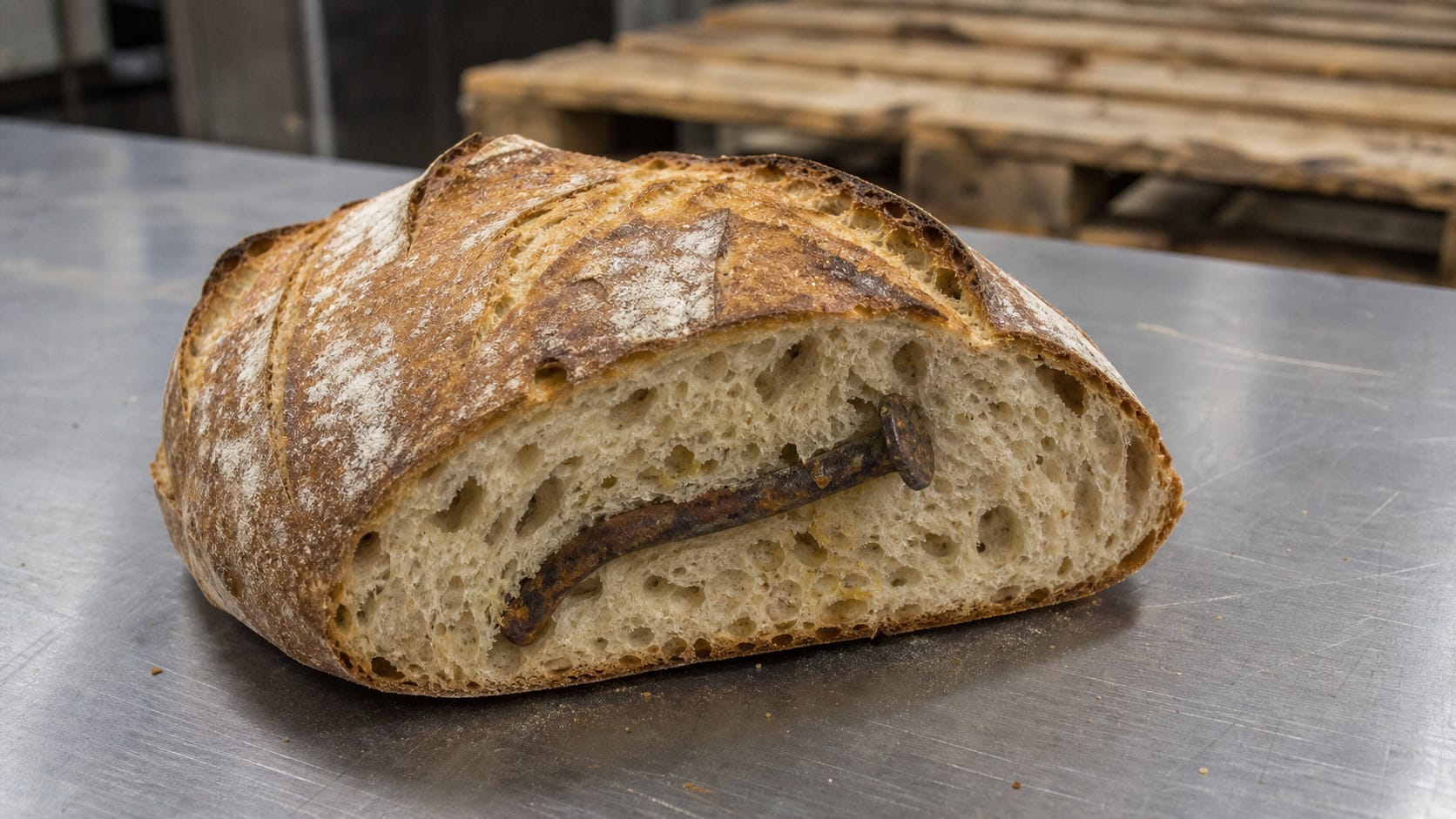
Last week’s incident was due to a pallet nail in a loaf of sourdough (yeeoch!). Examples of wood-related recalls include:
Wood pieces in cans of stew: recall — May 2025
The United States Food Safety Inspection Service (FSIS) announced a recall of about 256,000 lb of Hormel Dinty Moore Beef Stew after three consumer complaints about wood. FSIS | USDA
Pieces of wood embedded in corn dog batter: recall — April 2025
The FSIS announced a recall of approximately 3.84 million lb of Foster Poultry Farms chicken corn dogs because of wood fragments. FSIS | USDA
Wood in cilantro ingredient: public-health alert — April 2025
The FSIS issued an alert for multiple soup and bowl products after an ingredient was recalled for wood contamination. In this case the foreign material was introduced upstream and then spread across multiple finished products. Quality Assurance Mag
Takeaways for food safety professionals
You already know that wooden pallets are a no-no in food handling areas. Use this scenario to demonstrate to your co-workers that pallets can and do create hazards in food that can hurt consumers and lead to expensive recalls. (And try to resist the urge to say “I told you so!”)
FDA Recall Notice: Grand Central Bakery Seattle Recalls Potato Sourdough Bread Due to Possible Foreign Object | FDA
More new food safety hazards?
Last week I shared the four risks deemed “emerging” by the European Food Safety Authority (EFSA) in their annual emerging risks report for 2025.
That was four issues out of the fifty-five they considered.
This week we’ll take a brief look at some of the others.
The EFSA doesn’t classify everything it reviews as an emerging risk. Some issues are classified as “further information needed”, while others are simply deemed “not an emerging risk”.
The items marked as “further information needed” included some interesting risks involving: food ingredients; pesticides; animal health; food packaging materials; nutrition, including some crazy ideas, such as:
edible electronics;
carbon dots (nanoscale carbon particles being explored for use in food packaging and coatings for shelf life extension); and
fish milk (a dairy alternative made from fish).
While these sound intriguing, it is the items in the biological hazards category that are more relevant to your work as a food professional - bacteria like Shewanella spp., Streptococcus suis, antibiotic resistance with probiotics, Klebsiella spp. and risks associated with the use of Bacillus spp. as agricultural biocontrol agents.
I’ve covered some of these organisms in past issues. Some are new to me.
Below I’ll explain each in just one or two sentences. If you want to go deeper, the EFSA report and its bibliography are a good place to start.
A selection of potential new hazards from the EFSA report
Shewanella spp. are aquatic bacteria. Some species are associated with the spoilage of chilled seafood, and some have been linked to human infections, mostly through wound/skin. The EFSA considered issues of antimicrobial resistance in Shewanella, and the impact of global seafood trade and climate change on its global spread, concluding further information is needed.
Streptococcus suis is a pig pathogen that can also cause severe infection in humans. Raw-pork consumption is associated with human infection, with the organism crossing the oral or intestinal mucosa, entering the bloodstream, and causing an invasive systemic infection such as sepsis or meningitis. Such illnesses occur in places where raw pork and raw pig’s blood are eaten, such as Southeast Asia. The EFSA concluded more information is needed about the prevalence in pig populations and human cases in the European context.
Probiotics and antibiotic resistance. The EFSA considered evidence that shows probiotic organisms added to food and feed can carry transferable antimicrobial resistance genes, meaning such organisms could contribute to the spread of antimicrobial resistance. They concluded more information is needed.
Bacillus spp. are used as agricultural biocontrol agents, including on agricultural produce. The EFSA considered the safety of such species in the context of a recent outbreak linked to B. velezensis and a 2012 outbreak linked to B. thuringiensis and discussed whether their use as biocontrol agents could lead to potentially enterotoxigenic residues on agricultural produce. It concluded that since biocontrol agents are authorised at strain level, not species level, more information is needed about strain-specific toxigenicity.
Klebsiella spp. are serious pathogens in healthcare settings and an important contributor to multidrug-resistant infections in people. They have been found in a range of foods, including milk, salads and poultry products. Klebsiella pneumoniae has occasionally been implicated in foodborne illnesses, including serious cases of invasive infection. The EFSA concluded that more information is needed to understand foodborne exposure and antimicrobial resistance.
These were the biological hazards that caught my eye in the EFSA’s Emerging Risks Report. They are not necessarily imminent new foodborne threats. But they are the organisms that scientists are watching closely, and they may pose food safety risks in future, as food systems, climate and antimicrobial resistance patterns continue to change.
For more like this, see: Emerging Food Safety Risks (2025 update),
which includes:
Toxicity of rare earth elements in our food chain,
Nipah and Hendra virus in dates and other fresh foods,
Bacillus cytotoxicus, a thermotolerant bacterium found in potato flakes, potato starch and insect-derived ingredients.
Myth-busting parasites: how small changes create unexpected food safety risks,
about the increasing prevalence of potentially deadly trematode worms (flukes) in freshwater game fish in the US - a story that demonstrates how changing patterns of human behaviour (like eating fish raw) and changing environmental conditions can combine to create unexpected new food safety risks.
Bacillus velezensis – A Foodborne Pathogen You’ve Probably Never Heard Of,
about a Bacillus species which had never previously been associated with human illness being linked to an outbreak of gastrointestinal illnesses among people who ate rope-affected (spoiled) cakes in 2024.
Source:
Georgiev, M., Chobanov, G., Matas, R.G., Gkrintzali, G., Maggiore, A., das Neves, C.G., Tramontini, S., Verloo, D., Vlachou, A., Elsersawy, N. and Bottex, B. (2026). 2025 EFSA Annual Report Emerging Risks and Horizon Scanning Activities. EFSA Supporting Publications, 23(7). doi:10.2903/sp.efsa.2026.en-10262. Available at: https://efsa.onlinelibrary.wiley.com/doi/epdf/10.2903/sp.efsa.2026.EN-10262
Food Safety News and Resources
Our food safety news and resources roundups are carefully selected from around the globe. We select news that is unusual, unexpected or indicative of a new trend.
(Because you don’t need me to tell you there are a gazillion recalls for undeclared allergens every week!)
This week’s news is packed with recalls, outbreaks, warnings and free resources. Click the preview box below to access it.
Food Safety News and Resources | August

24 August | Food Safety News and Free Resources |
Salmonella in Jalapeno – outbreak and recalls (USA)
Cyclospora cases continue (USA)
Mexico warning: A sharp rise in Cyclospora cases among UK travellers returning from Mexico
STEC in ready-to-eat foods (United Kingdom)
A bottomless pickle jar (just for fun)
We all know the importance of ‘first-in-first-out’ in food manufacturing.
The guy in the video below was making pickles using a huge traditional Chinese pickle fermenting jar, which can be topped up with new vegetables while retaining the old pickle juice.
But, as you might imagine, a top-loading pickle jar is hopeless if you want to follow first-in-first-out protocols. So he built a continuous pickle maker, where fresh veg is fed into the top of a tubular system and months later, after it’s been sufficiently pickled, can be removed from the other end. Love it!
My favourite part of this video (in addition to the next-level-nerdism involved in crafting a massive continuous pickling system at home) is the lid used with traditional Chinese pickle jars.
This was my first introduction to the ancient and ingenious solution to keeping yeast and mould out of continuous pickle fermenting jars: the water moat jar lid.
Below for paying subscribers: Food fraud news, horizon scanning and incident reports
📌 Food Fraud News 📌
In this week’s food fraud news:
📌 Warnings for multiple foods and dairy ingredients in North America
📌 Undeclared pharmaceutical found in coffee and chocolate products
📌 Horse and donkey in sausages
📌 Adulterated honey
🔹Incident reports powered by iComplai🔹
iComplai is an AI-powered food safety intelligence platform that helps companies detect potential risks and monitor their supply chains through advanced analytics and real-time data.
This incident was discovered using iComplai’s Food Fraud dataset:
🔹 Dark chocolate with ginseng and coffee with ginseng products have been found to contain an undeclared pharmaceutical prescribed for sexual dysfunction by a government agency that has warned consumers not to consume the products – Saudi Arabia 06/08/2026
https://www.spa.gov.sa/en/N2648934 🔹
Horizon Scanning - News of emerging food fraud issues
Various food items and ingredients (North America)