
221 | The Worst and Weirdest Food Frauds of 2025 |
What on earth is saliva oil?

This is The Rotten Apple, an inside view on food fraud and food safety for professionals, policy-makers and purveyors. Subscribe for insights, latest news and emerging trends straight to your inbox each Monday.
Worst and weirdest food frauds of 2025
What’s next for The Rotten Apple
Food Safety News and Resources
Spotify for food safety nerds
Food fraud news, emerging issues and recent incidents
Hello and welcome to 2026 with The Rotten Apple, thank you for joining me.
This week’s issue is designed to help ease you into the new year - and help me catch up on three weeks’ worth of food fraud and food safety notifications.
In it I share some stats and explain what’s in store for this publication for 2026 and dive into my collection of weird and horrible food frauds from last year. Some are quite disgusting. Maybe don’t read it while eating!
There’s lots of food fraud news this week, including warnings to be on the lookout for contraband coffee and cheese. And my food safety news roundup has an unusual outbreak and two unusual recalls - one is absolutely massive too.
Enjoy your week,
Karen
P.S. Huge thank yous to everyone who upgraded to a paid subscription during the break, including 👏👏 Roussa, Julian, Sussy, SRG, Katarzyna and Charlie 👏👏. Your support means the world to me. Happy New Year!
Cover image: Pigeon carcass at a Chinese restaurant. Policia Municipal Policia, via The Sun
What’s next for The Rotten Apple?
I launched The Rotten Apple in 2021, to create the thing I wished existed in the world:
A food safety newsletter that inspires and educates.
A publication that exists to serve its readers, rather than a vehicle to sell advertising space.
A place to broaden and deepen food safety knowledge with information that is neither too academic nor too dumbed down.
A place to keep up to date with the world of food safety and food fraud without having to wade through endless lists of seemingly identical recalls week after week.
As we slide into 2026, here is a look at The Rotten Apple by the numbers.
Our total readership grew by 39% in 2025, to 5,124 subscribers (free and paid). Paid subscriber numbers increased by 20%.
Over the past year, my assistant Jane and I have scanned, read, written, spoken and shared hundreds of thousands of words for you…
25,590 headlines scanned;
5,680 online stories read;
800 short, sharp news items created;
433 peer-reviewed articles cited;
150 high-quality free webinars sourced;
105 impactful infographics shared;
50 podcast episodes published;
300+ takeaways for food professionals
… for a total of 269,203 views and 4,100+ listens from 110 countries.
We launched our ultra-popular Food Safety Resources page with 246 free resources, including training courses, downloadables and directories and we’ll continue to grow it throughout 2026 as we add to the collection.

In 2026, I’ll continue to host online events, including food fraud updates and training sessions. And I’ll continue to create more unique food safety competitions for you and your team to enjoy.
Meanwhile, I’ll continue to bring you only the best, most interesting, carefully crafted, hand-curated selection of food safety and food fraud insights from around the world each week, for less than the cost of a weekly sandwich🥪.
Worst and weirdest food fraud moments of 2025
In December, I shared the weirdest and worst food safety moments of the past year, from ropey cakes to anthrax-riddled beef and asked which you thought was the worst (poll results here).
In this issue, I do the same thing, but with food fraud. Here are the highlights and lowlights of 2025.
Beans means chems…
In January, I reported an incident in which more than 20 tons of bean sprouts (likely mung bean) were discovered to have been soaked in the unauthorised chemical 6-benzylaminopurine. The chemical, present in a mix growers call ‘syrup water’, speeds bean sprouting, reduces root size and improves appearance.
6-benzylaminopurine is not permitted for use with human food and is toxic, posing risks to foetuses, including low birth weight, hydrocephalus and congenital malformations.
Enforcement agencies arrested four people during visits to six production facilities in Vietnam where industrial quantities of bean sprouts are produced at a rate of more than 8 tons per day. One trader told authorities that the entire bean sprout market is “not clean” – implying all bean sprout producers in the area use the substance.
Source: Producers admit to chasing profits with toxic bean sprouts - VnExpress International

Rat juice: guilty!
Also in January, I shared the story of a guilty plea by a fruit juice company and its owner in a years-long food fraud case in the United States.
The company had been storing grape juice concentrate in large concrete vats that were not properly covered or cooled and which had initially been hidden from FDA inspectors, mixing years-old concentrate with newer juice before selling the blend to customers who supplied a school lunch program.
During a later inspection, a live rat was photographed walking over the top of a crust on the concentrate stored in a vat. The concentrate contained the remains of decaying animals, faeces from birds and rodents, insects, mould and yeast.
Source: Fruit Juice Manufacturing Company and its Former President Plead Guilty to Food Safety Crimes | FDA
Saliva oil (eeeyewww)
And in China in January, authorities seized more than 11 kg of recycled beef tallow from a restaurant that was discovered to be serving food made with ‘saliva oil’. Saliva oil is made from food collected from unfinished dishes left by diners.
Source: Chinese Restaurant Busted Making 'Saliva Oil' By Reusing Oil From Leftover Soup
Ostrich curry?!
Ostrich curry sold at a takeaway restaurant in the United Kingdom was found to contain sheep meat instead of ostrich meat. In February, the manager pleaded guilty to offences under the Food Safety Act and was fined and ordered to pay court costs and a victim surcharge. The business was also fined and ordered to pay costs and a victim surcharge.
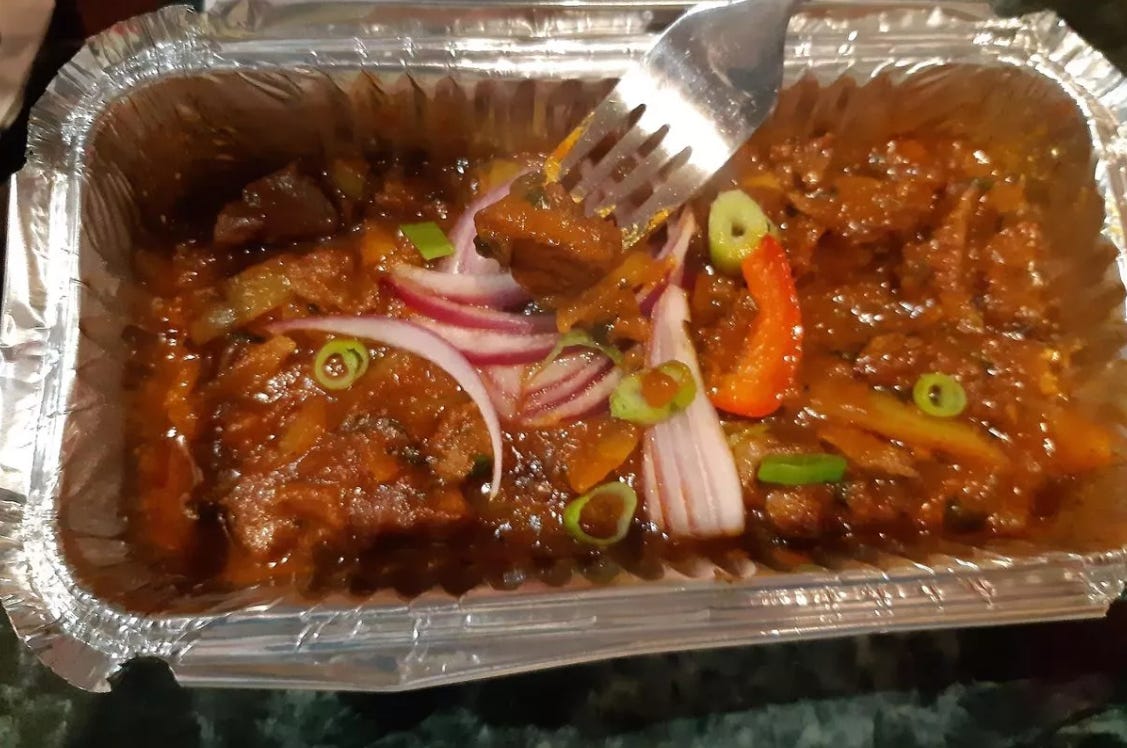
Source: Indian takeaway fined for putting sheep meat in 'ostrich' curry | Bristol Live
Dead pigeons served as ‘duck’
In April, a Chinese restaurant in Madrid was shut down after police found it had been passing off plucked street pigeons as ‘roast duck’ to unsuspecting diners.
Officers who raided the premises reported meat strips hanging from clothes hangers, a hidden storeroom behind a shelf in the disabled toilet and more than a tonne of untraceable food alongside the street pigeons.
Cheese work blerk
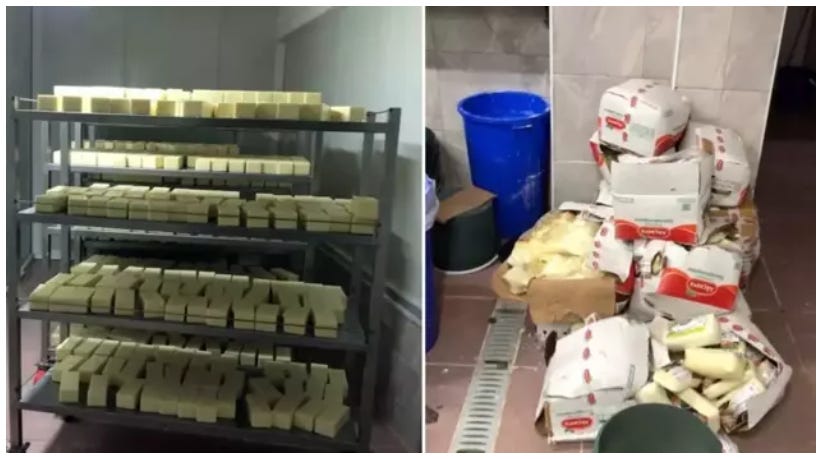
In May, Turkish officials seized 5 tons of cheddar-style cheese from a facility that was unregistered and unhygienic. The cheese had been made by collecting expired cheese from the market, melting it, and remoulding it for sale.
The operation was discovered after a consumer complained they had found a glove in a cheese.
Source: Incredible fraud in cheddar cheese! Tons were seized.
Secret stinky room
In September, food crime experts in the United Kingdom described how investigators found a putrid secret cutting room where tons of rotting chickens, expired lambs’ testicles and discarded packaged burger meat were being prepared for sale as human food. The items had been diverted from a pet‑food supply chain after being declared unfit for human consumption.
Investigations began after nearby residents complained of a “horrible stench”.
Source: From tip-off to convictions: inside the battle against food crime
Artificial sweetener smugglers
In November, authorities seized 39 metric tons of the artificial sweetener sodium cyclamate in Bangladesh during an attempted illegal import. The sweetener is prohibited in the country, and food safety officials claim that it is used as an illegal substitute for sugar in some food products.
The importing company shipped the sweetener in a mixed load with polyaluminium chloride and falsely declared the whole shipment as polyaluminium chloride.
Source: Huge quantity of import-prohibited Sodium Cyclamate seized in Chattogram | Others
Egg painters caught red-handed
Also in November, food safety officials in India seized almost half a million eggs from a warehouse where they allege white eggs were being coloured to mimic the appearance of premium (‘desi’) eggs, which sell for up to double the price of white eggs.
The officers seized 453,000 coloured eggs, 35,000 white eggs, colouring agents in jars, and colouring equipment during the raid. Officials said substances commonly used to colour eggs include tannin, tea-dust residue and vermillion (sindoor)
Source: Fake “Desi” Egg Factory Exposed In Moradabad — 4.5 Lakh Artificially-Coloured Eggs Seized - The420.in
Faked plastic rice (again!)
Also in November, the latest in a long line of claims that real rice is being replaced by rice made of plastic hit the airwaves, as a woman took to TikTok to show a pan full of ‘plastic’ rice.

 Tiktok failed to load.
Enable 3rd party cookies or use another browser
The claim that plastic rice is common has been debunked multiple times (including here and here).
Pangolins, porcupines and cane rats for dinner
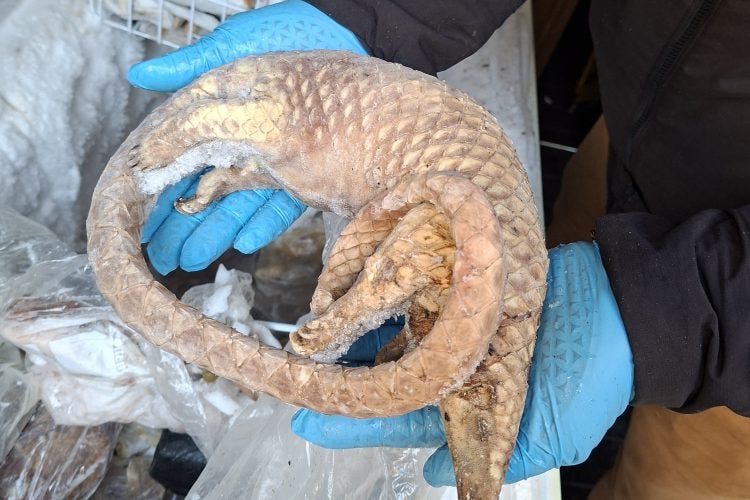
In December, food crime officers and police raided a location in the United Kingdom, where they seized 38 kg of illegally imported frozen bushmeat stored for sale as food. The operation targeted unregulated wild animal meat that had bypassed UK food safety and hygiene controls.
The seized materials included critically endangered pangolins, cane rats and porcupines.
Source: NFCU seizes illegal bushmeat in London as one man arrested
Food Safety News and Resources
There’s a massive and unusual recall of infant formula underway across the globe at the moment. Read about it in this week’s food safety news update, along with a second unusual recall and an unusual outbreak. Plus more…
Click the preview below to read.
Food Safety News and Resources | January

3 unusual recalls and outbreaks + lead poisoning from spice and 2 free webinars
The Rotten Apple: a ‘Rising Star’ on Spotify
Did you know I publish an audio version of this newsletter each week? You can find it on Spotify, Apple Podcasts and many other podcasting platforms (search for ‘The Rotten Apple food safety’).
In 2025, the number of listeners who tuned into The Rotten Apple Podcast on Spotify increased by 292%, earning me a ‘Rising Star’ label. Sheesh.
To be honest, I don’t know whether to be chuffed or embarrassed: the podcast is just me reading out each week’s issue in my dodgy Aussie accent, often with a croaky voice, occasionally with background noise and with minimal editing. But some of you obviously love it, so thank you!
Below for paying subscribers: Food fraud news, horizon scanning and incident reports
📌 Food Fraud News 📌
In this week’s food fraud news:
📌 Alerts for green coffee and cheese
📌 Soybean origin method
📌 Fish labelling warning
📌 Incidents with organic honey, deadly beverages, ‘beef’, horses, rice, buffalo meat, carrots, eggs and more.
Alert: green coffee! (USA)
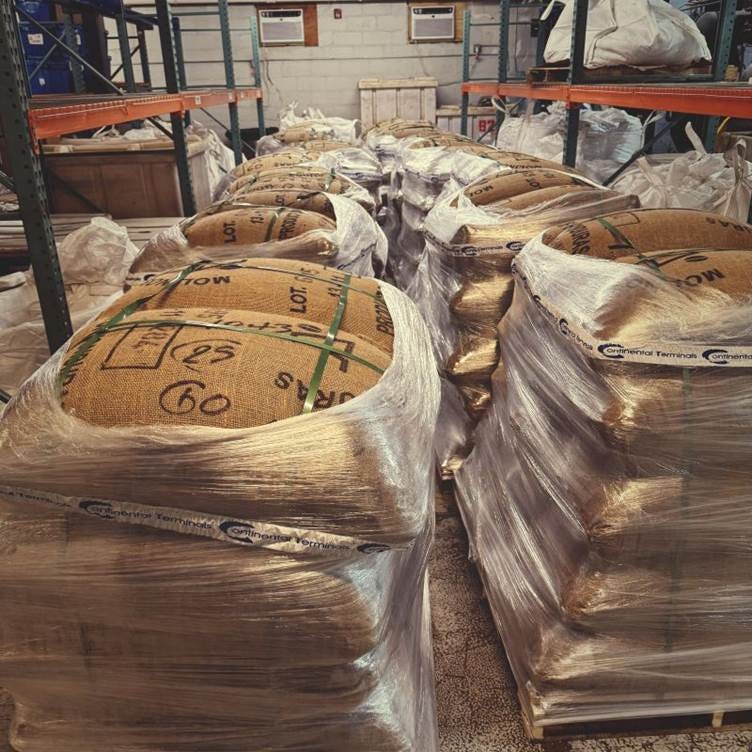
Coffee industry insiders report that on or about around 29 Dec 2025, a full trailer load of imported green coffee (40,000 lb) was stolen between a seaport in New Jersey and its final destination in the United States. There were at least four such thefts in the second half of December 2025.
A representative of the company from which the beans were stolen posted an image showing what the stolen coffee looked like and requested people to get in touch if they
- are offered suspicious green coffee,
- become aware of unusual inventory,
- are asked to trans-ship or store product by unknown parties or,
- have any other information that may be helpful.
For more details and to contact the company: ALERT | Yehuda Reich | LinkedIn
Update: it’s been reported that