
224 | Seek and Destroy: Real-world lessons in Listeria eradication |
Plus: Food fraud webinar tomorrow and a source for Byheart botulism named

This is The Rotten Apple, an inside view on food fraud and food safety for professionals, policy-makers and purveyors. Subscribe for insights, latest news and emerging trends straight to your inbox each Monday.
Real-world lessons in Listeria eradication (case study)
Webinar tomorrow: Food fraud trends and predictions for 2026
Food fraud is surging worldwide. Or is it?
Food safety news and resources
Food fraud news + recent incidents
Uh oh, food fraud is surging. It’s out of control. Or is it? In this week’s issue, I peek behind the curtains of the latest headlines.
We’ve got a great case study for you this week: a detailed run-down of how one ready-to-eat food manufacturer went to war on Listeria. Plus, the supplier of whole milk powder to Byheart Inc has been named in connection with the contamination that led to dozens of severe illnesses in infants in the US (find that in this week’s food safety news roundup).
And there’s plenty of food fraud news in this week’s issue too.
Karen
P.S. Love this newsletter? Please share it with your friends and colleagues and help grow our global food safety community.
Cover image: Møretrø, et al (2026)
Webinar tomorrow
Join me and Asli Solmaz-Kaiser from iComplai for Food Fraud Q1 2026: Emerging Threats & Predictive Intelligence.
Is food fraud really ‘surging’
Last month, the popular industry magazines Food Navigator and Confectionery News published articles titled Food fraud cases surge worldwide as prevention efforts fail.
But is food fraud really ‘surging’? Let’s follow the evidence.

The article’s headline claims that food fraud is surging but there’s no evidence of that. The writer was using Food Chain ID’s estimate of a 10% increase in records from 2024 to 2025 to justify the headline. Ten percent? It’s hardly a ‘surge’. Other data counts have remained relatively steady over the past three years.
I was interviewed for the article, but I do not support its premise. There is no solid evidence that food fraud is surging, which I told the journalist very clearly.
Food Chain ID’s increased incident count for 2025 is most likely due to increased awareness, increased enforcement and hence an increase in reported incidents. Only reported incidents make it into databases like Food Chain ID and they represent a tiny proportion of actual incidents.
The other false premise in the headline is that prevention efforts are failing. Again, there is no absolutely no evidence for this.
I’ve been working in food fraud prevention since 2015, when most people in the food industry barely knew what ‘food fraud’ even meant, and while today’s global supply chain is difficult, there have always been challenges and complexities in supply chains. There have always been vulnerabilities for fraudsters to exploit.
From where I’m standing, we’re actually in a better place now than we were in 2015... a lot of food fraud still occurs, but at least more of us are paying attention now!
Real-world lessons in Listeria eradication
The ‘Seek and Destroy’ method in action
I was delighted to stumble upon a fantastic article in the International Journal of Food Microbiology the other day. It was published by scientists from Norway and scientifically dissects the root causes of two Listeria outbreaks as well as describing a successful mission to eliminate the organism from a high-risk facility.
The lessons learned are relevant to most ready-to-eat foods and facilities and contain some fascinating insights into Listeria harborage sites.
Background
The initial outbreak of five listeriosis cases occurred in Norway in 2022. The outbreak was tentatively linked to a cold-smoked salmon producer after Listeria monocytogenes (strain ST121) was found in one of the company’s sealed products. However, the strain wasn’t found in the processing facility during swabbing by the Norwegian Food Safety Authority.
The second outbreak, of seven cases, occurred the year after, in 2023. It was linked to the same company after the same strain (L. monocytogenes (ST121) was again detected in unopened packages of their cold-smoked salmon. No deaths were reported from either outbreak.
The facility where the salmon was processed was relatively new, having opened in 2020. However, some of the machines and equipment were older, having been transferred from the company’s previous site.
Ready-to-eat and risky
Cold-smoked salmon is a food usually eaten cold, often in thin slices, with a glossy orange-pink colour and silky texture. It’s prepared by curing raw salmon with salt, followed by smoking at a low temperature - typically 20–30 °C (70–85 °F) for many hours.
This process does not raise the internal temperature enough to fully cook the fish, unlike hot smoking, so the proteins remain largely undenatured, giving it a soft, almost raw texture.
Cold-smoked salmon production poses a high risk for L. monocytogenes due to its cool, moist processing environment. Listeria’s ability to form biofilms also makes it notoriously resistant to cleaning and sanitising.
Before the outbreaks
Before the outbreaks began, the smoked salmon processor was performing a daily cleaning and sanitisation process and a monthly disinfection with peracetic acid. Among the daily post-production sanitation tasks was a partial disassembly of the salmon skinning machine.
After the outbreaks
Although the authorities had not found the outbreak strain of Listeria in the facility, the producer realised there must be a hidden reservoir of the pathogen on their site, since it had been isolated from sealed packages of their product.
The challenge: to find every trace of Listeria and get rid of it once and for all.
Seek and destroy
The company commenced interventions to seek and destroy the Listeria in their facility after the second outbreak. They were supported in their efforts by an external food safety consulting firm experienced in managing similar situations.
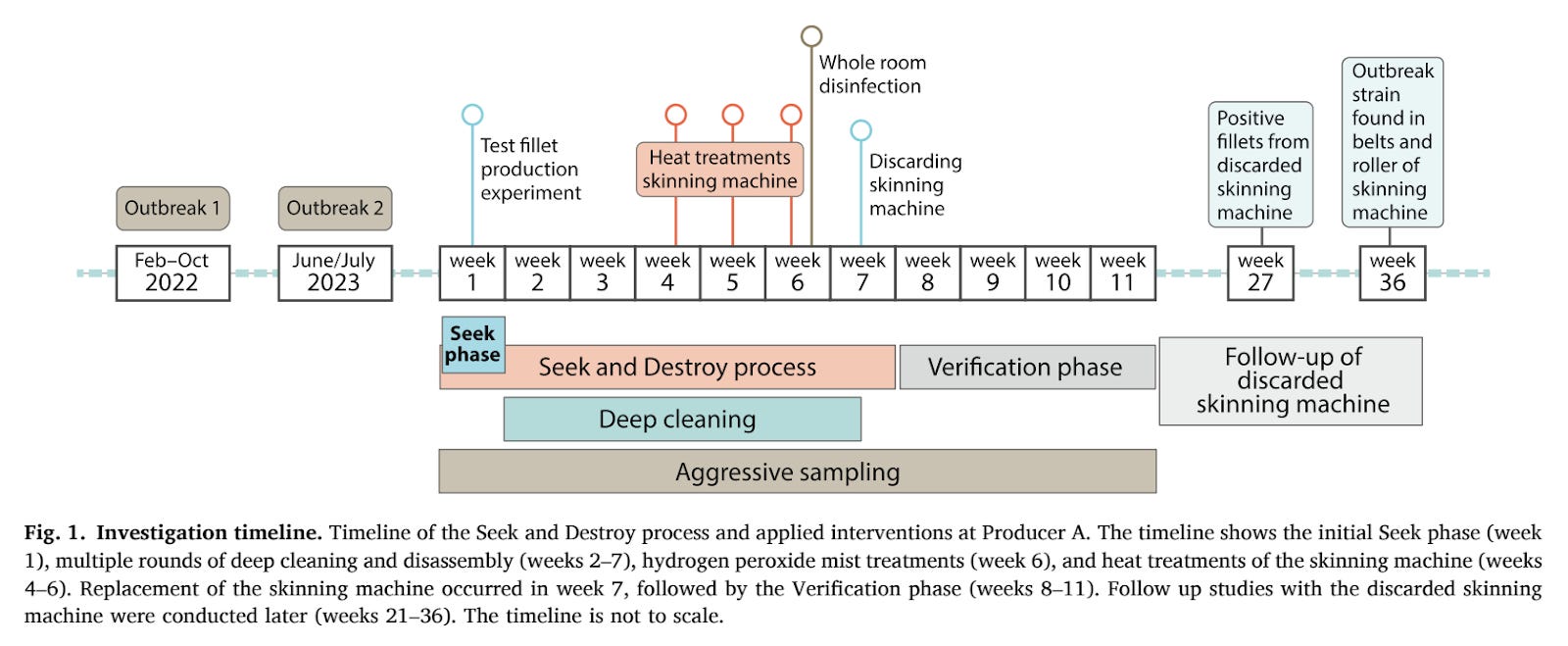
The process included an initial ‘seek’ phase (week 1), followed by multiple rounds of deep cleaning and disassembly (weeks 2-7), including hydrogen peroxide mist treatments (week 6) and heat treatments of the skinning machine (weeks 4-6). High-frequency sampling of food-contact and non-contact surfaces occurred throughout.
The Seek Phase (Week 1)
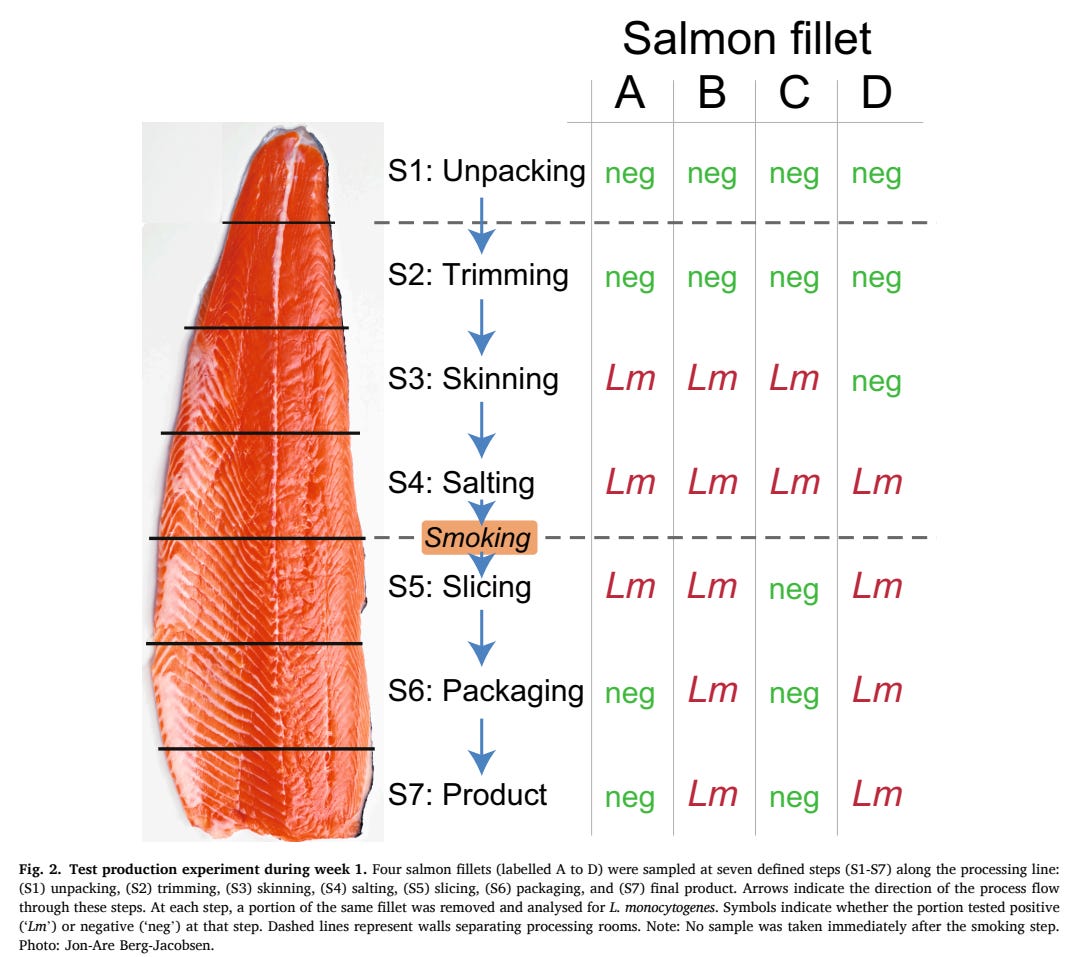
A test production experiment was performed in which the same fish fillets were sampled at different stages of processing.
Salmon fillets did not test positive for L. monocytogenes prior to passing through the skinning machine but some tested positive after the skinning process.
Equipment and production areas were sampled during production and after cleaning and sanitising, as were equipment parts before and during disassembly of machines.
14 out of 40 environmental samples tested positive for L. monocytogenes in this phase. These were from drains, the wheels and feet of the salt injector machine, as well as processing conveyors, a table and a trolley.
Whole genome sequencing (WGS) found that two ST121 clusters were present in the facility, with the main cluster related to the skinning machine (though not exclusively).
The Destroy Phase (Weeks 2–7)
Aim: to eliminate harborage sites for L. monocytogenes with a focus on the skinning machine and the salt injector machine.
Multiple interventions were carried out. These included:
Dismantling equipment beyond routine practice (down to small components such as screws and needles) for extensive cleaning and disinfection.
The cleaning and disinfection routine involved soaking the parts in a chlorinated alkaline cleaning solution before manually scrubbing, rinsing, and air-drying them. This was followed by an acidic cleaning step (soaking, rinsing, drying), and a final soaking in a peracetic acid-based disinfectant.
Parts that tested positive prior to dissassembly were retested after cleaning and disinfection and confirmed negative before reassembly.
Non-removable parts were scrubbed in place following same sequence. Water-sensitive components were cleaned with alcohol-based single-use wipes.
Worn-out components such as gaskets and tubes were replaced.
A new cleaning routine was introduced. For example, the conveyor belt was scrubbed weekly with additional dry-steaming, the salt injector disassembled weekly and needles and gaskets boiled for 1 hour.
Whole room disinfection with hydrogen peroxide mist (H2O2) was done. Hydrogen peroxide mist can penetrate inaccessible areas with lab- and pilot-scale studies suggesting strong efficacy against L. monocytogenes.
The skinning machine was also subjected to heat treatments on three occasions, with the heat and duration increasing each time.
Thermal treatments are highly effective against L. monocytogenes and can penetrate areas where chemical disinfectants may not. However, the temperature and duration of the treatment needs to be balanced against equipment limitations. In this instance, the skinning machine was partly disassembled prior to each heat treatment, with the conveyor belts and air-filled roller removed to avoid damage.
Results
Despite these interventions, both skinned fillets and the skinning machine tested positive for L. monocytogenes on several occasions after the deep cleans and thermal treatments. When the clean skinning machine was operated without fish it also began to test positive after 2 hours of operation.
Surfaces of the salt injector machine also returned positive tests after the interventions. However, pre-skinned fillets fed directly into the salt injector machine - i.e. fillets that bypassed the skinning machine - tested negative. The role of the salt injector machine in product contamination remains unclear.
Key action
Because the skinning machine seemed capable of harbouring Listeria and transferring it to fish, even after significant deep cleaning, H2O2 misting and thermal treatments, it was replaced.
The Verification Phase (weeks 8–11)
Aggressive sampling continued with the purpose of confirming the effectiveness of the Destroy Phase and replacement of the skinning machine.
Across the 11-week period, 329 samples were analysed (140 food-contact surfaces, 41 non-food-contact sites, 148 product samples).
Final situation
After the skinning machine was replaced, no positive samples were found in salmon after skinning or later in the process. However, one positive environmental sample was detected in the production facility.
During the next 8 months, L. monocytogenes was sporadically found in environmental samples taken in the facility, but none of the isolates were part of the outbreak cluster. There were no positive samples from the cold-smoked salmon product during this time.
Root cause
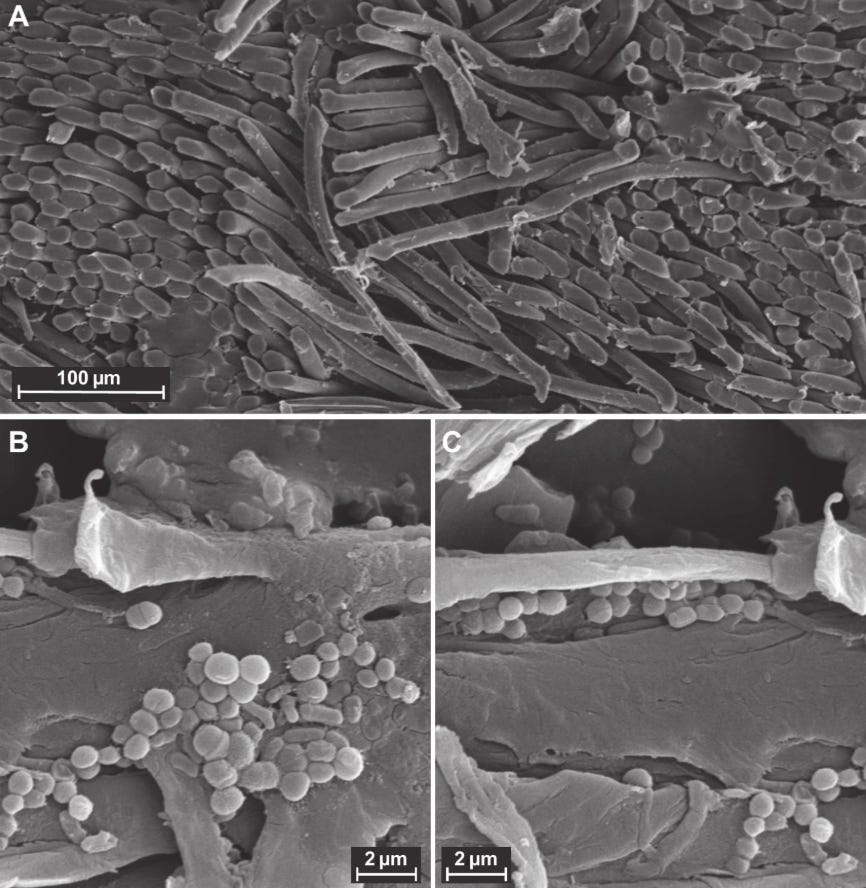
The contaminated skinning machine was provided to researchers who swabbed, disassembled, soaked parts and subjected them to electron microscopy over a period of months.
The researchers hypothesised that the skinning machine’s roller belts and an air-filled roller, which had not been heat treated during the interventions, were harborage sites for L. monocytogenes.
Swabs of these surfaces were negative. However, when the parts were placed in a pre-enrichment broth, they tested positive. Four months later, cleaned and disinfected metal parts from the end of the roller tested positive again.
The belts on the machine consisted of woven fabric coated with a rubber-like layer for food contact. The researchers cut the belts into small pieces and examined them using electron microscopy, finding that the fibres of the belt carried significant numbers of coccoid-shaped bacteria. Agar plating revealed 54% of these to be L. monocytogenes.
Previous research has also shown that L. monocytogenes can harbour inside conveyor belts, thereby resisting cleaning and disinfection processes.
Takeaways for food professionals
L. monocytogenes may persist for years on and inside equipment and parts such as rollers and conveyors.
Surface swabbing can miss key harbourage sites. For example, it is difficult to swab the inside of hollow rollers and impossible to swab the fibres inside conveyor belts. In this case, machinery parts that tested negative when swabbed were found to contain L. monocytogenes when immersed in pre-enrichment broth.
Controlling L. monocytogenes in food processing facilities requires a multifaceted approach. Biofilms render chemical cleaning and sanitising ineffective, while the use of heat as a control measure is constrained by materials that cannot tolerate heat exposure.
Easily cleanable, harbourage-free equipment is paramount for ready-to-eat food production, and hygienic design characteristics should be a non-negotiable.
Simultaneous implementation of multiple interventions is likely to be necessary to eliminate Listeria from a facility and these must be supported by intensive sampling to guide interventions and verify their effectiveness, noting that some harbourage areas cannot be sampled by surface swabbing.
In short: 🍏 A cold-smoked salmon producer implemented a Listeria ‘Seek and Destroy’ program after being linked to two listeriosis outbreaks in two years in Norway 🍏 Multiple interventions were carried out in the facility, however contamination persisted 🍏 The salmon skinning machine was then replaced, solving the problem 🍏 Scanning electron microscopy and culturing showed the fibres inside the machine’s belts and other small parts acted as Listeria harbourages that could not be swabbed or effectively cleaned or sanitised 🍏
Main source:
Møretrø, T., Langsrud, S., Heir, E. and Fagerlund, A. (2026). Controlling Listeria monocytogenes in the food processing environment: Lessons learned from a salmon processor associated with outbreaks. International Journal of Food Microbiology, [online] 449, p.111604. doi:https://doi.org/10.1016/j.ijfoodmicro.2025.111604.
Learn more
🍏A Guide to Listeria Controls and Environmental Monitoring Programs | The Rotten Apple 🍏
🍏 Introduction to Hygienic Design | The Rotten Apple 🍏
News and resources from around the globe this week, including an update on the Byheart infant formula scandal… [click below to view]
Food Safety News and Resources | February

2 February | A root cause for the Byheart botulism scandal? Radioactive shrimp recalls continue, free e-books for allergen controls and metal detection validations + 2 free webinars
This is food fraud
It’s unusual for media reports of food fraud to contain images of the fraud - more often the accompanying photographs are stock pictures. But this week, three of the reports I read contained actual photographs of the crimes.
Here they are. Find the details in this week’s Food Fraud News.


Image credits: Tuoitre, Arab Times Online, Bhaskar English
Below for paying subscribers: Food fraud news, horizon scanning and incident reports
📌 Food Fraud News 📌
In this week’s food fraud news:
📌 Food laundering: premium brands laundered into high-cost grocery stores with new expiry dates
📌 Counterfeit fertiliser, unsafe for human food crops, discovered
📌 Formaldehyde in frozen fish
📌 Illegal colourants in powdered teas and more…