

This is The Rotten Apple, an inside view on food fraud and food safety for professionals, policy-makers and purveyors. Subscribe for insights, latest news and emerging trends straight to your inbox each Monday.
Food safety: what’s in store for 2026?
Tariffs and food fraud risk: what you need to know
Food Safety News and Resources
No snow? No problem! How to cool your food in 1601
Food fraud news
Hi, welcome to Issue 231 of The Rotten Apple, which has a TLDR (too long didn’t read) version of a webinar about food safety risks for 2026, plus a deep dive into food fraud risks posed by tariffs, with helpful mitigations.
Our food safety news roundup has three free webinars, hand-picked for you, and news of a deadly Listeria outbreak.
And I explore the magic of a mysterious chemical the ancient Greeks used to cool their wine.
Enjoy,
Karen
P.S. Shoutout to 👋 Ilze from Finland 👋 for upgrading to a paid subscription. Every subscription counts. Thank you!
Food Safety: What’s in store for 2026?
Last month, I attended a webinar hosted by the Australian Institute of Food Science and Technology (AIFST) that explored the emerging risk landscape for food safety.
Here’s a little of what I learned.
GLP-1 drugs, ultraprocessed foods, psychotropic ingredients, novel foods and AI
GLP-1 drugs (glucagon-like peptide-1 receptor agonists) like Ozempic are transforming food demand. Companies are reformulating. This may have unforeseen consequences for food safety. (Do they really pose a threat to big food? I explored this in Issue 186).
Ultraprocessed foods remain a strong talking point for consumers and there are increasing calls for food companies to recognise that ultra-processed foods may be unsafe (How are UPFs relevant to food safety professionals? I discussed this in Issue 218)
Psychotropic ingredients pose safety risks, particularly when they are used in confectionery. Regulations vary from country to country, posing compliance challenges and potentially encouraging unregulated and unsafe illegal products in certain jurisdictions.
Other ingredients face similar cross-border issues. For example, Moringa powder is accepted as a dietary supplement in some countries, but the Australian regulator rejected an application for it to be approved as a novel food ingredient due to safety concerns.
AI-powered product development processes and AI-generated food safety programs pose risks if the technology is not used properly and does not apply local regulatory nuances properly.
Allergens
Expectations for allergen labelling are shifting internationally with Codex committee meetings discussing precautionary allergen labelling (PAL) guidance and major certification standards such as FSSC and BRCGS reframing expectations for allergen labelling.
There are emerging concerns about allergens in
seaweed foods;
biodegradable packaging (such as gluten in biodegradable servingware, as discussed in Issue 216); and
certain novel foods, such as milk made with precision fermentation.
Climate-influenced changes
Toxic algal blooms are affecting fisheries in areas that didn’t previously have problems with algal toxins. For example, nine oyster growing areas in South Australia were closed due to the presence of brevetoxin from an algal bloom for the first time in 2025. The area is temperate with waters that were previously too cold to be affected by algal blooms.
Increased risks from Vibrio spp. in shellfish due to warmer waters in shellfish-growing areas.
Food safety impacts of flood events in fresh produce growing areas – flood runoff is a known vector of pathogens in fresh produce production.
Emerging food fraud risks
Packaging artwork has emerged as an overlooked food fraud vulnerability, with unauthorised manufacturers gaining access to legitimate artwork or packaging materials, which are then used to create counterfeit products, with known cases in Australia as well as China.
Fraud perpetrators can use AI tools to facilitate origin fraud. AI systems can create plausible false chains of origin for materials that require claims verification, such as sustainable palm oil and commodities covered by the EU deforestation rules. Satellite imagery, historical land-use data, weather records and logistics timelines can be combined easily using AI to create plausible fake records.
Certificates forged using AI are becoming more believable, and AI tools allow perpetrators to commit forgeries faster and more easily. (Always verify certificates of analysis and food safety certifications directly with the issuer)
‘Stealing to order’ is increasingly prevalent (and/or known). This style of operation involves legitimate buyers requesting a particular type of food, such as cheese, which is then stolen and provided to the purchaser by criminals posing as food distribution companies.
Ongoing (but still relatively new) food fraud risks
Plant-based proteins such as pea, fava, and lentil are increasingly recognised as vulnerable to food fraud (I discussed this in Issue 15 and Issue 108).
There are ongoing problems with fraud in waste disposal. Legitimate-looking, long-established, high-profile waste management companies have been involved in schemes where food that should have been destroyed was relabelled to change expiry dates and moved across borders (I wrote about waste disposal fraud in Issue 211). In Australia, companies are now sending their own staff to personally witness the destruction of every batch of product they dispose of, and no longer rely on certificates of destruction.
Food sold through e-commerce channels, such as Facebook Marketplace, continues to be extremely vulnerable. Online marketplaces allow perpetrators to sell stolen foods and counterfeit foods directly to consumers at low prices, bypassing the checks imposed by major retailers.
Sources:
The information I have shared was presented in the members-only webinar: Food safety 2026 – What’s ahead (AIFST February 2026), with information verified where possible. Non-members may purchase a recording of the webinar from the AIFST here.
Tariffs and food fraud risk: what you need to know
When tariffs change, cost pressures increase. Price changes can enable food fraud perpetrators to make more profits and encourage desperate traders to bend the truth. Differences in tariffs between countries can motivate importers and exporters to avoid costs by moving commodities through different geographical channels.
Together, these opportunities and motivations increase the likelihood of food fraud for affected ingredients and commodities in four ways.
1. Price pressure creates fraud incentives
Higher tariffs increase landed costs, which decreases margins and tempts bad actors to cut corners to retain profits or remain in business. Frauds can show up as an increased likelihood of adulteration, substitution and dilution; smuggling; misrepresentation of legitimately transported goods to avoid/reduce duties and tariffs; and underreporting the value of goods.
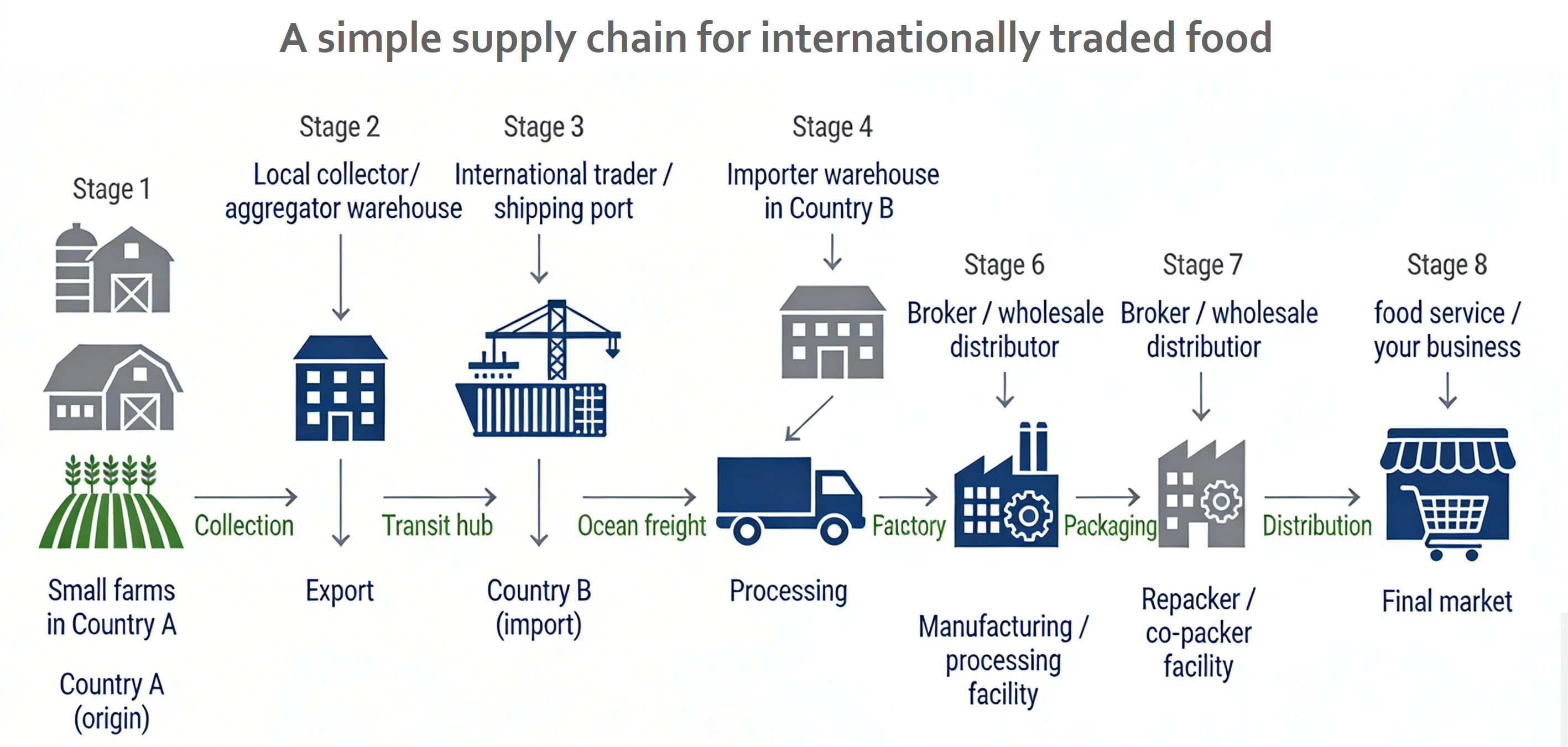
2. Long supply chains are more vulnerable
Global food supply chains already involve dozens of transfer points. With added tariff pressure, each new handoff becomes a potential point for document falsification, substitution, or origin laundering.
3. Complexity hides accountability
Each commodity may pass through multiple layers of brokers, traders, and handlers, which makes transparency and traceability difficult. Bad actors use shell companies and temporary corporations to distance themselves from fraud. When something goes wrong, tracing back to the source and discovering where documents have been falsified is a major challenge.
For example, in 2015 – 2017, a group of businessmen from Turkiye perpetrated a series of massive frauds while supplying huge quantities of ‘organic’ corn and soy beans from Eastern Europe to the United States.
They used two Dubai-based companies that procured ‘organic’ grain from Eastern Europe for an American organic feed broker, with the grains delivered to the broker through a third company based in Virginia (USA), which was run by one of the Turkish men’s ex-wives. The grain was not organic.
Read the whole story here: 🍏Multi-Million-Dollar Organic Fraud - How massive quantities of soybeans and corn turned “organic” in the blink of an eye
4. Transhipment is more attractive in a complex tariff landscape
Transhipment occurs when goods from a country that is subject to high tariffs are routed through a third country to avoid tariffs that would be incurred if they moved directly from the original country.
For example, if goods from China are being imported to the United States, the tariffs imposed by the United States are high. Traders may move the goods into Malaysia or Vietnam first so that the goods appear to have originated there, avoiding the Chinese tariff rate.
Transhipping is not always illegal or fraudulent. Fraud arises when false claims are made about the original source of the materials, or if the goods are represented as having undergone a substantial transformation in the second country when they have not.
Example: In Issue 227, I discussed alleged transhipping of mycotoxin-affected peanuts between India and Indonesia to circumvent border controls. The illicitly traded peanuts are allegedly first shipped to Malaysia as legitimate cargo. They are then transferred to barges and small boats in lots of 20 containers each and taken from Malaysia to small ports in Indonesia, where there are fewer, or no border controls.
Food fraud mitigation strategies
We’ve just seen how the likelihood of food fraud is increased for tariff-affected products. The increased likelihood should be reflected in food fraud vulnerability (VACCP) assessments for affected materials. Ingredients and products with large price increases should be flagged as high risk.
Below are suggested mitigations for fraud vulnerabilities related to tariffs:
Monitor for changed trading conditions, including new or increased tariffs, so procurement practices can be adjusted promptly.
Review approvals for suppliers of tariff-affected materials, re-verifying certifications, business registrations and compliance history. Risk ratings may need to change.
Ensure that importers have a legitimate trading history, proper company registrations, owners with no criminal history, and suitable past compliance records.
Ensure that import documents include accurate classification of all materials and that the value of materials is not under-declared.
Be aware that products, commodities and ingredients that appear to be from low-tariff countries could have originated in high-tariff countries, with their true origin obscured by transshipping. Check for unusual or unexpected shipping routes, mismatches between key growing areas and export countries, vague documentation and unexplained extra links in the supply chain (brokers, traders, distributors) that could indicate the use of shell corporations to obscure fraud.
Cross-check incoming materials against known transhipment routes and high-risk product categories.
Consider analytical testing to verify authenticity. Options include stable-isotope tests for geographical origin, DNA-based methods for species identification and spectroscopy (FTIR, NMR) for the presence of undeclared adulterants and fillers.
Consider increased food safety protocols for materials that are vulnerable to transhipping, since long transit times and long supply chains can increase the risk of mycotoxins and falsified expiry dates.
In short: New tariffs and increased tariffs can increase the likelihood of food fraud 🍏 Review vulnerability assessments for affected ingredients, commodities and products 🍏 Remain vigilant against document frauds which accompany illegal transhipments 🍏 Check materials from high-risk categories carefully and re-verify suppliers 🍏
Sources:
Lawrence, E. and O’Halloran, S. (2025). Customs busts $400M trade duty-evasion ring involving China and others. [online] Fox Business. Available at: https://www.foxbusiness.com/politics/cbp-breaks-up-400-million-bad-actor-duty-evasion-ring.
Pandey, N. (2025). China Beating US Tariffs: Secret Routes, ‘Place-of-Origin Washing’ Exposed. [online] NDTV. Available at: https://www.ndtv.com/world-news/china-beating-us-tariffs-secret-routes-place-of-origin-washing-exposed-8342415.
Food Safety News and Resources
Our news and resources section has not-boring food safety news plus links to free webinars and guidance documents. Click the preview below to access it.
Food Safety News and Resources | March

23 March | Food Safety News and Free Resources |
⚠ 💀 Deadly Listeria outbreak (France)
🥜 Guidance: Allergen declarations for ingredient suppliers
🎓Webinar - Make a Strong Food Safety Culture: From HACCP to Continuous Improvement, 27th March
🎓Webinar - Social Compliance in the Food Sector – Understanding Supply Chain Social Responsibility in the U.S. Food Industry, 30th March
🎓Webinar - Building Blocks of an Effective Food Safety Program, 16th April
How to cool your food in 1601
Long before the refrigerator was invented, we were using the power of chemistry to chill food. And it involved the main chemical found in gunpowder.
Saltpetre (potassium nitrate) is a naturally occurring white crystalline salt that forms as deposits on rocks, walls, caves and soils where there is a plentiful source of animal waste.
For centuries, it was one of the most strategically valuable substances on earth, being the key ingredient in gunpowder. In England in the 1600s, any surface upon which saltpetre developed was considered the property of the Crown and saltpetre collectors were empowered to dig it out wherever they found it, regardless of who actually owned the property.
But it was not only used to make gunpowder, saltpetre was also used in various industries such as glass-making, as well as for meat preservation and chilling wine in wealthy households.
When dissolved in water, saltpetre causes an endothermic reaction that reduces the temperature of the solution. When a vessel containing a beverage is immersed in the solution, the beverage is chilled.
Ancient Romans and Greeks used sal petrae (Latin for “salt of the stone”) scraped from cellar walls and crypts to chill drinks for their banquets. However, saltpetre was difficult to find and expensive to buy, so it was only used for special banquets.
The practice appears to have vanished from Europe after the fall of Rome, before resurfacing in the 1500s.
While a 2014 study verified that saltpetre can effectively chill beverages, pricing and availability mean it is not a cost-effective alternative to modern refrigeration.
Below for paying subscribers: Food fraud news, horizon scanning and incident reports
📌 Food Fraud News 📌
In this week’s food fraud news:
📌 Test methods for garlic and herbal medicine
📌 Counterfeit fresh strawberries
📌 Undeclared titanium dioxide in garlic paste and mayonnaise
📌 Fines for origin fraud (and more)